
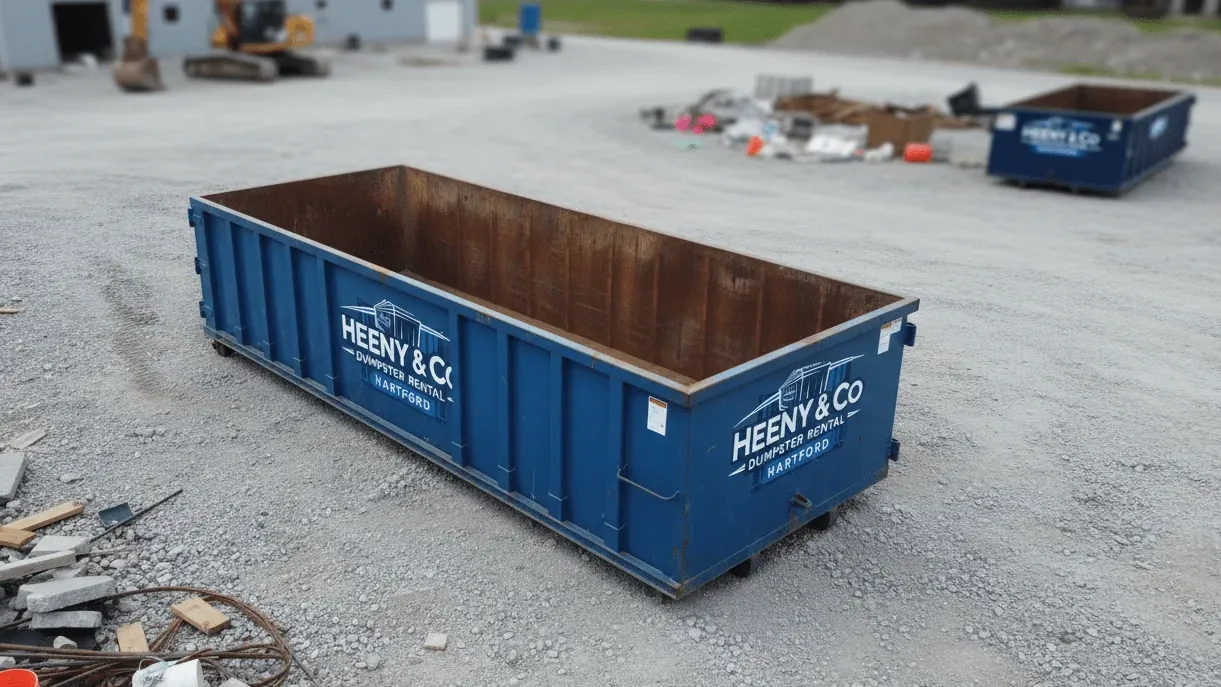
Heavy debris
Concrete and Heavy Debris Containers in Hartford
Concrete, brick, plaster and foundation spoil dug off a 42 inch frost depth. Heavy material wants a small box loaded flat and low, and that is a different job entirely from a container full of furniture and old cabinetry.
Heavy debris is the one category where the container that looks too small is the right one. Concrete, brick, block, mortar, tile in a mortar bed, plaster from a pre-1950 wall and foundation spoil are all several times denser than the mixed household material most people picture when they think of a roll-off. A 10 yard box loaded flat with broken concrete reaches its legal payload well before the sides are anywhere near full, and that is not a container being wasted, it is a container being loaded correctly. Anyone who tells you to put a slab into a 30 yard is planning a load that cannot legally leave your drive.
Hartford generates a lot of it, for reasons that come straight out of how the city was built. Connecticut's frost line is 42 inches, so footings, piers, steps and post bases all go below four feet and full excavated cellars were the norm. That means foundation spoil, old cellar floors, area-way walls and step-and-walk masonry on nearly every older property. Add that about half of Hartford's housing units predate 1950 and were plastered on lath rather than boarded out, and an interior strip-out here produces a dense keyed plaster debris that behaves like masonry rather than like sheet rock. Granite kerbing, brick chimneys and mortared brick piers under the porches fill in the rest.
One point of Connecticut law worth knowing before you order: clean fill is expressly excluded from the statutory definition of construction and demolition waste under CGS section 22a-208x, alongside asbestos, hazardous waste, radioactive material and liquids. Soil, in other words, is a different conversation from rubble and it is worth telling us which one you actually have. Beyond that, mixed C and D can go in one container — CT DEEP recommends commingling into a single roll-off — with corrugated cardboard and scrap metal separated as mandatory recyclables. Reinforcing steel coming out of a slab counts as scrap metal and is worth pulling rather than burying.
Heavy Material A Small Box Handles
Driveway And Path Tear-Outs
Broken concrete or asphalt off a Hartford drive, usually cracked and spalled by decades of freeze-thaw. Clean, uniform and easily the densest load a residential customer ever orders.
Foundation And Footing Spoil
Anything dug below the 42 inch frost line. Call Before You Dig comes first under CGS section 16-345, and note that clean fill sits outside Connecticut's C and D definition, so tell us if it is soil.
Cellar Floors And Area Ways
Old cellar slabs broken up for a new floor or a drainage run, plus the masonry area-way walls beside a bulkhead. Awkward to carry up a stair and heavy the whole way.
Chimneys And Brick Piers
Brick and mortar off a chimney above the roofline or the piers under a rear porch. Loads flat on the floor of the box, never on top of timber.
Plaster And Lath Strip-Outs
Keyed plaster off pre-1950 walls is dense, dusty and much heavier than modern board. It is the material that decides the box size on almost every Hartford interior gut.
Tile In A Mortar Bed
Bathroom and kitchen tile from older buildings comes off with the bed attached and behaves like masonry. Tubs and copper come out first as scrap metal.
Steps, Walks And Kerbing
Concrete steps, front walks and granite kerb sections. Granite is heavier again than concrete and is worth mentioning at the booking so we bring the right box.
Retaining Walls And Hardstanding
Block, stone and mortar out of a garden wall or a hard yard behind a multifamily. Clean of soil where possible, because fill is a separate material under state law.
Sizing For Weight Rather Than Volume
There are really only two sizes in this conversation. A 10 yard is the heavy box: it is short, it sits low on the drive, it is easy to place on a narrow Hartford lot, and it is what concrete, brick, plaster, tile and foundation spoil should go in. A 15 yard is the sensible step up where the material is mixed — masonry with a proportion of timber or general debris through it — or where the volume genuinely is large and the density slightly lower. A 20 yard is the practical ceiling for anything heavy, and only where the material is mixed rather than pure rubble. Beyond that, a 30 or a 40 with masonry in it is a container that cannot legally leave, and everybody involved has wasted a morning. The right approach on a mixed job is two boxes: heavy material flat in a 10, light bulky material in whatever size the volume needs, loaded by weight rather than by which pile is nearest.
10 Yard Dumpster
Concrete, brick, plaster and foundation spoil — weight fills it long before volume does.
View this size →15yd³15 Yard Dumpster
A single room, a small tear-off, or one unit of a multifamily turnover.
View this size →20yd³20 Yard Dumpster
A full basement and attic clear-out — the New England default — or a multi-room remodel.
View this size →Loading Flat, Protecting The Ground And Digging Safely
Loading technique matters more with heavy debris than with anything else we run. Break material into pieces two people can place rather than pieces one person can drop, spread the load flat across the floor of the container rather than heaping it at the door end, and stop at the fill line marked on the box rather than at the rim. A container loaded flat and low goes out legally; one heaped at one end is unbalanced on the hoist and often cannot be taken. Keep it tarped, because rubble and plaster absorb water and a rained-on load gains weight overnight. Heavy sets are where driveway protection earns its keep: boards go under the wheels on every delivery and we photograph the approach, which matters on Hartford drives already carrying freeze-thaw cracking. Granite kerbing is common here and a raised kerb changes where the boards go, so mention it when you book. If the job involves digging — footings below the 42 inch frost line, a slab, a post base, a stump — Call Before You Dig comes first under CGS section 16-345.
Not sure this is the right service? Describe the job on the phone and we will point you at the right container even if it is a different service page. Call (959) 666-6427.
Get a flat quote
Two minutes on the phone gets you a size, a price and a delivery slot. No forms.
(959) 666-6427Recommended sizes
How it works
Concrete & Heavy Debris in four steps
- 1
Call us
Tell us the project, your address and when you want it. Two minutes on the phone and you have a flat price.
- 2
We deliver
Our driver walks the drop, lays protection boards and sets the container exactly where you want it.
- 3
You load it
Take your time within your rental window. Keep it level with the top rail and we handle the rest.
- 4
We haul it
Call or text when you are done. We pull it, sort what can be recovered and dispose of the rest properly.
Concrete & Heavy Debris FAQs
Why can I not put concrete in a bigger container?
Because weight, not volume, is the limit. Broken concrete, brick and mortar are several times denser than mixed household debris, and a container reaches its legal payload long before it looks full. Fill a 30 yard with rubble and you have a box that cannot legally leave your drive, which helps nobody. A 10 yard loaded flat and low is the correct tool: short, easy to place on a narrow Hartford drive, and able to go out at a legal weight. If you also have timber, cabinetry or general debris, take a second larger box for that and load the two by material rather than by whichever is closest to the pile.
Is plaster really as heavy as masonry?
Close enough that it should be treated the same way. About half of Hartford's housing predates 1950 and was plastered over wood lath rather than boarded out, and keyed plaster with the lath attached is dense, dusty and much heavier than modern board. It is the single most common reason an interior gut-out in this city goes over payload. Load it flat, keep it low, and if the job also produces cabinetry and framing put those in a separate container. The other habit worth having is tarping the box: plaster soaks up rain and a wet load can gain a real amount of weight between one evening and the next morning.
Can I put soil or fill in the container?
Tell us first, because it is a different material in Connecticut law. Clean fill is expressly excluded from the statutory definition of construction and demolition waste under CGS section 22a-208x, alongside asbestos, hazardous waste, radioactive material and liquids. That means soil, sand and stone are not simply another kind of rubble to be mixed in, and a load that is part fill and part debris can be a problem at the destination rather than at your kerb. If you are digging footings below the 42 inch frost line or taking out a slab, say at the booking how much is spoil and how much is masonry and we will bring the right arrangement.
Does rebar have to come out of broken concrete?
Where it is practical, yes, and it is worth the effort. Scrap metal is a mandatory recyclable in Connecticut under CGS section 22a-241b and must be separated from other building material wastes, and reinforcing steel is scrap metal. Beyond compliance there is a practical reason: long tails of rebar sticking out of a broken slab make a load impossible to level, catch on the container as it comes onto the truck, and leave the box sitting proud of the rim. Cut it back, stack it separately, and you have a flatter load, a legal separation and a scrap pile that has some value. The same applies to pipe, ducting and steel lintels out of a chimney breast.
Will a heavy container damage my driveway?
It is the loaded weight rather than the container that does the work, so this is the service where the precautions matter most. Protection boards go under the wheels and rollers on every delivery and collection, we set square rather than dragging, and we photograph the approach on arrival so there is a record. Most Hartford drives already carry cracking and spalling from decades of freeze-thaw, which is worth acknowledging honestly rather than arguing about later. Tell us about a raised granite kerb, a fresh sealcoat, decorative pavers or a soft verge when you book. If the drive genuinely cannot take a loaded heavy box, the alternative is a street set under the city's Obstruction Permit on 860-757-9970.
More services
Other things we haul
Residential Dumpster Rental
Driveway placement for full-basement, attic, porch and shed cleanouts and remodels.
Learn more →Commercial Dumpster Rental
Containers for businesses and buildings over six units, which the City does not collect from.
Learn more →Construction Dumpster Rental
Mixed C&D in one roll-off, the way CT DEEP recommends, with next-day swap-outs.
Learn more →Roofing Dumpster Rental
Weight-rated cans sized by squares and layers for asphalt shingle tear-offs.
Learn more →Roll-Off Dumpster Rental
10, 15, 20, 30 and 40 yard roll-offs across Hartford and the Capitol Region.
Learn more →Same-Day Dumpster Rental
Call before the cut-off and we can usually get a container to you this afternoon.
Learn more →Junk Removal Dumpsters
Clear a full basement, attic, porch or shed on your own schedule.
Learn more →Estate Cleanout Dumpsters
Discreet, patient container service for families clearing a lifelong home.
Learn more →Demolition Debris Removal
Containers and fast swaps for porches, decks, sheds, garages and interior gut-outs.
Learn more →Yard Waste & Brush Removal
Separate clean loads — Connecticut bans grass clippings from solid waste facilities.
Learn more →Where we deliver
Concrete & Heavy Debris across the Capitol Region and Greater Hartford
Same service, same flat rates, every town below. Pick yours for local placement and permit notes.
Talk to a real person
Need concrete & heavy debris in Hartford?
Tell us what you are clearing out and we will tell you the right size and the flat price to put it in your driveway. No forms, no waiting on an email — just call and we will sort it out in a couple of minutes.
Serving Hartford, the Capitol Region and Greater Hartford · Mon–Fri 6:30am–5pm, Sat 7am–1pm