
The weight box
10 Yard Dumpster Rental in Hartford, CT
The smallest container we run and the one most Hartford jobs actually need when the material is dense. Concrete off a drive, brick off a chimney, plaster and lath out of a pre-1950 wall, foundation spoil from a 42 inch frost depth, or the contents of a cellar that took water. It sits low, goes on a narrow shared drive where nothing longer will swing, and reaches a legal payload long before it looks full. That is the box working correctly, not the box being too small.
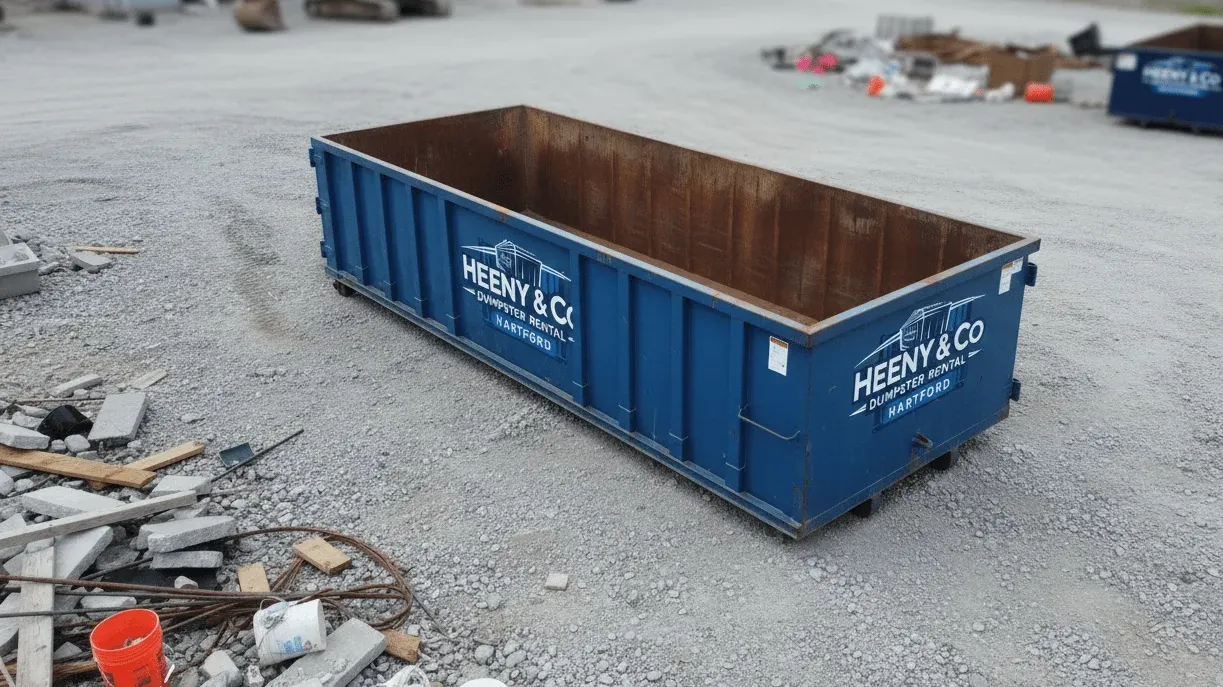
A 10 yard roll-off is roughly twelve feet long, eight feet wide and about three and a half feet tall — three or four pickup loads. Short sides mean you can lift material in over the rim rather than up a ladder, and the short footprint means it fits on a shared drive between two Hartford multifamily houses where a twenty-two foot box has nowhere to go. It is the container for heavy, dense material, and the rule that goes with it is simple: load flat, load low, and stop at the fill line rather than the rim.
- Capacity10 cubic yards
- Footprint12 ft x 8 ft x 3.5 ft
- Weight allowance2 – 3 tons
- Holds about~3 pickup truck loads
Why people choose the 10 yard
Start with the material, because in Hartford it decides everything else. Masonry rubble is the classic 10 yard load: broken concrete off a driveway tear-out, brick off a chimney or a porch pier, mortar, block, a section of cellar floor, granite kerb. All of it is several times denser than the mixed household debris people picture when they imagine a roll-off, and a container reaches its legal payload while the sides are still visible. That is why a 10 loaded flat with rubble is the correct tool and a 30 loaded with the same material is a box that cannot legally leave your drive. Connecticut adds one wrinkle worth knowing before you order: clean fill is expressly excluded from the statutory definition of construction and demolition waste under CGS section 22a-208x, alongside asbestos, hazardous waste, radioactive material and liquids. So soil and rubble are two different conversations. Tell us at the booking which one you have, and if it is both, tell us roughly how much of each.
The second material that belongs in a 10 is the one people never expect: plaster. About half of Hartford's housing units were built before 1950, according to the city's own Municipal Affordable Housing Plan adopted in December 2022, and houses of that vintage were plastered over wood lath rather than boarded out. Keyed plaster with the lath still attached is dense, dusty and much heavier than modern board, and it is the single most common reason an interior strip-out in this city ends up over payload in a container that still looks half empty. The same applies to bathroom and kitchen tile from older buildings, which comes off with the mortar bed attached and behaves like masonry rather than like tile. If you are gutting one room of a Perfect Six flat, the honest answer is usually a 10 for the plaster and the tile and a second, larger box for the cabinetry, the timber and the general debris.
The third case is water. Hartford sits on a valley floor that, in the words of the city's own plan of conservation and development, flooded each spring and continues to do so, which is why the Army Corps built roughly thirty-five thousand feet of earthfill dike and four thousand four hundred feet of concrete floodwall around it between 1938 and 1944. Cellars in this city take water, from the river, from a wet spring, from a failed sump or a burst pipe. Sodden carpet, saturated cardboard boxes, swollen furniture and wet insulation weigh two to three times what the same material weighs dry, and they keep gaining weight if the container sits open in the rain. A 10 yard box, loaded flat, tarped between sessions and collected promptly is the right way to move wet cellar contents. A big open box full of the same material is a load nobody can lift. Ring the yard as soon as the cellar is clear rather than leaving a wet load standing in the weather.
Good fit for
- Broken concrete, brick, block and mortar rubble
- Foundation and footing spoil from a 42 inch frost dig
- Plaster and lath out of a pre-1950 Hartford wall
- Bathroom and kitchen tile set in a mortar bed
- Wet cellar contents after a thaw or a burst pipe
- A single chimney or a set of porch piers
- Granite kerb sections and concrete steps
- Small strip-outs on a narrow shared drive
Not the right size for
- Whole-house cleanouts full of furniture
- A cellar and an attic in one weekend
- Multi-room remodels making airy debris
- Porch or deck volume off a three-decker
- A full Perfect Six unit turnover
- Roof tear-offs above about fifteen squares
- Shop fittings and office partitions
- Brush, branches and hedge clearance
- Cabinetry, doors and window frames in bulk
- Anything measured in rooms rather than tons
- Mattresses, which go to Bye Bye Mattress
- Electronics, banned from disposal here
- Paint and liquids, which PaintCare takes
- Asbestos, in any form, at any time
Will it fit?
The 10 is the easiest box we place, which is exactly why it suits Hartford. At around twelve feet long it goes on a narrow shared drive between two multifamily houses where a twenty-two foot container has nowhere to swing, and its low sides mean material goes in over the rim rather than up a ladder. We still want about sixty feet of straight approach for the truck to line up and back, roughly ten and a half feet of working width, and twenty feet or more of overhead clearance for the hoist. Overhead is what fails in this city rather than the ground: mature maple and oak arch across residential streets and the service drop runs beneath them from the pole to the house. A short box gives the hoist more room than a tall one, so where a 30 will not go, a 10 usually will. Protection boards go under the wheels on every set and we photograph the approach on arrival, because most Hartford drives already carry cracking and spalling from decades of freeze-thaw. Granite kerbing is common here and a raised kerb changes where the boards go, so say so when you book. On placement, Connecticut has no per-dumpster fire permit but IFC 2021 section 304.3.3 keeps any container of 1.5 cubic yards or more out of buildings and at least five feet from combustible walls, openings and roof eave lines. With street parking on both sides of most residential blocks, a street set means an Obstruction Permit from the Public Works Permit Division at $50 plus three cents per square foot per day, on 860-757-9970.
Before delivery, move cars and bins, mark irrigation heads and septic lids, and tell us about new concrete, soft ground, a steep grade or low power lines. Our delivery and driveway protection guide covers all of it.
Compare all four sizes
| Size | Footprint | Weight allowance | Holds about | Best for |
|---|---|---|---|---|
| 10 Yard Dumpster | 12 ft x 8 ft x 3.5 ft | 2 – 3 tons | ~3 pickup truck loads | Concrete, brick, plaster and foundation spoil — weight fills it long before volume does. |
| 15 Yard Dumpster | 16 ft x 8 ft x 4 ft | 2 – 3 tons | ~4 – 5 pickup truck loads | A single room, a small tear-off, or one unit of a multifamily turnover. |
| 20 Yard Dumpster | 22 ft x 8 ft x 4.5 ft | 3 – 4 tons | ~6 – 8 pickup truck loads | A full basement and attic clear-out — the New England default — or a multi-room remodel. |
| 30 Yard Dumpster | 22 ft x 8 ft x 6 ft | 4 – 5 tons | ~9 – 12 pickup truck loads | A whole Perfect Six or three-decker with basement and attic, or a large remodel. |
| 40 Yard Dumpster | 22 ft x 8 ft x 8 ft | 5 – 6 tons | ~14 – 16 pickup truck loads | Bulky light debris only: porch framing, fencing, siding, insulation, fit-outs. |
Still not sure? Describe what you are throwing away and we will size it on the phone in two minutes. Getting it wrong costs us more than it costs you, so we have every reason to get it right. Call (959) 666-6427.
Book a 10 yard
Flat rate including delivery, pickup, rental period and disposal. Same-day where we can.
(959) 666-6427Other sizes
Popular services
All sizes
Compare our four roll-off containers
10 Yard Dumpster
Concrete, brick, plaster and foundation spoil — weight fills it long before volume does.
View this size → 15yd³15 Yard Dumpster
A single room, a small tear-off, or one unit of a multifamily turnover.
View this size → 20yd³20 Yard Dumpster
A full basement and attic clear-out — the New England default — or a multi-room remodel.
View this size → 30yd³30 Yard Dumpster
A whole Perfect Six or three-decker with basement and attic, or a large remodel.
View this size → 40yd³40 Yard Dumpster
Bulky light debris only: porch framing, fencing, siding, insulation, fit-outs.
View this size →10 Yard Dumpster FAQs
Why is a small box right for a big pile of concrete?
Because the limit is weight, not volume. Broken concrete, brick and mortar are several times denser than mixed household debris, so a container hits its legal payload long before the sides fill. A 10 yard loaded flat and low goes out at a legal weight. The same rubble in a 30 gives you a box that cannot lawfully move, which costs everybody a morning and solves nothing. Load in pieces two people can place rather than pieces one person can drop, spread it across the floor of the box rather than heaping it at the door end, and stop at the marked fill line.
Will plaster really fill a 10 yard on its own?
Very often, yes. About half of Hartford's housing predates 1950 and was plastered over wood lath, and keyed plaster with lath attached is dense and heavy in a way modern board is not. One room stripped to the studs in a Perfect Six flat can put a 10 close to payload by itself. That is not a reason to order bigger; it is a reason to split the job. Put the plaster and the tile in a 10 loaded flat, and put the cabinetry, framing and general debris in a larger box. Two containers loaded by material beat one container loaded by room, every time.
Can I put soil or fill in it?
Tell us before you book, because Connecticut treats fill differently. Clean fill is expressly excluded from the statutory definition of construction and demolition waste under CGS section 22a-208x, along with asbestos, hazardous waste, radioactive material and liquids. That means soil is not simply another kind of rubble to mix through the load. If you are digging footings below the 42 inch frost line or lifting a slab, say roughly how much is spoil and how much is masonry and we will bring the right arrangement. Anything that breaks ground also needs Call Before You Dig first, under CGS section 16-345 and following.
Does it fit on a shared driveway?
Usually, and that is its main advantage in this city. At around twelve feet long the 10 will sit on a shared drive between two multifamily houses where a twenty-two foot box simply cannot swing. What still has to work is the approach and the overhead: roughly sixty feet to line up and back, about ten and a half feet of width, and twenty feet of vertical clearance for the hoist. On a shared drive the practical question is the neighbour, so it is worth telling them before the truck arrives rather than after. And the fire code still applies: five feet clear of combustible walls, openings and roof eave lines.
How long can I keep it?
As long as the job honestly needs. Ring the yard on (959) 666-6427 when you want it collected and we will fit it into a Capitol Region route rather than hold you to a fixed day. Two things are worth watching with a heavy box. Keep the tarp on: plaster and rubble absorb water, and a rained-on load gains real weight overnight. And if the container is in the street rather than on private ground, Hartford's Obstruction Permit is charged per day at $50 plus three cents per square foot, so a street set is worth finishing promptly.
Services
What people put in a 10 yard
Residential Dumpster Rental
Driveway placement for full-basement, attic, porch and shed cleanouts and remodels.
Learn more →Commercial Dumpster Rental
Containers for businesses and buildings over six units, which the City does not collect from.
Learn more →Construction Dumpster Rental
Mixed C&D in one roll-off, the way CT DEEP recommends, with next-day swap-outs.
Learn more →Roofing Dumpster Rental
Weight-rated cans sized by squares and layers for asphalt shingle tear-offs.
Learn more →Roll-Off Dumpster Rental
10, 15, 20, 30 and 40 yard roll-offs across Hartford and the Capitol Region.
Learn more →Same-Day Dumpster Rental
Call before the cut-off and we can usually get a container to you this afternoon.
Learn more →Talk to a real person
Need a 10 yard in Hartford?
Tell us what you are clearing out and we will tell you the right size and the flat price to put it in your driveway. No forms, no waiting on an email — just call and we will sort it out in a couple of minutes.
Serving Hartford, the Capitol Region and Greater Hartford · Mon–Fri 6:30am–5pm, Sat 7am–1pm