
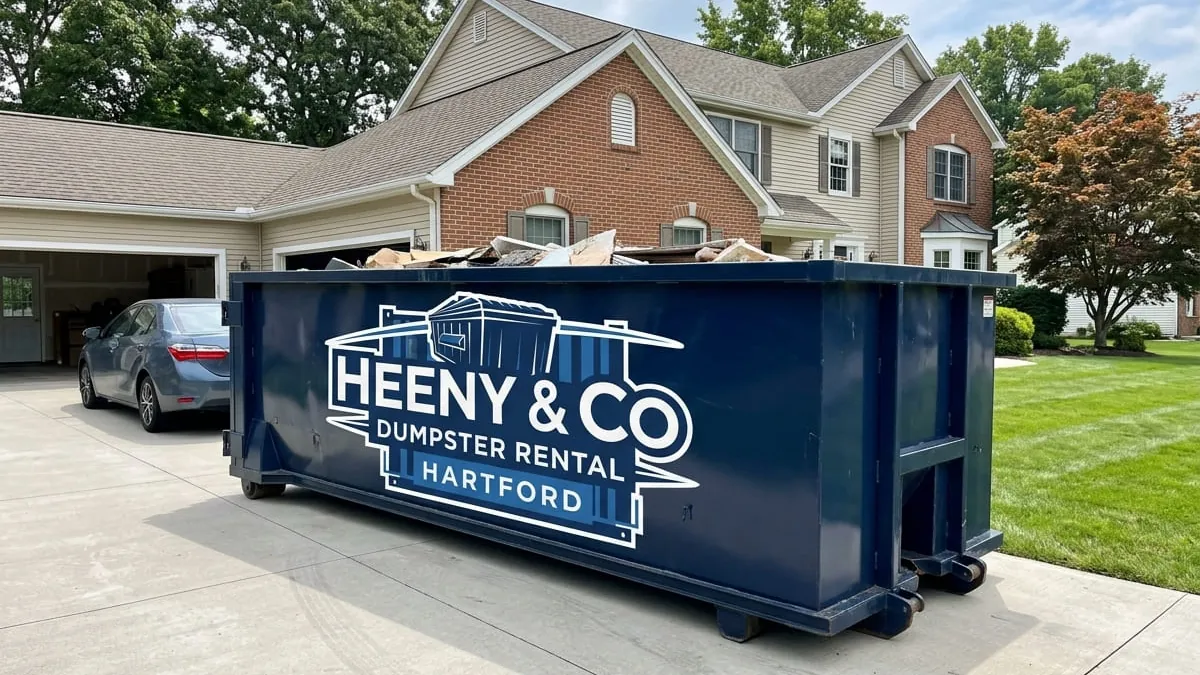
Hartford, CT · the Capitol Region
Dumpster Rental in Hartford, CT — Delivered Fast, Priced Flat
10 through 40 yard roll-off dumpsters for homeowners, contractors and businesses across Hartford and Greater Hartford. One phone call, one flat price, and a driver who protects your driveway. Locally owned since 2014.
- Same-day & next-day delivery
- Flat rates that include disposal
- Driveway protection boards as standard
- Licensed, insured and locally owned
Licensed & insured · Flat-rate quotes · Locally owned since 2014
Why Heeny & Co Dumpster Rental
The dumpster company Hartford calls back
Most people renting a dumpster are already having a stressful week. The kitchen is in pieces, the roof is half off, or a family member has passed and there is a house full of forty years to sort out. The last thing anyone needs is a hauler who quotes one price, invoices another, and drops a container across the mailbox.
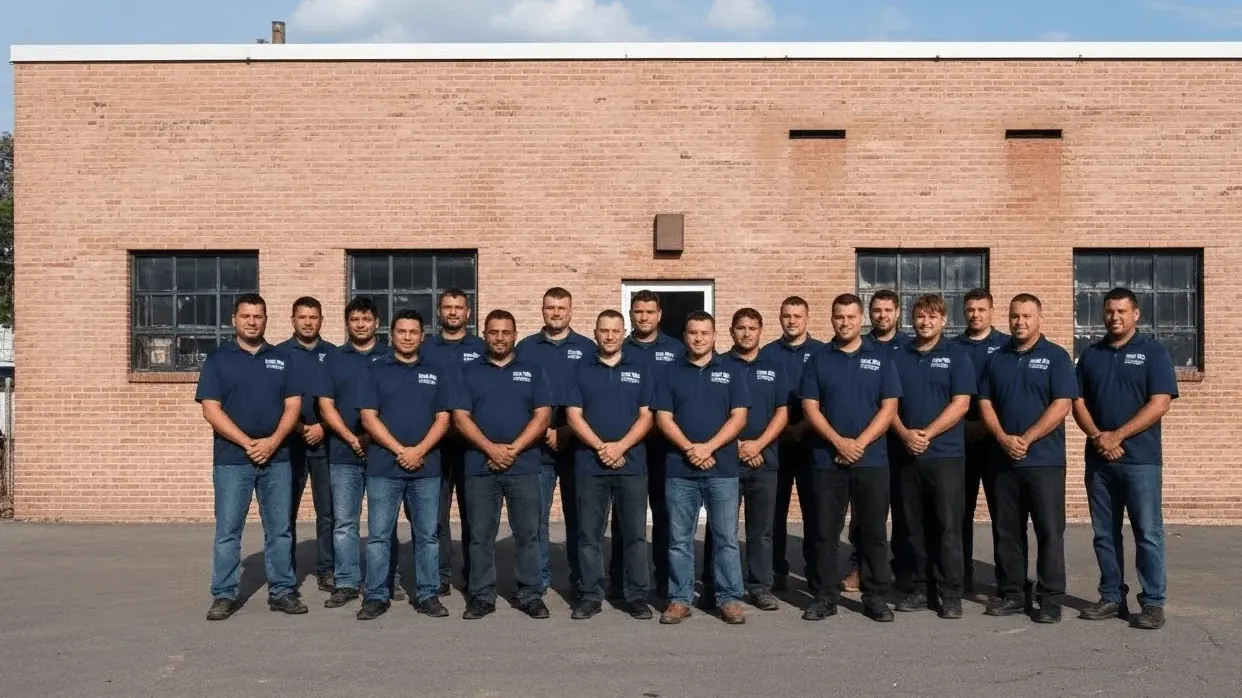
We started Heeny & Co Dumpster Rental in 2014 with one truck and one rule: tell people the truth about what it costs and show up when we said we would. 12 years later that has not changed. Declan Heeny still answers the phone most mornings, and our drivers still walk the drop before they back in.
We run out of 192 Ledyard St in the South Meadows, Hartford’s industrial river district, with I-91, I-84 and Route 2 all a few minutes from the gate, which is exactly why we cover Hartford and the rest of the Capitol Region every single day rather than routing a truck in from another market when you need a container this afternoon. The yard sits behind the wall the city built after the 1936 flood, a short run from the plant that used to burn Hartford’s rubbish and does not any more. It also means we know the rulebooks apart. Connecticut has 169 towns and no county layer running solid waste — county government was abolished on 1 October 1960 and the Census Bureau retired the counties as statistical units in June 2022 — so there is no regional rulebook to fall back on. The town is the unit of government here, each one arranges its own collection and disposal, and CT DEEP keeps a list of municipal transfer stations precisely because no two are alike; the state mattress programme notes that 157 communities out of 169 offer direct access, which tells you what the other twelve are like. The regional frame is the Capitol Region Council of Governments, which Hartford and all fifteen of the towns we serve belong to. Over the top of all of it sits one rule that applies statewide: IFC 2021 §304.3.3, adopted by the 2022 Connecticut State Fire Safety Code, says a container of 1.5 cubic yards or more must not be stored in a building or placed within five feet of combustible walls, openings or combustible roof eave lines — that is every roll-off we own, and it is a placement rule rather than a paperwork rule, because there is no per-dumpster fire permit in this state. Past that it is street knowledge: which Perfect Sixes off Ledyard Street and Wethersfield Avenue share one narrow drive between two buildings, so the can goes at the head of it before a tenant’s car boxes it in; which turnovers in Frog Hollow and off Maple Avenue and New Britain Avenue have a rear yard no truck will ever reach; which blocks around Asylum Avenue, Sigourney Street and Forest Street run a maple or oak limb straight across the approach; where a winter of ploughing has buried the kerb line and the last few feet of the apron until March; and which downtown addresses off Main Street and Columbus Boulevard have no drive at all, so the box goes in the right-of-way and the Permit Division gets a call first.
Read more about who we are and how we got started, or jump straight to what we haul.
- Founded2014
- Container sizes10 – 40 yd³
- Typical deliverySame or next day
- Areas served18+
What we haul
Dumpster rental services in Hartford and Greater Hartford
Eleven container services, one flat-rate promise. Whatever the job, the price we quote on the phone is the price on your invoice.
Residential Dumpster Rental
Driveway placement for full-basement, attic, porch and shed cleanouts and remodels.
Learn more →Commercial Dumpster Rental
Containers for businesses and buildings over six units, which the City does not collect from.
Learn more →Construction Dumpster Rental
Mixed C&D in one roll-off, the way CT DEEP recommends, with next-day swap-outs.
Learn more →Roofing Dumpster Rental
Weight-rated cans sized by squares and layers for asphalt shingle tear-offs.
Learn more →Roll-Off Dumpster Rental
10, 15, 20, 30 and 40 yard roll-offs across Hartford and the Capitol Region.
Learn more →Same-Day Dumpster Rental
Call before the cut-off and we can usually get a container to you this afternoon.
Learn more →Junk Removal Dumpsters
Clear a full basement, attic, porch or shed on your own schedule.
Learn more →Estate Cleanout Dumpsters
Discreet, patient container service for families clearing a lifelong home.
Learn more →Demolition Debris Removal
Containers and fast swaps for porches, decks, sheds, garages and interior gut-outs.
Learn more →Concrete & Heavy Debris
Dedicated heavy cans for concrete, brick, plaster and foundation spoil.
Learn more →Yard Waste & Brush Removal
Separate clean loads — Connecticut bans grass clippings from solid waste facilities.
Learn more →Choose your size
Five sizes, sized for real projects
Not sure which one? Tell us what you are clearing out and roughly how much of it there is. Ninety percent of the time we can size it correctly over the phone in under two minutes. The first question here is what the debris weighs rather than how much room it takes, because plaster and lath off a Perfect Six gut, broken concrete and brick out of a basement or a chimney, spoil from a footing dig taken down to the 42-inch frost line, and an asphalt shingle tear-off counted in squares and layers are all weight jobs long before they are volume jobs. Dense material like broken concrete, brick, block, pavers and excavation spoil wants a small can; a porch or deck tear-off, or a full turnover of a six-unit building in Frog Hollow — framing lumber, cabinets, insulation and trim — is the job that genuinely wants a 40, because that debris takes up enormous space and weighs comparatively little. Bear in mind that an open can catches every storm and every thaw, and a load that has taken on water or snow weighs a good deal more at the scale than the same load dry, so keep it below the rails where it can be tarped.
10 Yard Dumpster
Concrete, brick, plaster and foundation spoil — weight fills it long before volume does.
View this size → 15yd³15 Yard Dumpster
A single room, a small tear-off, or one unit of a multifamily turnover.
View this size → 20yd³20 Yard Dumpster
A full basement and attic clear-out — the New England default — or a multi-room remodel.
View this size → 30yd³30 Yard Dumpster
A whole Perfect Six or three-decker with basement and attic, or a large remodel.
View this size → 40yd³40 Yard Dumpster
Bulky light debris only: porch framing, fencing, siding, insulation, fit-outs.
View this size →How it works
Four steps, no paperwork
- 1
Call us
Tell us the project, your address and when you want it. Two minutes on the phone and you have a flat price.
- 2
We deliver
Our driver walks the drop, lays protection boards and sets the container exactly where you want it.
- 3
You load it
Take your time within your rental window. Keep it level with the top rail and we handle the rest.
- 4
We haul it
Call or text when you are done. We pull it, sort what can be recovered and dispose of the rest properly.
Local knowledge
What makes hauling in Hartford different
Shared drives, snowbanks, low maple limbs and the fire code’s five feet
Placement is where most of the trouble starts here, and it is rarely about the size of the box. Hartford was built dense, for people who walked or took the trolley to the insurance offices and the Colt works, and its signature building is the “Hartford Perfect Six” — three storeys, a symmetrical double-bow front, a centre-hall entrance, six flats, two to a floor. Whole streets of them went up in the late nineteenth and early twentieth centuries, with a yellow-brick variant in the 1920s, and they sit close together with one narrow drive shared between two buildings and a tenant’s car already on it. 81 percent of Hartford housing is multifamily, against 64 percent single-family across Connecticut, so rear yards a truck will never reach are the rule rather than the exception, particularly in Frog Hollow and off Maple Avenue and New Britain Avenue. Often the honest answer is that the can sits at the head of the drive, or on the street. From December into March the constraint is snow: ploughing banks the kerb line and the last few feet of the apron, and until that pile is moved we need a different spot. Overhead it is low maple and oak limbs, with white pine, birch and ash behind them, and then the service drop into the building. Figure on roughly 60 ft of straight approach, 10.5 ft of width and 20+ ft of clear sky for the hoist arm. If the property is a condominium, the association and its managing agent decide placement, not the city.
Then the rule national guides get wrong for this state. Connecticut has no fire-department permit for a dumpster. The only rubbish entry in the state fire prevention code’s permit table is a permit to operate a commercial rubbish-handling business, which is the hauler’s to hold rather than yours. What the state does have is a placement rule: IFC 2021 §304.3.3, adopted by the 2022 Connecticut State Fire Safety Code, provides that containers with an individual capacity of 1.5 cubic yards or more shall not be stored in buildings or placed within 5 feet of combustible walls, openings or combustible roof eave lines. Five feet, not the ten you will read on sites written for other states. Every roll-off we run, 10 through 40 yard, is far bigger than 1.5 cubic yards, so that clearance governs the driveway as much as the street, and it is the usual reason a box ends up out on the apron rather than tight against the side of the building. For the public way, Hartford’s Public Works Permit Division issues an Obstruction Permit for temporary obstruction of the public right-of-way — $50 plus $0.03 per square foot per day under the City’s published rules and specifications, with a $10,000 performance bond and a certificate of liability insurance. The City’s rules document does not use the word dumpster anywhere, so do not let anyone sell you a permit under a name that is not in it: ring the Permit Division on 860-757-9970, or Hartford 311 on (860) 757-9311, and ask how they want your address handled. Before anything gets dug — footings, a fence line, a stump, an oil tank — call Call Before You Dig on 811, the Connecticut one-call centre under CGS §16-345 et seq.. Tell us the cross streets and we will tell you where the can goes, or see the permit and placement guide.
Full basements at a 42-inch frost line, and the volume that comes with them
The single fact that separates a Hartford job from one in a warm-weather market is the frost line: 42 inches in Connecticut. Footings have to reach three and a half feet whatever you are building, and once an excavator is that deep a full basement costs very little more, which is why so much of the older stock here has one and why so many jobs start in the cellar. That has two consequences for us. A foundation dig, a bulkhead replacement or a set of new deck posts produces far more spoil than anyone expects. And a cleanout here has a whole extra floor in it: the basement and the attic are the cleanout, and sizing guides written for slab markets assume neither, so they get the first question wrong. Spring is when it shows. The frost comes out of the ground, water finds the basement, and boxes that have been stacked down there for decades come up the bulkhead stairs wet and far heavier than they went down. Mattresses out of those cellars go free at the city drop-off, because Connecticut was the first state to pass a comprehensive mattress stewardship law and the producer has already paid — see Bye Bye Mattress. February through April the other driver is the ice dam, which is why the code here requires an ice barrier under the shingles and why the work that follows a hard winter is re-roofing, ceiling and insulation tear-out and attic air-sealing. The bigger water risk in this city, though, comes off the river rather than the roof: the Connecticut River at Hartford crested at 37.6 feet in March 1936, the flood of record, and 35.4 feet in the September 1938 hurricane, and FEMA is redrawing the flood insurance rate maps for this area now. Watch the National Weather Service through the winter and the spring melt — the normals everyone quotes for Hartford are measured at Bradley International Airport, just north of the city.
The housing is older than most people assume and it is not what general knowledge says. Half of Hartford’s housing units were built before 1950, and the Connecticut State Historic Preservation Office’s National Register nomination for the local type describes the “Hartford perfect six” as “essentially a variation on the triple decker … three stories in height with a symmetrical, double-bow facade and a center-hall main entrance and was designed to accommodate six units, two on each floor”, developed by local builders in the late nineteenth and early twentieth centuries for a growing working and middle-class population, with a yellow-brick version popular in the 1920s. With 25.7 percent of homes owner-occupied, among the lowest of any American city, the person calling us is more often a landlord, a property manager or a contractor between tenants than a homeowner clearing a garage. Inside buildings of that age expect plaster and lath rather than drywall, and the things that come with pre-1940 New England construction generally: asbestos pipe insulation on old steam and hot-water lines, knob-and-tube wiring, and balloon framing, which is worth checking before demolition because of the uninterrupted stud cavities. Heating oil tanks are a live issue in these cellars, and we do not take a tank in a container — it is a licensed job with its own reporting rules. On asbestos, Connecticut splits the work three ways and it catches people out: the Department of Public Health takes the abatement notification, on ten days’ notice, and licenses the trades; CT DEEP issues the $300 Special Waste and Asbestos Disposal Authorization; and the DAS Office of the State Fire Marshal licenses demolition contractors. There is no owner-occupied carve-out here — the state regulation defining a regulated facility expressly includes residential property “including single family homes” — and a demolition notification is required for any structure whether asbestos is present or not; DPH publishes a factsheet on asbestos-containing siding shingles specifically, which is a live issue on this city’s pre-1940 stock. Hartford adds a step of its own, a 60-day public notice period before a demolition permit application. Pre-1978 housing is the lead trigger, the City runs a Lead Hazard Reduction Grant Program for lower-income households with children under six, and lead paint chips are refused by the city’s bulky programme. And we cannot take asbestos-containing material in any container. See our notes on basement and attic cleanouts and Perfect Six and multifamily turnovers, and confirm current requirements with the agency before you start.
Connecticut’s mandatory recyclables, and what cannot go in the box
There is no Connecticut ban list, whatever a national guide tells you, and no state-imposed recycling rate on construction waste. What the state does instead is designate mandatory recyclable items under CGS §22a-241b and RCSA §22a-241b-2, and forbid mixing them back in once they have been separated. On a renovation job that comes down to two materials: corrugated cardboard and scrap metal are mandatory recyclables and must be separated from other building material wastes. Everything else can travel together. CT DEEP’s own renovation guidance says “the easiest and most common way to manage construction waste is to commingle most waste into one roll-off”, taken by the hauler to a materials recovery facility or transfer station — so one mixed container is not merely legal here, it is what the state recommends. The genuine disposal bans are short: electronics, banned since 1 January 2011 under CGS §22a-636, and grass clippings, under CGS §22a-208v. The container deposit is now ten cents.
What may not ride is set by the statutory definition of construction and demolition waste at CGS §22a-208x, which excludes asbestos, clean fill, hazardous waste, radioactive material, and liquid or semi-liquid material — adhesives, paints, oils and tars. So no wet paint, no solvents, no fuel or motor oil, no tar buckets, and no asbestos, ever. Paint and mattresses both have producer-funded programmes in this state, which is exactly why they should not be in our box. PaintCare has operated here since July 2013 under CGS §§22a-904 and 904a, funded by a point-of-sale fee of up to $2.25 and running about 157 drop-off sites statewide; other household chemicals go to the Metropolitan District’s operations facility at 125 Maxim Road, minutes from our yard. Mattresses came out of Public Act 13-42, which made Connecticut the first state with a comprehensive mattress stewardship law; the programme went live 1 May 2015 and the fee charged at the till is $16.00, rising to $19.50 on 1 October 2026, which is why Hartford takes mattresses free and why we would rather route yours that way. The other half of the story is where the rest of it goes. The trash-to-energy plant in the South Meadows has closed, Connecticut has no active municipal landfills, and a large share of the state’s waste now leaves by truck and rail. Disposal here is a distance problem rather than a what-is-banned problem, and that is the real reason we ask what is in the load before we quote. Full detail in the Connecticut recycling and disposal rules and the Hartford recycling and disposal guide, and check current rules with CT DEEP.
Weight at one end, the six-unit collection line at the other
Broken concrete, brick, block, pavers and wet excavation spoil all run around 2,400–2,800 lbs per cubic yard, so a heavy load reaches legal transport weight in a container that still looks half empty. That material belongs in a 10 yard, twice, not a 30 once — see concrete and heavy debris. The local versions are spoil out of a footing or foundation dig taken down to the 42-inch frost line, a bulkhead or a basement wall opened up, a chimney taken down to the roofline, plaster and lath off a Perfect Six gut, a porch footing broken out and a drive apron lifted. Wet basement contents after a thaw or a river rise are the quiet one: cardboard, carpet and stored paper that have soaked up water weigh several times what the same pile weighed dry. Storm limb wood is the other heavy load — after a blow like Tropical Storm Irene in August 2011, or Isaias across Connecticut in August 2020, it is green maple, oak, ash and white pine, and green hardwood sits at payload in a box that still looks half full, which is why we run it as a clean separate load — see our notes on storm and flood cleanup. A tear-off is the same conversation from the other direction: it is counted in squares and layers rather than roof area, and on a Connecticut roof the ice barrier the code requires usually comes off with it, so get the material and the layer count before you order — see roofing dumpsters and the tear-off sizing guide.
The other half of the job is the kerb, and in Hartford the kerb gives out at a number every landlord here knows. Collection is run directly by the Department of Public Works, and it covers only a “single family home, multifamily 6 units or less, condo association of 6 units or less”. Every other property type arranges private hauling from day one. Hartford’s signature building is a six-unit building, so the Perfect Six sits exactly on that line — and the moment the debris stops being household trash it is off the line anyway. Recycling is single-stream, and DPW names construction debris as contamination that will get a cart skipped. Bulky collection is two free pickups per unit per year, five items or fewer each, by appointment only on (860) 757-9983, with 25 appointments a day, first come first served; additional collections are $75 each, or there is a $10 permit good for four self-haul loads. It is a household programme — furniture, appliances, mattresses, water heaters, tied bundles of wood or branches — and not a renovation programme: there is no construction and demolition category in it, DPW names construction debris as unacceptable material, and bulky waste excludes hazardous or toxic material outright, motor oil, asbestos and lead paint chips among them. Self-haul runs to the Bulky Waste & Recycling Center at 180 Leibert Road, Tuesday to Saturday, 8:45am to 1:45pm, on a three-tier permit bought from DPW at 50 Jennings Road: green is free for recyclables, blue is $10 for four visits, and the red commercial permit is $50 plus a per-load charge — $40 a half ton, $60 for three-quarters, $85 a ton. The red permit names handymen and landscapers in as many words and caps out at a one-ton load or a 16-foot trailer, which is precisely where a gut renovation stops fitting inside the municipal system. The City does not rent roll-off containers. So we load heavy over light, keep everything below the top rail where it can be tarped, bag the insulation, and pull the cardboard and the scrap metal out first because the state requires it. See yard waste removal and the Hartford recycling and disposal guide.
- 12+Years serving the Capitol Region
- 18Towns and neighbourhoods served
- 13In-depth local guides published
- 5Container sizes, 10 to 40 yard
What customers say
Straight talk from Hartford and Greater Hartford
Declan was the only one who asked what was coming out of the cellar before he quoted. Two mattresses and an old chest freezer, and he told me straight that the mattresses go free through the state programme and the freezer is scrap metal, so neither belonged in the box. He sorted both routes and we never had a turned-away load.
Three layers of shingle on a 1912 six-family and a crew booked for the Monday. They had a can on the drive at seven in the morning, on boards, and their driver moved it once so the arm would clear the service drop. He also pointed out we had to stay five feet off the eave line, which nobody else had mentioned.
We turn units in three buildings and the city only collects up to six, so we are private-hauler customers whatever happens. Heeny know the Connecticut rules cold and tell us what has to come out of the load before the truck arrives. The cardboard and the scrap metal, every time.
My mother had been in the same house off Maple Avenue since 1976 and we had six weeks before the closing. They set a 20 on boards and swapped it twice, and never once made us feel rushed. The driver pointed us at the paint programme rather than letting us bin half a cellar of cans.
Reviews are shown as supplied by customers. Ratings and counts shown elsewhere on this site are illustrative pending live review syndication.
Service area
Dumpster delivery across the Capitol Region
We deliver daily from our Hartford yard. Pick your city for local placement notes, landmarks and permit guidance — or see the full service area.
Dumpster Rental FAQs
How fast can you deliver a dumpster in Hartford?
Most of the time, same day if you call before about 11am, and next morning otherwise. We run our own trucks out of 192 Ledyard St in the South Meadows, with I-91 and I-84 minutes from the gate, so we are not waiting on a dispatcher in another state. In the week after a bad storm, when every roofer and tree crew in Greater Hartford is booked solid, it can stretch to 48 hours, and we will tell you honestly when you call. The other predictable rushes are the spring thaw, when the frost lets go and half the cellars in Hartford are being pumped and cleared at once, and the last dry weeks of October and November before the ground freezes again. If you know your dates, book ahead and we will hold the slot.
What does a flat rate actually include?
Delivery, pickup, an agreed rental period and a set tonnage allowance with disposal included. No fuel surcharge, no environmental fee, no admin fee. The only way the number changes is if you go over the weight allowance or keep the container longer than agreed, and we tell you both limits before we deliver.
Do I need to be home for delivery or pickup?
No. Plenty of our customers text us a photo of where they want it and go to work. All we need is clear access, a spot free of cars and low branches, and permission to be on the property. If the only way in is a narrow drive shared with the building next door, a rear yard behind a six-family, a gate beside a detached garage or a shed, or a spot the plough has banked with snow, tell us when you book and we will schedule accordingly. If the building is a condominium, say so on the first call — the association and its managing agent govern placement there, and it is easier squared away before we roll than after. Mention low maple and oak limbs, porch roofs and the service drop as well, because the hoist arm needs the height. Say so if the building is empty, too — on an unattended job the weather is the risk, so we will talk you through keeping the load below the rails where it can be tarped, and we will time the pull so a loaded can is not sitting open through a storm.
Will the dumpster damage my driveway?
We put protection boards under the wheels and rails on every residential delivery, which spreads the load instead of concentrating it on four small contact patches. The complication here is the ground rather than the concrete: with a 42-inch frost line, drives and aprons lift and drop with frost heave through the winter, and by the spring thaw older flatwork has usually cracked and stepped long before we ever arrive. We photograph the existing condition on delivery either way. Narrow shared drives, alley approaches and older or hairline-cracked concrete get extra boards, and so does newer flatwork poured during a turnover, which settles under a point load rather than scuffing. On a gravel or dirt pad we are fine while it is dry, but for a day or two after a thaw or a hard rain we would rather come back than cut ruts into it. Our placement guide explains it fully.
Do I need a permit for a dumpster in Hartford?
On your own driveway there is no permit to pull. Connecticut has no fire-department permit for a dumpster — the only rubbish entry in the state fire prevention code’s permit table is a permit to operate a commercial rubbish-handling business, which is the hauler’s to hold. What you do have is a placement rule, and it is the one national sites get wrong for this state: IFC 2021 §304.3.3, as adopted by the 2022 Connecticut State Fire Safety Code, provides that containers with an individual capacity of 1.5 cubic yards or more shall not be stored in buildings or placed within 5 feet of combustible walls, openings or combustible roof eave lines. Five feet, not ten. Every roll-off is far bigger than 1.5 cubic yards, so that clearance decides where the box sits on a driveway. The street is a different desk: Hartford’s Public Works Permit Division issues an Obstruction Permit for temporary obstruction of the public right-of-way, $50 plus $0.03 per square foot per day under the City’s published rules and specifications, with a $10,000 performance bond and a certificate of liability insurance. The City’s rules document never uses the word dumpster, so ring the Permit Division on 860-757-9970, or 311 on (860) 757-9311, and ask how they want your address handled rather than trusting a permit name you read online. Individual towns can add their own fire marshal requirements, and each one runs its own desk — Connecticut has 169 towns and has had no county government since 1960 — so West Hartford, Wethersfield, Newington and Manchester will each answer differently. If the property is a condominium, the association’s rules govern placement as well. Call Call Before You Dig on 811, under CGS §16-345 et seq., before anything gets dug. Requirements change, so confirm before you book — or read our permit and placement guide.
What can I not put in the dumpster?
Wet paint, solvents, adhesives, motor oil, fuel, tar, pesticides, automotive chemicals, asbestos-containing material, propane and other pressurised cylinders, lead-acid batteries, medical waste and refrigerant appliances. Most of that comes straight from the statute: CGS §22a-208x excludes asbestos, clean fill, hazardous waste, radioactive material and liquid or semi-liquid material — adhesives, paints, oils and tars — from construction and demolition waste. What surprises people is how short the rest of the list is. Connecticut has no waste-ban list. It designates mandatory recyclables under CGS §22a-241b and RCSA §22a-241b-2 and forbids remixing them once they have been separated, and on a renovation job that means exactly two things come out of the load: corrugated cardboard and scrap metal. CT DEEP itself says the easiest and most common way to manage construction waste is to commingle most of it into one roll-off, so a mixed container is what the state recommends rather than something to apologise for. The only outright disposal bans are electronics, since 1 January 2011 under CGS §22a-636, and grass clippings, under CGS §22a-208v. Leftover paint goes to a PaintCare drop-off — the programme has run here since July 2013 and there are about 157 sites across the state — and other household chemicals go to the Metropolitan District facility at 125 Maxim Road. Mattresses are free at the Hartford drop-off because Connecticut’s stewardship programme has already been paid for at the till, so tell us and we will route yours that way instead. Vegetative debris still travels best as its own clean separate load rather than mixed into a construction load. Everything else on a normal cleanout or renovation is fine. Rules do change, so ask us before it goes in.
Still not sure?
Two minutes on the phone beats twenty minutes reading. Tell us the job and we will size it, price it and book it.
(959) 666-6427Helpful Local Resources
Useful official sources for permits, disposal rules and recycling in Hartford and the Capitol Region. We keep these handy because half the questions we get are really questions for one of these offices.
- City of HartfordCurbside eligibility, the two free bulky pickups, the Leibert Road drop-off and its permit tiers, and the Obstruction Permit.
- CT DEEPMandatory recyclables, what may and may not ride in a C&D container, the asbestos disposal authorization and the state materials strategy.
- Call Before You DigFree utility locates before you dig, demolish or excavate — the one-call centre for Connecticut.
- PaintCare ConnecticutFree drop-off for leftover paint across Connecticut, funded by a fee already paid at the register.
- Bye Bye MattressConnecticut’s mattress recycling programme — the first in the country — and where to bring a mattress.
- The MDCRegional household hazardous waste collection for Hartford and the surrounding member towns.
- USACE New EnglandThe Hartford Local Protection Project — the dikes, floodwall and conduits that keep the river out of the city.
- National Weather ServiceNor’easter, ice-storm and river-flood forecasts for the Connecticut River valley.
Talk to a real person
Need a dumpster in Hartford today?
Tell us what you are clearing out and we will tell you the right size and the flat price to put it in your driveway. No forms, no waiting on an email — just call and we will sort it out in a couple of minutes.
Serving Hartford, the Capitol Region and Greater Hartford · Mon–Fri 6:30am–5pm, Sat 7am–1pm