
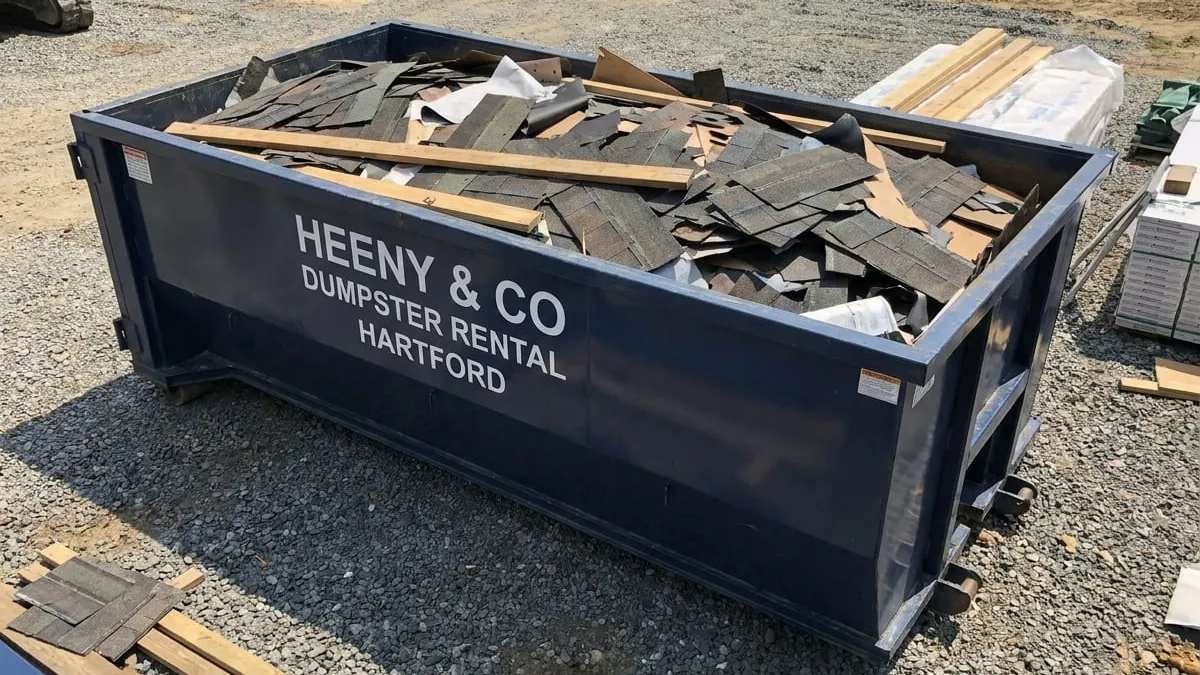
Roofing
Roofing Dumpster Rental in Hartford
A tear-off is a weight job that looks like a volume job. Size it by squares and layers, keep the flashing and drip edge out for scrap, and remember the five-foot rule bites hardest here: the eave line is what you are working over.
Roofing is the one job where the arithmetic is genuinely reliable, because asphalt and composition shingle comes off in a countable unit. Work in squares — a hundred square feet of roof surface — and count the layers, because a great many Hartford roofs carry two and some carry three. A single layer of standard three-tab off a square weighs on the order of two hundred and fifty pounds; architectural shingle is heavier; a second layer roughly doubles it, and a third adds a hundred per cent again on the first. That is why a tear-off container fills by weight while the box still looks half empty, and why the right answer for a two-layer strip on a modest roof is usually a 10 or a 15 rather than the 20 the homeowner imagines.
The seasonal driver in this city is ice. Connecticut's code requires an ice barrier on new roof coverings, and ice dams are a genuine recurring problem on the older stock: a warm attic, a cold eave, a freeze-thaw cycle and water pushed back up under the courses until it comes through a bedroom ceiling. That failure pattern is why so much roofing work in Hartford is not a scheduled replacement but a repair booked in February and executed in April, and why the tear-off often reveals rotted decking, saturated felt and damaged fascia that were not in the original scope. Order the box for the roof you find rather than the roof you quoted, or plan for a swap.
Two things come out of a roofing load before it goes. Scrap metal is a mandatory recyclable in Connecticut, so flashing, valley metal, drip edge, vent collars and any gutter coming down with the roof are pulled and stacked separately rather than buried in shingle where nobody can recover them. And on older Hartford buildings the material itself needs checking: asphalt and asbestos-cement roofing products, and asbestos-cement siding shingles, both turn up on pre-1940 stock, and the Connecticut Department of Public Health publishes a factsheet specifically on siding shingles. Asbestos-containing material cannot go in any container at any time. If a sample is in doubt it gets tested before the strip starts, not after it is in the box.
Roofing Work That Fills A Container Here
Single-Layer Asphalt Tear-Off
The straightforward case. Count squares, allow roughly two hundred and fifty pounds a square for three-tab and more for architectural, and load flat and level so the box sits inside payload rather than heaped at one end.
Two And Three Layer Strips
Common on Hartford's older roofs and the usual reason a container is undersized. Each extra layer changes the arithmetic more than it changes the volume, which is exactly backwards from how most people order.
Ice Dam Repairs And Eave Rebuilds
The eave courses, the saturated felt, the ice barrier detail and the rotted decking behind it. Repair work generated by a freeze-thaw winter rather than by the age of the roof.
Decking And Sheathing Replacement
Plank sheathing on pre-war roofs comes off in long lengths and takes up more room than its weight suggests, so it wants loading down the length of the box rather than dropped across it.
Flat And Low-Slope Sections
Rubber, modified bitumen or built-up roofing off a rear addition or a Perfect Six porch roof. Denser than shingle by the square foot and often bedded to substrate that comes with it.
Chimney Flashing And Masonry
Loose brick, mortar and the old flashing set into it. The brick is a weight material and should go flat on the floor of the box, not on top of a pile of shingle.
Gutter, Fascia And Soffit
Aluminium and steel gutter is scrap and comes out of the load. Rotted fascia and soffit board is ordinary construction debris and can ride with the shingle.
Storm-Damaged Roofs
Limb strikes and wind damage after events like Tropical Storm Irene in August 2011 or Isaias in August 2020, where the tear-off, the branch debris and the interior damage arrive at once.
Sizing A Roofing Container By Squares
Roofing is the one service where you can size the box before anyone climbs the ladder. Measure in squares, count the layers, and work from weight. A 10 yard handles roughly a ten to fifteen square single-layer strip and is often exactly right for a Hartford porch roof, a rear addition or a small dwelling. A 15 yard is the common Hartford tear-off box: a mid-size roof at one layer, or a smaller roof at two. A 20 yard covers a larger single-family roof, a two-layer strip, or a three-storey multifamily where the decking comes off too. Beyond that a bigger box is rarely right: a 30 or a 40 loaded with shingle hits payload long before the sides are full. Two smaller boxes swapped beat one large one that cannot legally move. If the deck is suspect, budget a swap.
10 Yard Dumpster
Concrete, brick, plaster and foundation spoil — weight fills it long before volume does.
View this size →15yd³15 Yard Dumpster
A single room, a small tear-off, or one unit of a multifamily turnover.
View this size →20yd³20 Yard Dumpster
A full basement and attic clear-out — the New England default — or a multi-room remodel.
View this size →The Five-Foot Rule And The Eave Line
Every roofing job runs into the same placement problem. Under IFC 2021 section 304.3.3, as adopted in Connecticut, a container of 1.5 cubic yards or more must not be stored in a building or placed within five feet of combustible walls, openings or combustible roof eave lines. On a tear-off the eave line is precisely what you want the box parked under, so this is the service where the rule bites hardest. The workable compromise is a box set five feet clear with a chute or a tarped landing zone rather than one tucked against the wall. Connecticut has no per-dumpster fire permit, so this is a placement question, not a paperwork one. Shingle-loaded containers are among the heaviest we run and Hartford drives are old concrete or asphalt with freeze-thaw cracking already in them, so boards go under the wheels on every set and we photograph the approach. Overhead is the other constraint, mature maple and oak plus the service drop, and on a tight Frog Hollow lot the honest answer is sometimes the street under an Obstruction Permit at $50 plus three cents per square foot per day, on 860-757-9970.
Not sure this is the right service? Describe the job on the phone and we will point you at the right container even if it is a different service page. Call (959) 666-6427.
Get a flat quote
Two minutes on the phone gets you a size, a price and a delivery slot. No forms.
(959) 666-6427Recommended sizes
How it works
Roofing Dumpster Rental in four steps
- 1
Call us
Tell us the project, your address and when you want it. Two minutes on the phone and you have a flat price.
- 2
We deliver
Our driver walks the drop, lays protection boards and sets the container exactly where you want it.
- 3
You load it
Take your time within your rental window. Keep it level with the top rail and we handle the rest.
- 4
We haul it
Call or text when you are done. We pull it, sort what can be recovered and dispose of the rest properly.
Roofing Dumpster Rental FAQs
What size container do I need for a tear-off?
Work in squares and layers rather than in rooms. Roughly, a 10 yard takes a ten to fifteen square single-layer strip, a 15 yard is the common size for a mid-range Hartford roof or a smaller roof carrying two layers, and a 20 yard covers a large single-family roof or a two-layer strip on a substantial house. A single layer of three-tab runs around two hundred and fifty pounds a square and architectural shingle is heavier, so a second layer roughly doubles the weight without doubling the volume. Going bigger is not the safe hedge people assume: a 30 loaded with shingle reaches payload long before it is full. If the decking might be coming off too, plan a swap instead of a larger box.
My roof might have asbestos. What happens then?
It stops being a roofing job and becomes an abatement job before anything is stripped. Older asphalt and asbestos-cement roofing products turn up on pre-1940 buildings, and the Connecticut Department of Public Health publishes a factsheet specifically about asbestos-containing siding shingles, which are common on the same stock. In Connecticut abatement notification and licensing sit with DPH on ten days' notice, CT DEEP issues the $300 Special Waste and Asbestos Disposal Authorization, and DAS Office of the State Fire Marshal licenses demolition contractors. RCSA section 19a-332a-1 expressly includes single family homes, so there is no owner-occupied exemption here. We cannot take asbestos-containing material in a container, ever. Test first.
Why does the flashing have to come out?
Because scrap metal is a mandatory recyclable in Connecticut under CGS section 22a-241b and must be separated from other building material wastes. On a roof that means step and valley flashing, drip edge, vent collars, chimney counterflashing and any gutter and downpipe coming down with the job. It is a five minute discipline that pays twice: it keeps the load compliant, and metal buried in a shingle load is unrecoverable once the box is tipped. Corrugated cardboard, the other mandatory recyclable, matters less on a tear-off but adds up on a re-roof where new bundles arrive wrapped and boxed. Keep both in their own piles and the rest of the load can go mixed.
Can the box go right under the eaves so we can throw straight in?
Not in Connecticut. IFC 2021 section 304.3.3, as adopted here, says a container of 1.5 cubic yards or more must not be placed within five feet of combustible walls, openings or combustible roof eave lines, and on a tear-off the eave line is the whole point of the placement. Five feet is not much ground but it is not nothing on a narrow Hartford lot. In practice crews work it with a chute into the box, a tarped landing area and someone moving material, or by taking the set into the drive at an angle so the open door faces the work. It is a placement rule, not a permit rule — Connecticut has no per-dumpster fire permit — so nobody is filing paperwork, but the distance is real.
When is the best time of year to do a roof here?
Late spring through autumn for the work itself, but the phone rings in February. Ice dams are the recurring failure mode on Hartford's older housing: a warm attic melts snow, the cold eave refreezes it, and water backs up under the shingle courses. Connecticut's code requires an ice barrier on new coverings for exactly that reason. So a great many tear-offs are booked in the depth of winter, done when the weather allows, and come with rotted decking and damaged fascia that were not in the first quote. If you are working through winter, tell us about snowbanks and plough windrows on the drive when you book; the container needs the same clear approach in February as it does in July, plus room to swing the door.
More services
Other things we haul
Residential Dumpster Rental
Driveway placement for full-basement, attic, porch and shed cleanouts and remodels.
Learn more →Commercial Dumpster Rental
Containers for businesses and buildings over six units, which the City does not collect from.
Learn more →Construction Dumpster Rental
Mixed C&D in one roll-off, the way CT DEEP recommends, with next-day swap-outs.
Learn more →Roll-Off Dumpster Rental
10, 15, 20, 30 and 40 yard roll-offs across Hartford and the Capitol Region.
Learn more →Same-Day Dumpster Rental
Call before the cut-off and we can usually get a container to you this afternoon.
Learn more →Junk Removal Dumpsters
Clear a full basement, attic, porch or shed on your own schedule.
Learn more →Estate Cleanout Dumpsters
Discreet, patient container service for families clearing a lifelong home.
Learn more →Demolition Debris Removal
Containers and fast swaps for porches, decks, sheds, garages and interior gut-outs.
Learn more →Concrete & Heavy Debris
Dedicated heavy cans for concrete, brick, plaster and foundation spoil.
Learn more →Yard Waste & Brush Removal
Separate clean loads — Connecticut bans grass clippings from solid waste facilities.
Learn more →Where we deliver
Roofing Dumpster Rental across the Capitol Region and Greater Hartford
Same service, same flat rates, every town below. Pick yours for local placement and permit notes.
Talk to a real person
Need roofing dumpster rental in Hartford?
Tell us what you are clearing out and we will tell you the right size and the flat price to put it in your driveway. No forms, no waiting on an email — just call and we will sort it out in a couple of minutes.
Serving Hartford, the Capitol Region and Greater Hartford · Mon–Fri 6:30am–5pm, Sat 7am–1pm