Roll-off
Roll-Off Dumpster Rental in Hartford
Ten to forty yards, delivered on a cable hoist from the yard on Ledyard Street. What decides where a box can go in this city is not the ground so much as the approach, the width and what is hanging over the drive.
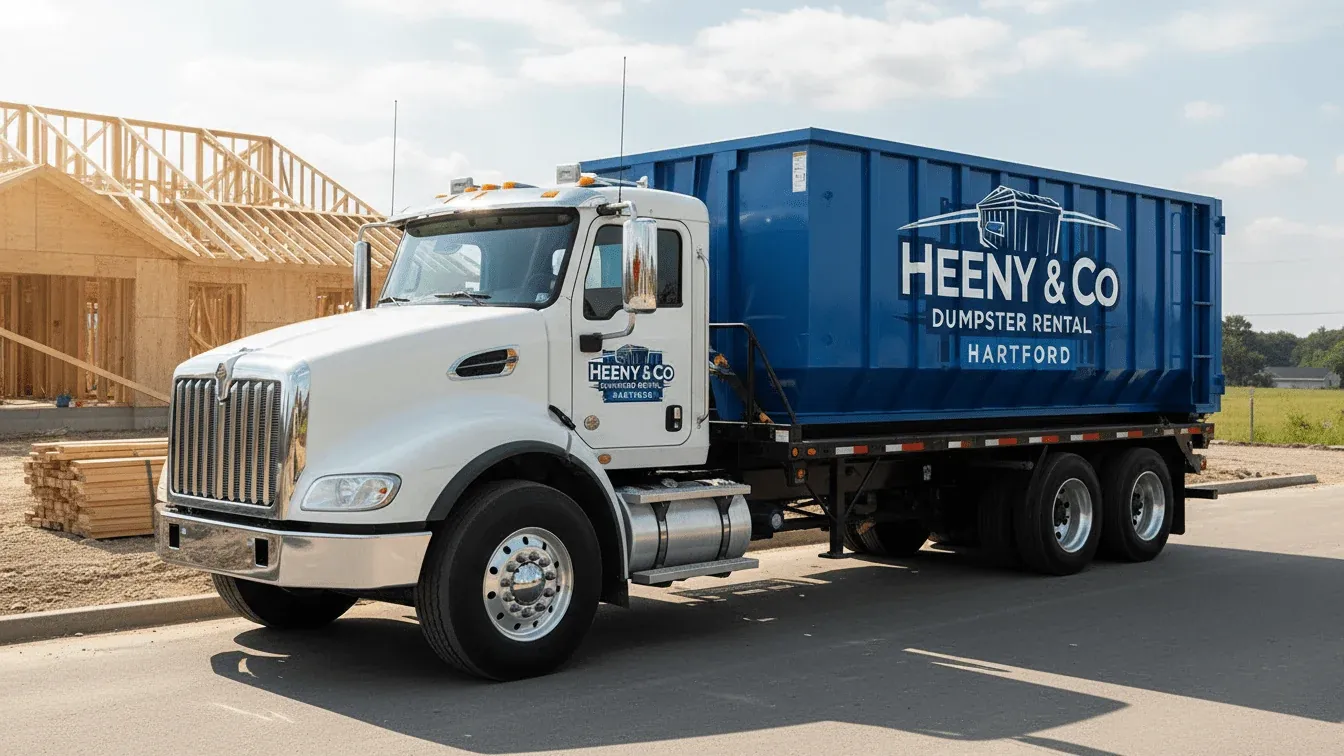
A roll-off is the open-topped rectangular container you see on driveways and building sites, named for how it is delivered: the truck backs in, the cable hoist pays out, and the box rolls down the rails onto its own wheels. We run five sizes — 10, 15, 20, 30 and 40 yards — and the whole range shares one useful property. The 10, 15 and 20 have progressively longer footprints at similar heights, while the 30 and the 40 keep the 20's footprint and add height. That means the choice between a 20 and a 30 is not usually a driveway question, and the choice between a 15 and a 20 usually is. It also means the 30 and 40 are the boxes where weight discipline matters, because the extra height makes it very easy to load past a legal payload while the container still looks half full.
Delivery in Hartford is a geometry problem. We want roughly sixty feet of straight approach so the truck can line up and back, about ten and a half feet of width to work in, and twenty feet or more of overhead clearance for the hoist to stand the box up as it comes off. Width and approach are usually fine. Overhead is what stops sets in this city. Hartford has a mature street tree canopy of maple and oak, particularly through the West End, Asylum Hill and Barry Square, and behind the limbs there is the service drop running from the pole to the house. A limb that would have cleared a 15 will stop a 30. That is worth a look before you book rather than a conversation with a driver who has already made the trip.
The ground itself we take as we find it. Most Hartford drives are older concrete or asphalt with cracking and spalling already in them, which is freeze-thaw doing its work over decades rather than anything a container did in a week. Protection boards go under the wheels and the rollers on every set, and we photograph the approach when we arrive so there is a record rather than an argument. Granite kerbing is common here and worth pointing out when you book, because a set that has to cross a raised granite kerb needs the boards placed differently. In winter, the snowbank and the plough windrow have to be cleared before the truck arrives; a driver cannot make ground appear.
How The Five Sizes Are Actually Used
10 Yard, The Weight Box
Concrete, brick, plaster, tile in a mortar bed, foundation spoil off a 42 inch frost line dig, and wet cellar contents. Short, low-sided and easy to place on a narrow drive. It fills by weight long before volume.
15 Yard, One Room Done Properly
A kitchen, a bath, a bedroom stripped to the studs, a small tear-off, or a hard week in an attic. The size that fits a shared drive between two multifamily houses where a longer box will not swing.
20 Yard, The Default
The most-ordered container in Hartford. A whole flat turned over between tenants, a cellar and an attic in one weekend, a medium remodel, a substantial roof. Twenty-two feet long and about four and a half feet tall.
30 Yard, Whole Property
Same footprint as the 20, half again the height. A whole Perfect Six unit gutted front to back, two flats at once, a large remodel or a builder job. Overhead clearance is the constraint that decides placement.
40 Yard, Bulky And Light Only
Framing, cabinetry, furniture, shop fittings, siding, packaging. It is a volume box and it should never see plaster, masonry or wet material, or it will be over payload while it still looks half empty.
Staged Pairs On Larger Jobs
A 30 for the mixed debris and a 10 alongside it for the heavy fraction. The heavy box goes when it is heavy, the bulk box goes when it is full, and neither is paying to move the other's problem.
Swap Cycles For Live Sites
Rather than one large container standing for a month, a smaller box swapped on a schedule. It keeps each load inside payload and keeps the drive or the bay usable through the job.
Standing Arrangements For Landlords
Repeat turnovers across a portfolio in Hartford, West Hartford, East Hartford and Wethersfield, where we already know the address, the swing side and where the box has to sit to keep the drive open.
Choosing Between Two Sizes
When a job sits between two sizes, decide on material rather than optimism. If the load is dense — plaster from pre-1950 walls, tile bedded in mortar, brick, concrete, or anything out of a wet cellar — take the smaller box and expect it to go out heavy rather than full. If the load is airy — furniture, cabinetry, framing offcuts, packaging, siding — take the larger one, because you will run out of room long before you run out of payload. The mistake we correct most often is a homeowner ordering a 30 for a cellar clear-out because there is a lot of it, when half of what is down there is soaked cardboard and old plaster and the box will be immovable at two thirds. Describe the material honestly and we will tell you which box it wants. If the answer is genuinely both, take two and load them by weight rather than by room.
15 Yard Dumpster
A single room, a small tear-off, or one unit of a multifamily turnover.
View this size →20yd³20 Yard Dumpster
A full basement and attic clear-out — the New England default — or a multi-room remodel.
View this size →30yd³30 Yard Dumpster
A whole Perfect Six or three-decker with basement and attic, or a large remodel.
View this size →Approach, Overhead And Putting One In The Street
The three numbers to have in your head before you book are sixty feet of straight approach, ten and a half feet of width and twenty feet of overhead clearance. In Hartford the last one is what fails. Mature maple and oak arch across residential streets and the service drop runs beneath them from the pole, so the hoist may have nowhere to stand a taller box up even where the drive is generous. Where overhead is tight a 15 or a 20 goes in where a 30 will not. On the ground, protection boards are standard on every set and we would rather hear about a soft verge, a septic run, a raised granite kerb or a fresh sealcoat before the truck arrives than after. Placement on private property is governed by the fire code rather than a permit: IFC 2021 section 304.3.3 keeps any container of 1.5 cubic yards or more out of buildings and five feet from combustible walls, openings and roof eave lines. If there is no room on the property, the box goes in the street under an Obstruction Permit from the Public Works Permit Division at $50 plus three cents per square foot per day, on 860-757-9970.
Not sure this is the right service? Describe the job on the phone and we will point you at the right container even if it is a different service page. Call (959) 666-6427.
Get a flat quote
Two minutes on the phone gets you a size, a price and a delivery slot. No forms.
(959) 666-6427Recommended sizes
How it works
Roll-Off Dumpster Rental in four steps
- 1
Call us
Tell us the project, your address and when you want it. Two minutes on the phone and you have a flat price.
- 2
We deliver
Our driver walks the drop, lays protection boards and sets the container exactly where you want it.
- 3
You load it
Take your time within your rental window. Keep it level with the top rail and we handle the rest.
- 4
We haul it
Call or text when you are done. We pull it, sort what can be recovered and dispose of the rest properly.
Roll-Off Dumpster Rental FAQs
How much room does the truck actually need?
About sixty feet of straight approach to line up and back, roughly ten and a half feet of working width, and twenty feet or more of vertical clearance for the hoist to stand the box up as it comes off the rails. The width and the approach are usually available even on a tight Hartford lot. What catches people out is the overhead. This is a city with a mature maple and oak canopy over its residential streets and a service drop running under it from the pole, so a spot that looks wide open at eye level can be closed at twenty feet. Walk out and look up before you book, and tell us what you see. If the overhead is marginal, a shorter box often solves it where a longer one cannot.
Will the container damage my driveway?
We take every reasonable precaution and we are honest about what a loaded box weighs. Protection boards go under the wheels and the rollers on every delivery and collection, we set square rather than dragging, and we photograph the approach on arrival so there is a record of what the surface looked like. Most Hartford drives already carry cracking and spalling from decades of freeze-thaw, and that is what it is: a container did not cause it in a week. Tell us in advance about a fresh sealcoat, decorative pavers, a septic run, a soft verge or granite kerbing you would rather we did not cross, and we will place the boards accordingly or suggest a different spot.
Do I need a permit to put one on my own driveway?
No permit specific to a container on private property was identified in Hartford, and unlike some states Connecticut has no per-dumpster fire permit. The only rubbish entry in the state fire code permit table is for operating a commercial rubbish-handling business, which is our paperwork, not yours. What does apply is placement: IFC 2021 section 304.3.3, as adopted in the 2022 Connecticut State Fire Safety Code, keeps a container of 1.5 cubic yards or more out of buildings and at least five feet away from combustible walls, openings and roof eave lines. Individual municipalities can add local fire-marshal requirements, so on an unusual property it is worth a call. In the street it is a different matter and needs an Obstruction Permit.
What if there is no room on the property at all?
Then it goes in the street, and that needs a permit from the city. Hartford's Public Works Permit Division runs three permit categories — Curb and Walk, Street Excavation and Obstruction — and the Obstruction Permit covers temporary obstruction of the public right-of-way. The published fee is $50 plus three cents per square foot per day, with a certificate of liability insurance required. The Permit Division is on 860-757-9970 and Hartford 311 is (860) 757-9311. Ring before the container goes in the street rather than after. Bear in mind most Hartford residential blocks have parking on both sides, so a street set usually means losing a couple of spaces and telling the neighbours.
Can I move the box once it has been dropped?
No, and please do not try. A roll-off is designed to be positioned by the hoist and moved on the truck; an empty one is heavy and a loaded one is unmanageable, and dragging it is how driveways get gouged and boards get pushed out of place. If the box is in the wrong place, ring the yard on (959) 666-6427 and we will come and reposition it properly. It is much easier to get the position right first time, which is why we ask about the swing side and the working side when you book. Tell us which end you want the door on and where the material is coming from and the driver will set it that way.
More services
Other things we haul
Residential Dumpster Rental
Driveway placement for full-basement, attic, porch and shed cleanouts and remodels.
Learn more →Commercial Dumpster Rental
Containers for businesses and buildings over six units, which the City does not collect from.
Learn more →Construction Dumpster Rental
Mixed C&D in one roll-off, the way CT DEEP recommends, with next-day swap-outs.
Learn more →Roofing Dumpster Rental
Weight-rated cans sized by squares and layers for asphalt shingle tear-offs.
Learn more →Same-Day Dumpster Rental
Call before the cut-off and we can usually get a container to you this afternoon.
Learn more →Junk Removal Dumpsters
Clear a full basement, attic, porch or shed on your own schedule.
Learn more →Estate Cleanout Dumpsters
Discreet, patient container service for families clearing a lifelong home.
Learn more →Demolition Debris Removal
Containers and fast swaps for porches, decks, sheds, garages and interior gut-outs.
Learn more →Concrete & Heavy Debris
Dedicated heavy cans for concrete, brick, plaster and foundation spoil.
Learn more →Yard Waste & Brush Removal
Separate clean loads — Connecticut bans grass clippings from solid waste facilities.
Learn more →Where we deliver
Roll-Off Dumpster Rental across the Capitol Region and Greater Hartford
Same service, same flat rates, every town below. Pick yours for local placement and permit notes.
Talk to a real person
Need roll-off dumpster rental in Hartford?
Tell us what you are clearing out and we will tell you the right size and the flat price to put it in your driveway. No forms, no waiting on an email — just call and we will sort it out in a couple of minutes.
Serving Hartford, the Capitol Region and Greater Hartford · Mon–Fri 6:30am–5pm, Sat 7am–1pm