
One room, done properly
15 Yard Dumpster Rental in Hartford, CT
The size for a job with a boundary around it. A kitchen, a bath or a bedroom stripped to the studs. A garage cleared. A hard weekend in the attic of a three-decker. A small roof. It has enough volume to take a room's worth of mixed material without turning into a box you have to ration, and it is still short enough to sit on a narrow Hartford drive. Where it stops is the moment plaster, tile or wet cellar contents make up most of the load rather than part of it.
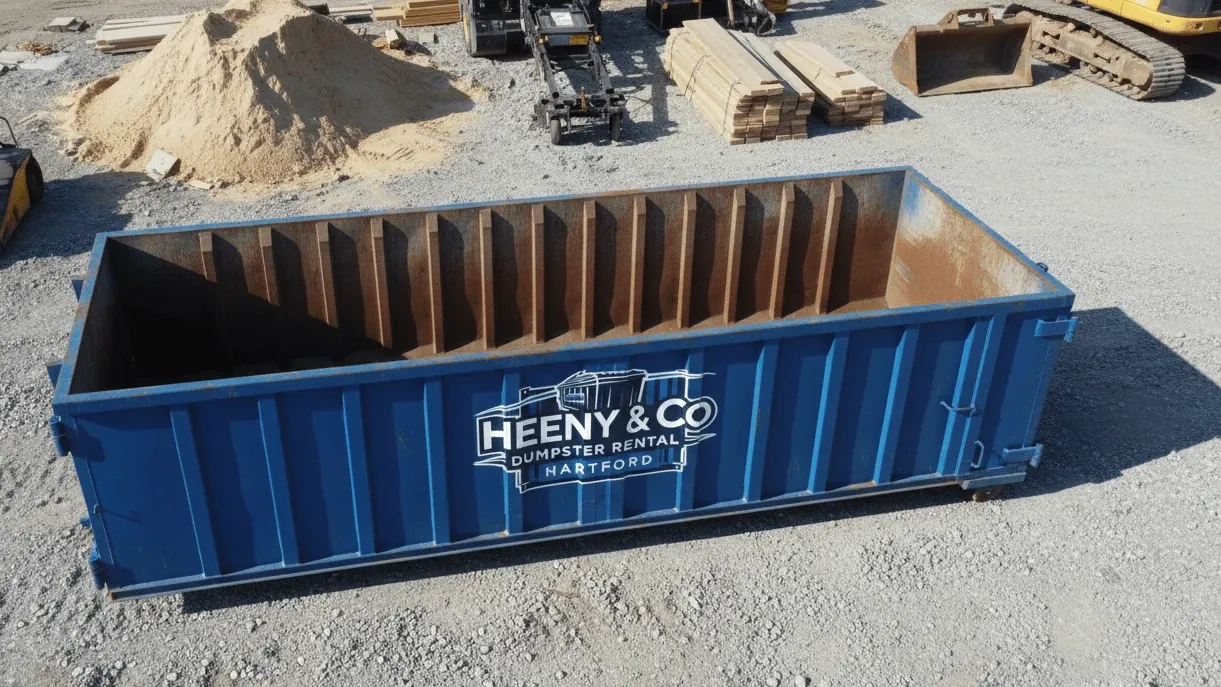
A 15 yard roll-off is around sixteen feet long, eight feet wide and about four feet tall — roughly four to six pickup loads. It is the middle of the small end: more room than a 10 without the twenty-two foot footprint of a 20, which matters a great deal on Hartford's shared drives and tight side lots. Think of it as one room done properly, or one clearly bounded job, rather than a container you keep going back to for the whole house.
- Capacity15 cubic yards
- Footprint16 ft x 8 ft x 4 ft
- Weight allowance2 – 3 tons
- Holds about~4 – 5 pickup truck loads
Why people choose the 15 yard
The 15 exists for jobs with an edge around them. A kitchen out to the studs, a bathroom rip-out, a bedroom stripped, a garage emptied, an attic cleared over a hard weekend, a small tear-off, a hedge line removed. What those have in common is that you can see the end of them from the start, which is exactly what makes a mid-size container sensible: you are not rationing space, and you are not paying to move air. In a Hartford multifamily this is the box that handles one flat's bathroom and kitchen at the same time, or the storage bays in a cellar without the rest of the cellar. If the job keeps expanding as you look at it — and cellars in this city do — the honest answer is the next size up rather than a second 15. Tell us at the booking whether the job has a hard edge or an open one, because that single answer moves the recommendation further than the room count does.
Material still governs, and in Hartford the material tends to be older and denser than people expect. About half the city's housing predates 1950, so a kitchen strip-out here often means plaster and lath rather than sheet rock, tile bedded in mortar rather than thinset on board, a cast-iron tub, and cabinetry built in place from solid timber. The metal comes out first, because scrap metal is a mandatory recyclable in Connecticut under CGS section 22a-241b and must be separated from other building material wastes. Corrugated cardboard is the other mandatory separation and it accumulates fast if new units are being delivered in boxes. After those two, CT DEEP's own guidance is that the easiest and most common way to manage construction waste is to commingle most of it into one roll-off, so the rest of the room can go in mixed. Keep those two separations honest and what is left is an ordinary Hartford load: cabinetry, trim, flooring, insulation, doors and the packaging the new units arrived in.
The third thing the 15 does well is act as the heavy box on a two-container job. On a whole-flat gut in a Perfect Six, the volume argument says one big container and the weight argument says one small one, and both are right about different material. Running a 30 for the cabinetry, framing and general debris alongside a 15 for the plaster, tile and masonry means each box goes out at the right weight, neither is carrying the other's problem, and you are not paying to move a half-empty container that has reached payload. Load by material rather than by whichever pile is nearest the door. It takes a little more discipline on site and it is consistently cheaper than the alternative. In practice that means two piles rather than one heap by the door, and it is the habit that separates a job which finishes on schedule from one that stalls waiting on a container nobody can lift.
Good fit for
- A kitchen or bathroom stripped to the studs
- One bedroom or living room gutted
- A garage or storage bay cleared out
- A hard weekend in a three-decker attic
- A small to mid-size roof tear-off
- Hedge, shrub and fence line removal
- The heavy box on a two-container job
- Mixed masonry with timber through it
Not the right size for
- A whole flat turned over between tenants
- Cellar and attic in the same weekend
- A full Perfect Six unit gutted
- Pure concrete or brick rubble
- Foundation spoil off a 42 inch dig
- Wet cellar contents in quantity
- Whole-house furniture clearances
- Commercial fit-outs and shop fittings
- Office partitions and ceiling grid
- Large storm and tree debris jobs
- Estate clearances of a whole house
- Anything with asbestos in it
- Paint, adhesives, oils or tars
- Electronics and mattresses
Will it fit?
At around sixteen feet the 15 is still an easy box to place, and in Hartford that is worth real money. It goes onto a narrow shared drive between two multifamily houses where a twenty-two foot container will not swing, and it sits low enough that material can be lifted in over the side rather than carried round to the door. The truck still needs about sixty feet of straight approach, roughly ten and a half feet of width, and twenty feet or more of overhead clearance for the hoist to stand the box up as it comes off the rails. Overhead is what stops sets here: mature maple and oak arch over residential streets across the West End, Asylum Hill and Barry Square, and the electrical service drop runs beneath the canopy from the pole to the house. Look up before you book. Protection boards go under the wheels on every delivery and we photograph the approach on arrival, because Hartford drives are mostly older concrete and asphalt with freeze-thaw cracking already in them. Raised granite kerbing changes where the boards go, so mention it. Connecticut has no per-dumpster fire permit, but IFC 2021 section 304.3.3 keeps any container of 1.5 cubic yards or more out of buildings and at least five feet from combustible walls, openings and combustible roof eave lines, which on a tight side lot is often the constraint that picks the spot. If it has to go in the street, that is an Obstruction Permit at $50 plus three cents per square foot per day, from the Permit Division on 860-757-9970.
Before delivery, move cars and bins, mark irrigation heads and septic lids, and tell us about new concrete, soft ground, a steep grade or low power lines. Our delivery and driveway protection guide covers all of it.
Compare all four sizes
| Size | Footprint | Weight allowance | Holds about | Best for |
|---|---|---|---|---|
| 10 Yard Dumpster | 12 ft x 8 ft x 3.5 ft | 2 – 3 tons | ~3 pickup truck loads | Concrete, brick, plaster and foundation spoil — weight fills it long before volume does. |
| 15 Yard Dumpster | 16 ft x 8 ft x 4 ft | 2 – 3 tons | ~4 – 5 pickup truck loads | A single room, a small tear-off, or one unit of a multifamily turnover. |
| 20 Yard Dumpster | 22 ft x 8 ft x 4.5 ft | 3 – 4 tons | ~6 – 8 pickup truck loads | A full basement and attic clear-out — the New England default — or a multi-room remodel. |
| 30 Yard Dumpster | 22 ft x 8 ft x 6 ft | 4 – 5 tons | ~9 – 12 pickup truck loads | A whole Perfect Six or three-decker with basement and attic, or a large remodel. |
| 40 Yard Dumpster | 22 ft x 8 ft x 8 ft | 5 – 6 tons | ~14 – 16 pickup truck loads | Bulky light debris only: porch framing, fencing, siding, insulation, fit-outs. |
Still not sure? Describe what you are throwing away and we will size it on the phone in two minutes. Getting it wrong costs us more than it costs you, so we have every reason to get it right. Call (959) 666-6427.
Book a 15 yard
Flat rate including delivery, pickup, rental period and disposal. Same-day where we can.
(959) 666-6427Other sizes
Popular services
All sizes
Compare our four roll-off containers
10 Yard Dumpster
Concrete, brick, plaster and foundation spoil — weight fills it long before volume does.
View this size → 15yd³15 Yard Dumpster
A single room, a small tear-off, or one unit of a multifamily turnover.
View this size → 20yd³20 Yard Dumpster
A full basement and attic clear-out — the New England default — or a multi-room remodel.
View this size → 30yd³30 Yard Dumpster
A whole Perfect Six or three-decker with basement and attic, or a large remodel.
View this size → 40yd³40 Yard Dumpster
Bulky light debris only: porch framing, fencing, siding, insulation, fit-outs.
View this size →15 Yard Dumpster FAQs
Is a 15 big enough for a kitchen?
For most Hartford kitchens, yes, provided the plaster is not the majority of the load. Cabinets, counters, appliances, flooring and trim from a single kitchen fit comfortably. What changes the answer is what is behind the cabinets: in a pre-1950 house that is usually keyed plaster on wood lath, which is dense and heavy, and if the whole room is coming back to the studs the plaster alone can dominate the weight. The tub and the copper come out for scrap either way, because scrap metal is a mandatory recyclable in Connecticut. If the walls are coming out too, ask us about a 10 for the plaster alongside.
Can I use it for a roof tear-off?
For a small to mid-size roof, yes. Roofing is sized by squares and layers rather than by rooms: a single layer of three-tab runs roughly two hundred and fifty pounds a square and architectural shingle is heavier, so a second layer roughly doubles the weight without doubling the volume. A 15 handles a mid-range Hartford roof at one layer, or a smaller roof carrying two. Flashing, drip edge, valley metal and any gutter coming down are scrap metal and come out of the load. If the decking is also coming off, plan a swap rather than a bigger box.
What is the difference between a 15 and a 20 in practice?
Footprint, mostly. A 15 is around sixteen feet long and a 20 is around twenty-two, and on a narrow shared Hartford drive those six feet decide whether the box goes in at all. In volume terms the step is real but not dramatic; in placement terms it can be the whole question. Our rule of thumb is that a bounded single-room job takes a 15, and anything measured in flats, floors or whole cellars takes a 20. If you are genuinely between the two and the drive is tight, take the 15 and plan a swap rather than finding out the 20 cannot be set.
Can I load it over the side?
Yes, and that is part of what makes this size useful. At about four feet tall the walls are low enough for two people to lift material in over the rim, so you are not restricted to carrying everything round to the swing door. Tell us at the booking which side you want the door on and where the material is coming from, and the driver will set the box that way. What you should not do is heap material above the rim: an overloaded box cannot be tarped, cannot be taken legally, and material sitting proud of the sides is what comes off on the road.
How long can I keep it?
As long as the job needs. Most one-room jobs run a week to a fortnight and there is no reason to rush a container off your own drive. Ring the yard on (959) 666-6427 when you want it collected and we will fit it into a Capitol Region route. Keep it tarped if wet weather is due, because plaster, carpet and cardboard gain weight fast in the rain and that is what tips a load past payload. If the box is in the street under an Obstruction Permit, remember the city charges per square foot per day, so a street set is worth finishing promptly.
Services
What people put in a 15 yard
Residential Dumpster Rental
Driveway placement for full-basement, attic, porch and shed cleanouts and remodels.
Learn more →Commercial Dumpster Rental
Containers for businesses and buildings over six units, which the City does not collect from.
Learn more →Construction Dumpster Rental
Mixed C&D in one roll-off, the way CT DEEP recommends, with next-day swap-outs.
Learn more →Roofing Dumpster Rental
Weight-rated cans sized by squares and layers for asphalt shingle tear-offs.
Learn more →Roll-Off Dumpster Rental
10, 15, 20, 30 and 40 yard roll-offs across Hartford and the Capitol Region.
Learn more →Same-Day Dumpster Rental
Call before the cut-off and we can usually get a container to you this afternoon.
Learn more →Talk to a real person
Need a 15 yard in Hartford?
Tell us what you are clearing out and we will tell you the right size and the flat price to put it in your driveway. No forms, no waiting on an email — just call and we will sort it out in a couple of minutes.
Serving Hartford, the Capitol Region and Greater Hartford · Mon–Fri 6:30am–5pm, Sat 7am–1pm