
Delivery
Driveway Protection on a Hartford Dumpster Delivery
Hartford driveways come apart from 125 freezing nights a year, not from summer heat. How we set a loaded roll-off on a narrow multifamily lot without leaving a mark, and why five feet from the eave line decides the spot.
Nobody books a container thinking about their driveway. Then the truck backs in, the arm tips up, and several tons of steel rolls down onto the surface the family parks on every day. We have been setting roll-offs out of 192 Ledyard Street since 2014, and placement is the part of the job we take slowest. In Hartford the question is rarely whether the surface is strong enough. It is whether thirty Connecticut winters have already loosened what sits underneath it, and whether the arm can clear what hangs over it.
How a roll-off actually gets on the ground
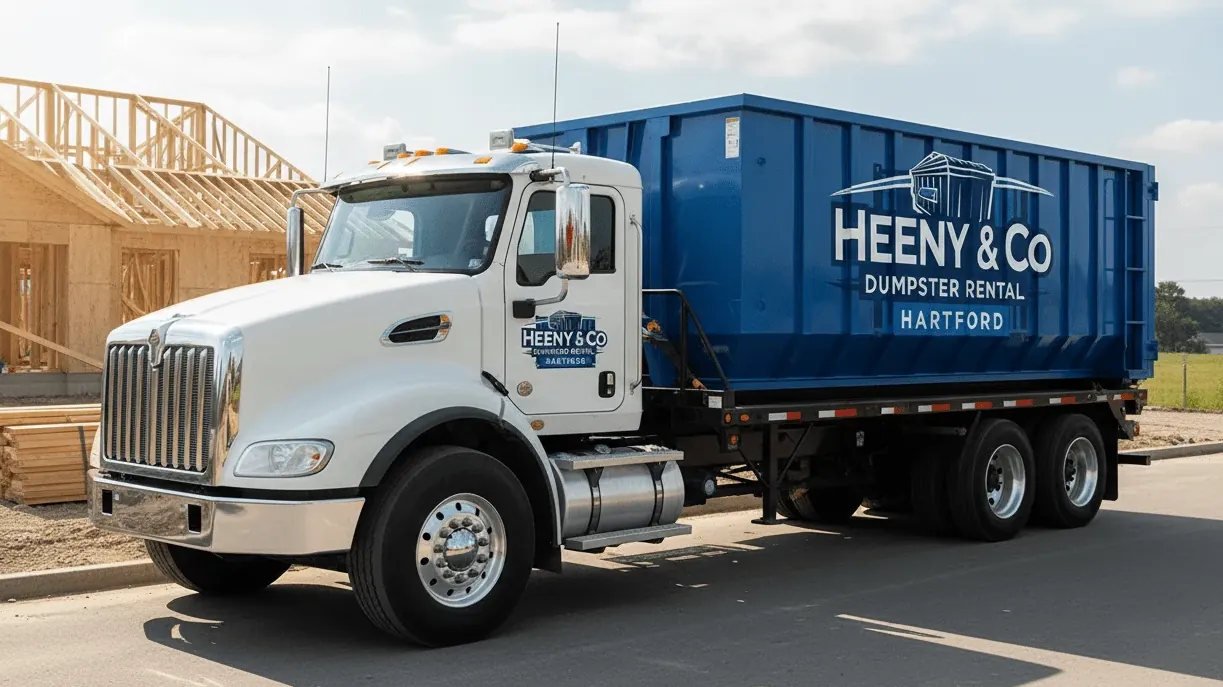
A roll-off is placed with a cable hoist. The truck backs in, the arm tips up, the cable pays out, and the container runs down the rails at the back of the chassis on its own rear wheels until it is on the ground and the truck pulls out from under it. Nothing is lifted and lowered gently: the box rolls off the back, and for a few seconds most of its weight rides on two small steel wheels.
Once it is down, a container does not rest on its floor. It sits on two steel rails running the length of the box, plus that pair of rear wheels, so the weight arrives through a handful of small contact patches rather than spreading across the footprint. That is point loading, and it is the whole of the driveway problem. A car spreads its weight over four soft tyres and never dwells; a loaded box is a static line load in one place for a week or two. Footprints for the 10, 15, 20, 30 and 40 are on the dumpster sizes page.
And the truck is heavier than the box it carries. It crosses the same ground twice, on delivery and again on the pull, so its wheel path over the apron matters as much as where the container lands.
What the truck needs
- About 60 feet of straight approach for truck and container together. Not 60 feet of driveway — 60 feet of line the driver can back down without swinging the tail.
- About 10.5 feet of width for the truck and its mirrors, measured at the pinch point rather than at the kerb.
- 20 feet or more of clear overhead while the hoist is working.
The overhead figure is the one people get wrong, always for the same reason: they measure the box. The box is not what stops the job. The arm is. A hoist at full tip reaches far above the roofline of the truck, so a limb or a service drop at fourteen feet is nothing to a car and an absolute stop for us. If the arm cannot come up, the container cannot come off, and there is no careful version of trying anyway.
Protection boards go down on every residential set
The answer to point loading is not complicated and it is not an upgrade. Boards ride on the truck and go under the rails and wheels on every residential set without you asking. They spread the load instead of letting it concentrate. On a thin old pour or a frost-lifted panel they get doubled.
The second thing on arrival is a photograph. The driver shoots the approach and the set spot before anything touches the ground, and again at the pull. A great many Hartford driveways already carry a hairline crack, a settled panel or a lifted edge before our truck turns into the street, and with a picture from the moment we arrived, nobody argues three weeks later about a crack that was already there.
The New England driveway problem is freeze-thaw, not heat
This is where most national dumpster advice misleads you, because most of it is written for hot climates. There the worry is asphalt going soft in the afternoon under a steel rail and holding the print once it cools, and the advice is to schedule the delivery for a cooler part of the day. That is the opposite of our case. It was not written for a Connecticut driveway.
Our problem is freeze-thaw. Hartford's official climate station at Bradley Airport records 124.9 nights a year at or below 32°F and about 40.5 inches of snow. Water gets into every joint and hairline crack, freezes, expands and levers it a fraction wider, well over a hundred times a year, every year. Frost also moves the ground itself: heave lifts a slab in January and drops it in March, and the panel never lands quite where it started.
So an asphalt drive that has been through thirty Connecticut winters is already cracked, already lifted at the edges, and sitting on ground that has heaved and settled dozens of times. That is what this climate does to flatwork, and our truck is not what started it.
Spring thaw is the genuine risk window
If there is one time of year to think hard about placement, it is the thaw. Frost coming out of the ground leaves the sub-base soft and saturated under a surface that looks perfectly solid from above. A driveway that carried a loaded truck in October can rut or crack at a joint in late March, and lawns and gravel are worse again. In spring we set on the firmest run we can reach, we double the boards, and if the ground is soft enough to worry us we would rather move the delivery a day than leave you with a repair.
Hartford lots are their own problem
Hartford was built dense and built early — half the housing stock predates 1950, and 81 percent of it is multifamily. These streets were laid out for carts and a streetcar. What the driver is assessing when he pulls up:
- The shared driveway. A narrow strip between two multifamilies in Frog Hollow or Barry Square, often serving eight or ten households, frequently with no turnaround. It is often under 10.5 feet at its pinch point, and the pinch point is usually a corner board, a porch post or a chimney base rather than the whole run.
- Granite kerbing. Hartford has a great deal of it, and it is not a rolled concrete kerb. Cut granite at a narrow apron is unforgiving, and it dictates the angle the truck can take into the drive.
- Street parking both sides. With 25.7 percent owner-occupancy and more cars than off-street spaces, the kerb is full from late afternoon. Morning deliveries work; four o'clock deliveries often do not.
- The bulkhead. Most of these houses have a full cellar and a bulkhead, and it must not be blocked. It is egress and it is a route in for a fire crew.
- Overhead service drops. The wires from pole to house, which on these older lots cross the drive at exactly the height the arm needs.
- Mature maples and oaks. A century of canopy over a narrow drive. A limb that clears a van by a foot will not clear a hoist at full extension, and the trimmings are their own yard waste load.
Winter: snowbanks and plough windrows
From December to March the surface is not the only variable. A plough windrow at the end of the drive is a dense berm a truck cannot push through, and a snowbank narrowing a shared drive from ten feet to eight makes the set impossible even though the ground underneath is fine. Piled snow also hides the kerb line, the apron edge and the bulkhead. So the request is plain: clear the drive and the set spot down to the surface before the truck comes, and clear enough width for the mirrors, not just for a car. A container standing in a Hartford street in January is also a plough obstruction, which is a good way to have it buried or struck.
The five-foot rule decides placement more often than people expect
This surprises people who have rented containers in other states, and it is worth reading twice because half the dumpster advice on the internet has the number wrong for Connecticut.
IFC 2021 §304.3.3, as adopted by the 2022 Connecticut State Fire Safety Code, provides that dumpsters and containers with an individual capacity of 1.5 cubic yards or more shall not be stored in buildings or placed within five feet of combustible walls, openings or combustible roof eave lines. There are exceptions for containers in areas protected by an approved automatic sprinkler system, and for dedicated Type I or Type IIA structures located at least ten feet from other buildings.
Every roll-off we run is well over 1.5 cubic yards, so the rule applies to all of them, on private property as much as in the street. And note what it names: not just the wall, but openings and the combustible eave line. On a Hartford lot with a wood-frame three-decker standing three feet off the property line and a side yard ten feet wide in total, that five feet is very often the binding constraint — it rules out the spot tight against the clapboard that everybody suggests first, and sometimes there is no compliant spot on the side of the house at all. The box goes at the head of the drive instead.
| Question | Connecticut answer |
|---|---|
| Container size the rule applies to | 1.5 cubic yards or more — every roll-off |
| Distance from combustible walls, openings, eave lines | Five feet, IFC 2021 §304.3.3 |
| Inside a building | Not permitted |
| Exceptions | Sprinklered areas; dedicated Type I / IIA structures 10+ feet from other buildings |
| Per-dumpster fire permit | None in Connecticut |
Five feet is the Connecticut figure. Massachusetts uses ten, and most US dumpster content quotes one number or the other without ever saying which state it means. If you have read a figure somewhere and it was not attached to a code citation and a state, treat it as noise. Connecticut requires no per-dumpster fire permit — the only rubbish entry in the state fire prevention code permit table is a permit to operate a commercial rubbish-handling business, not a permit for a container on a driveway. This is a placement rule, not a paperwork rule. Individual municipalities may add local fire-marshal requirements, so on a genuinely tight lot it is worth a call before the truck is loaded.
If it has to go in the street
Hartford's Public Works Permit Division issues an Obstruction Permit for temporary occupation of the public right-of-way. The published figures are $50 plus $0.03 per square foot per day, with a $10,000 performance bond and a certificate of liability insurance. The Permit Division is on 860-757-9970.
One honest caveat. The city's own Rules and Specifications document never uses the word "dumpster." The Obstruction Permit is plainly the instrument that would apply to a container occupying a travel lane or a parking lane, but we are not going to tell you Hartford issues a "dumpster permit" by name when its published rules do not say so. Call the Permit Division, describe the container and the location, and let them tell you what they want. More detail is in our guide to dumpster permits in Hartford, and the city's pages are at hartfordct.gov.
Condominiums: the driveway is usually not yours to lend
In a condominium the driveway and parking area are almost always common area under the Connecticut Common Interest Ownership Act, held for the benefit of all unit owners rather than any one of them. So a unit owner cannot unilaterally authorise a container on it, however reasonable the request and however obviously the space belongs to their unit in practice. The association has to consent. We ask every time, because a box set on common area without board approval becomes the unit owner's problem inside a day.
Worth knowing alongside that: Hartford's city collection stops at six units — a single family home, a multifamily of six units or less, or a condo association of six units or less. Any larger association is already a private-hauling customer. The statutes are at cga.ct.gov.
The pre-delivery checklist
- Measure the approach: roughly 60 feet of straight line, 10.5 feet of width at the pinch point, 20-plus feet of overhead.
- Move the cars the night before, and on a shared drive talk to whoever else parks there. One car left in place costs everybody the delivery.
- Clear the snow down to the surface, windrow at the apron included.
- Mark the spot with a cone or a scrap of two-by-four, and text us a photograph of it.
- Look up and tell us about the service drop and any limbs over the drive.
- Flag the bulkhead, and any oil fill or vent pipe on that side of the house.
- Say what the surface is — asphalt, concrete, gravel or lawn. Four different conversations.
- Say what is going in it — tear-off, cellar cleanout, kitchen gut, soil and stumps. That is how we bring the right box first time; our sizing guide works it through.
What we will not do
- Run a loaded truck across a soft spring lawn to save you a walk. The ruts outlast the rental by years.
- Set a box where the arm cannot clear a service drop.
- Leave a container somewhere it will have to be moved. That is a second visit.
Tell us about the driveway before the truck rolls
Heeny & Co Dumpster Rental Hartford runs out of 192 Ledyard Street, in the South Meadows, behind the wall the city built after the 1936 flood. Declan Heeny started with one truck and four cans in 2014 and still answers the phone, which is why the detail is worth the call: the surface, the width at the tightest point, what hangs over the drive, where the bulkhead is, and whether the drive is shared. If the spot will not work, we would rather say so before the truck is loaded. Call (959) 666-6427 or use the contact page.
Questions this guide did not answer? Call (959) 666-6427. We would rather spend two minutes on the phone than have you order the wrong container.