
Farmington, CT · the Capitol Region
Dumpster Rental in Farmington, CT
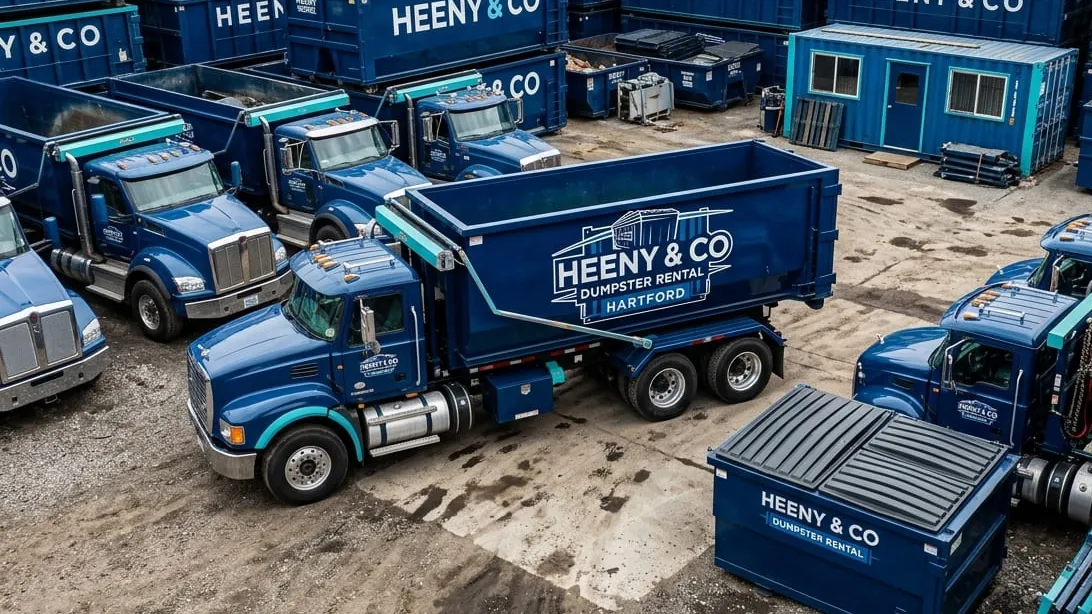
Roll-off containers delivered to Farmington from our Hartford yard — about 10 miles west of our Ledyard Street yard. Flat rates, driveway protection as standard, and same-day delivery when we can get a truck free.
Roll-off containers for Farmington homes and jobsites
Farmington is where the Capitol Region stops being a city and starts being the Farmington Valley. The town sits in the bend of the Farmington River with the traprock ridge behind it, and Main Street in Farmington village is one of the best-preserved eighteenth and nineteenth-century streets in New England — Miss Porter’s School has been on it for a very long time, and Hill-Stead, the house Theodate Pope Riddle designed and filled with Impressionist paintings, sits above it. Unionville, the mill village on the western side, is a different town in everything but name: tighter, later, industrial, built around the river and the canal.
Then there is the modern town. The UConn Health campus on Route 4 and the corporate development along the I-84 corridor make Farmington a working weekday place with a lot of commercial fabric, and the residential building runs from colonial through interwar into a heavy layer of post-war and modern subdivision on the hillsides.
For a container that means three quite different sets of constraints inside one town, and the historic streets are the ones that need the most care. Old Farmington lots have narrow, short drives, granite kerbing and mature hardwood — maple, oak, white pine — over the approach. We need the clearance to raise the arm, and we would rather see a photograph than turn up hopefully. Everything here sits on a 42-inch frost line, so full basements are the norm across all three kinds of housing, and the cellar is where most Farmington jobs actually start. The other regular Farmington job is the outdoor one: retaining walls, patios, pool surrounds and driveway rebuilds on sloping ground, which is why the digging rules matter more here than in most of the towns we serve, and why we ask about spoil before we ask about anything else.
What we know about working in Farmington
Farmington runs its own solid waste arrangements, like every other Connecticut town — there are 169 of them and no county layer standardising anything — so the household side is a question for the town and the renovation side is a question for a container. On the container: one mixed roll-off for construction and demolition debris is legal here and is what CT DEEP recommends rather than merely permits. There is no Connecticut waste ban list to work through and no recycling quota imposed on the processors. The two mandatory separations on a renovation job are corrugated cardboard and scrap metal, under CGS §22a-241b and RCSA §22a-241b-2. Excluded from the container by statute: asbestos, clean fill, hazardous waste above de minimis, radioactive material and liquid or semi-liquid materials including adhesives, paints, oils and tars. The digging rules matter more in Farmington than in most of our area, because so much work here involves footings, retaining walls, pools and driveway rebuilds on sloping ground. Connecticut is served by Call Before You Dig under CGS §16-345 et seq. — and the mark-out has to be booked before anything goes into the ground, including a stump, a fence post or a footing at the 42-inch frost depth. Book it at cbyd.com. On placement, five feet clear of combustible walls, openings and roof eave lines under IFC 2021 §304.3.3, and on the older village lots that usually means the drive rather than the side passage.
- Regionthe Capitol Region
- Distance from our yard10 miles west of our Ledyard Street yard
- Main routesI-84 west from the Hartford ramps to the Farmington exits, which is the main line for the whole town
- Typical deliverySame or next day
Getting a truck to you
I-84 west from the Hartford ramps to the Farmington exits is our normal line and takes about twenty-five minutes off-peak. Farmington Avenue west through West Hartford is the surface alternative and is often pleasanter mid-morning. Route 4 carries us through Farmington village for the centre and the UConn Health campus, and Route 177 runs north and south through Unionville for the western end. Before we book we want the street and number, whether the box goes on the drive or the street, the drive width and surface, the overhead clearance — that is the usual limit on the village streets — and a clear description of what is going in it.
Routes we run: I-84 west from the Hartford ramps to the Farmington exits, which is the main line for the whole town, Farmington Avenue west out of Hartford through West Hartford and on toward the Farmington line, Route 4 west through Farmington village for the centre and the UConn Health campus, Route 177 north and south through Unionville for the western end of the town.
Landmarks and neighborhoods we work around
Local landmarks
- the Farmington Main Street historic district
- the Hill-Stead Museum
- Miss Porter’s School on Main Street
- the Unionville village centre and the old mill buildings
- the Farmington Canal Heritage Trail
Neighborhoods & communities
- Farmington village
- Unionville
- the Route 4 and UConn Health corridor
- Talcott Notch
- the I-84 corporate corridor
Permits, streets and placement in Farmington
On a private driveway in Farmington the placement question is not really a permit question at all, and that surprises nearly everybody. Connecticut has no per-dumpster fire permit. The only rubbish entry in the state fire code permit table is a permit to operate a commercial rubbish-handling business, and that one is ours to hold rather than yours. What the state has instead is a placement rule. Under IFC 2021 §304.3.3, adopted in the 2022 Connecticut State Fire Safety Code, a container with an individual capacity of 1.5 cubic yards or more must not be stored in a building or placed within five feet of combustible walls, openings or combustible roof eave lines. Five feet is the figure, whatever the dumpster pages written for other states tell you. Every roll-off we run is well over 1.5 cubic yards, so the rule reaches a 10 yard in a Farmington driveway just as much as a 40 yard on a commercial site, and it is the reason the open side of the drive beats the narrow gap beside the house. Keep the box clear of exits, fire-apparatus access and hydrants as well, and no flammable or combustible liquids go in it. A local fire marshal can add requirements of his own, so if the only workable spot is tight against the building, it is worth a call to the fire marshal covering Farmington before we deliver. For a container that has to sit in the public way in Hartford the instrument is the Obstruction Permit from the city’s Public Works Permit Division — temporary obstruction of the public right-of-way, $50 plus $0.03 per square foot per day under the published Rules and Specifications, with a $10,000 performance bond and a certificate of liability insurance. That document never uses the word dumpster, so ring the Permit Division on 860-757-9970 and ask how they want it handled. Outside Hartford the same call goes to the town’s own public works or engineering office, because the answer follows the address rather than any county line. Sidewalks, hydrants and fire lanes stay clear either way. Sort the approval before you book the delivery. It is a ten-minute call that saves a week.
Two more rules reach every job we run, and both are state rules rather than local ones. The first is asbestos, and Connecticut splits it three ways. The Department of Public Health takes the abatement notification and licenses the people who do the work, on ten days’ notice. CT DEEP issues the $300 Special Waste and Asbestos Disposal Authorization that lets the material move. The DAS Office of the State Fire Marshal licenses demolition contractors. The trap on an older Farmington house is that Connecticut is stricter than the federal rule: RCSA §19a-332a-1 defines a facility to include residential buildings, single-family homes expressly included, so there is no owner-occupied carve-out here, and a demolition notification is required for any structure taken down, whether or not asbestos is present. CT DPH publishes a factsheet on asbestos-containing siding shingles in particular, which is a live issue on pre-1940 stock. We cannot take asbestos-containing material in any container. Anything built before 1978 also carries lead paint under the federal RRP rule, and lead paint chips are one of the materials Hartford’s bulky programme refuses outright. The second rule is what may not ride in a construction load: CGS §22a-208x excludes asbestos, clean fill, hazardous waste, radioactive material and liquids — adhesives, paints, oils and tars from construction and demolition waste, and corrugated cardboard and scrap metal are mandatory recyclables under CGS §22a-241b, so they come out of the load and cannot be mixed back in once they are separated. Everything else can be commingled — CT DEEP’s own guidance is that most construction waste is best managed in one roll-off taken to a processing facility. That is why we ask what is going in the box before we quote, and it is not fussiness. Before anything is dug, trenched or a stump pulled, call Call Before You Dig on 811, as CGS §16-345 et seq. requires; Connecticut is CBYD territory. Our permit and placement guide walks through the whole process, and collection, drop-off and bulk-item details are published by the City of Hartford.
The ground is the other local variable, and here it is the frost line that decides both the container size and the approach. Connecticut works to a 42-inch frost depth, so footings in Farmington reach three and a half feet regardless of what sits on top — and once the hole is that deep, a full basement costs almost nothing more, which is why so much of the pre-war housing here has one. Two practical consequences follow. A cleanout starts a floor lower than a sizing guide written for the south would assume: the basement and the attic are the job, and what comes up the bulkhead stairs is storm windows, paint tins, furniture, a workbench and thirty years of boxes. And frost heave, the spring thaw and plain groundwater keep the heavy work coming — footing and foundation spoil, broken concrete and brick out of a cellar floor or a front walk, plaster off a gutted six-family, and wet basement contents after water has come in. All of that is heavy for its volume, so it rides in a small container, often in two hauls rather than one big box, and the wet clay it comes out of weighs a good deal more in April than it does in August. Access moves with the season as well: snowbanks and the plough windrow narrow a drive that took a 30 yard in October, granite kerbing and cars parked both sides of the street decide how much swing the truck has on the older blocks, shared drives between multifamily houses are tighter than they look, and on gravel approaches we would rather move you a day than leave ruts through soft spring ground. Where it all ends up is the part people assume and get wrong. The MIRA trash-to-energy plant in Hartford’s South Meadows has closed, Connecticut has no active MSW landfills, and the state exports a large share of its municipal solid waste — so disposal here is a distance and logistics problem rather than a question of what is banned. A mixed construction load in one box is perfectly legal, and it is what CT DEEP recommends. Household quantities are a different route: Hartford residents take those to the Bulky Waste and Recycling Center, 180 Leibert Road, Tuesday to Saturday, 8:45 a.m. to 1:45 p.m., on a green permit for recyclables, free; a blue residential permit at $10.00 for four visits; or a red commercial permit at $50.00 plus a per-load charge — half a ton $40, three-quarters $60, a ton $85 — and that red permit names handymen and landscapers and stops at a one-ton load or a 16-foot trailer. Mattresses and electronics are free there, because Connecticut’s producer-funded stewardship programmes pay for them. Paint, solvents, automotive fluids, batteries and pool chemicals never ride in a container: household hazardous waste for Hartford goes to the MDC Operations Facility at 125 Maxim Road. Every town around us answers all of this differently, because Connecticut has 169 towns, each running its own solid waste arrangements with no county layer above them — the answer changes at the town line.
Sizes we deliver to Farmington
10 Yard Dumpster
Concrete, brick, plaster and foundation spoil — weight fills it long before volume does.
View this size → 15yd³15 Yard Dumpster
A single room, a small tear-off, or one unit of a multifamily turnover.
View this size → 20yd³20 Yard Dumpster
A full basement and attic clear-out — the New England default — or a multi-room remodel.
View this size → 30yd³30 Yard Dumpster
A whole Perfect Six or three-decker with basement and attic, or a large remodel.
View this size → 40yd³40 Yard Dumpster
Bulky light debris only: porch framing, fencing, siding, insulation, fit-outs.
View this size →Delivering to Farmington today
Call before about 11am and we can usually get a container to Farmington the same afternoon.
(959) 666-6427Popular in Farmington
Services in Farmington
What we haul in and out of Farmington
Junk Removal Dumpsters
Clear a full basement, attic, porch or shed on your own schedule.
Learn more →Estate Cleanout Dumpsters
Discreet, patient container service for families clearing a lifelong home.
Learn more →Residential Dumpster Rental
Driveway placement for full-basement, attic, porch and shed cleanouts and remodels.
Learn more →Yard Waste & Brush Removal
Separate clean loads — Connecticut bans grass clippings from solid waste facilities.
Learn more →Roofing Dumpster Rental
Weight-rated cans sized by squares and layers for asphalt shingle tear-offs.
Learn more →Roll-Off Dumpster Rental
10, 15, 20, 30 and 40 yard roll-offs across Hartford and the Capitol Region.
Learn more →How it works
Delivering to Farmington in four steps
- 1
Call us
Tell us the project, your address and when you want it. Two minutes on the phone and you have a flat price.
- 2
We deliver
Our driver walks the drop, lays protection boards and sets the container exactly where you want it.
- 3
You load it
Take your time within your rental window. Keep it level with the top rail and we handle the rest.
- 4
We haul it
Call or text when you are done. We pull it, sort what can be recovered and dispose of the rest properly.
Dumpster Rental in Farmington — FAQs
Who do I call before digging footings for an addition?
Call Before You Dig, every time. Connecticut is a CBYD state under CGS §16-345 et seq., and it is a separate organisation from the notification centre that serves Massachusetts, Rhode Island, New Hampshire, Maine and Vermont — that one does not cover this state. Book the mark-out at cbyd.com or by phone before excavation starts. The frost line here is 42 inches, so footings are going deep enough to find anything that is down there: gas, water, electric, telecoms, and on older properties an oil line nobody remembered. Then call us about the spoil.
Can we get a container onto a Farmington village drive?
Often, but it is a question about height as much as width. Those drives are short, the kerbing is granite and the maples and oaks over them have had a very long time to grow. We need clear space above the truck to raise the arm and slide the box off, not just floor area for the container to sit on. Send us a photograph of the drive and what is above it and we will tell you straight whether it is a 10, a 15, or a conversation about setting the box at the kerb instead.
Do we have to separate anything for a whole-house remodel?
Two things: corrugated cardboard and scrap metal. Those are mandatory recyclables in Connecticut under CGS §22a-241b, so the flattened boxes and the old ductwork, radiators, copper and steel come out of the load. Everything else in a normal remodel — plaster, lath, timber, cabinets, flooring, tile, fixtures, insulation — can go into one mixed roll-off, and CT DEEP says commingling like that is the ordinary way to manage renovation waste. Keep paint, adhesives, oils and tars out entirely, and stop if anything might contain asbestos.
How quickly can you deliver a dumpster to Farmington?
Farmington is about 10 miles west of our Ledyard Street yard, so it is a routine run for us. Same-day delivery is usually possible if you call before about 11am, and next morning otherwise. The week after a nor’easter or a hard wind event can stretch that, and so can the spring thaw when half the region opens a wet basement at once. We will tell you honestly when you call.
Do you charge extra to deliver to Farmington?
No. Farmington sits inside our standard service area and the flat rate is the same as it is in Hartford. Delivery, pickup, your rental window and disposal up to the agreed tonnage are all included in the number we quote you.
What size dumpster do most Farmington customers take?
A 20 yard is the most common by a wide margin — it suits kitchen guts, multi-room renovations and a full basement and attic cleanout in a multifamily, which is where most of the volume in this market actually lives. But if you are stripping shingle off a roof, breaking out a front walk, a patio slab or a cellar floor, or hauling footing and foundation spoil off a repair job, size DOWN to a 10 yard heavy container and take two hauls — that material hits the weight limit long before it fills the box.
Nearby
Towns we serve around Farmington
Talk to a real person
Need a dumpster in Farmington?
Tell us the job and the address and we will size it, price it flat and get a truck out. We run to Farmington most days, so a same-day slot is often available.
Farmington, CT · the Capitol Region · delivered from 192 Ledyard St, Hartford, CT 06114