
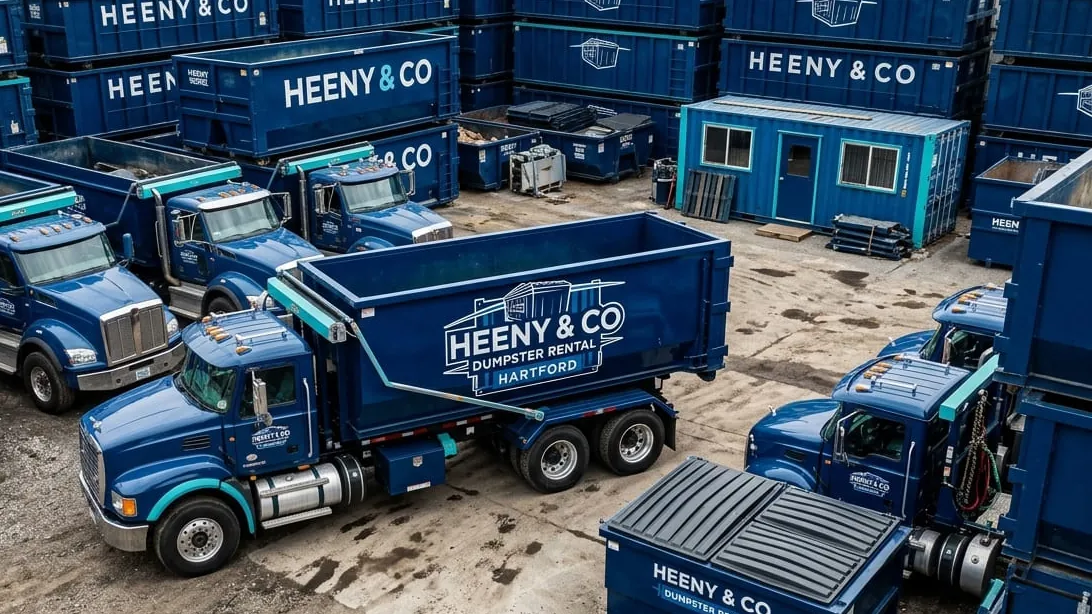
Whole property, whole project
30 Yard Dumpster Rental in Hartford, CT
The size for work that takes in a whole building or a whole programme: a Perfect Six unit emptied front to back with the cellar and the attic, a large remodel, an addition, or a builder job running for weeks. Same twenty-two foot footprint as the 20, half again the height, so the driveway question does not change but the weight discipline does. Fill it with plaster, masonry or wet cellar contents and it will pass payload while it still looks half empty.
A 30 yard roll-off is about twenty-two feet long, eight feet wide and roughly six feet tall — nine to twelve pickup loads. Same footprint as a 20 and half again the height, which means the access question is identical and the loading question is not. It is the container for whole-structure work, and it is also the box where weight discipline matters most, because the extra height makes it very easy to load past a legal payload without noticing.
- Capacity30 cubic yards
- Footprint22 ft x 8 ft x 6 ft
- Weight allowance4 – 5 tons
- Holds about~9 – 12 pickup truck loads
Why people choose the 30 yard
The 30 is the whole-project box. In Hartford that most often means a Perfect Six unit gutted front to back — three storeys of double-bow frontage, two flats to a floor, and one of them coming out to the studs including the cellar bay and the attic space. It also covers a large remodel across several rooms, an addition where the existing fabric comes out where the new work ties in, a builder job on an infill lot, and an estate clearance of a substantial single-family house. What those share is that the volume arrives over weeks rather than days, and the material is genuinely mixed: framing, cabinetry, flooring, trim, doors, windows, insulation, packaging, plus a proportion of plaster and masonry that has to be managed rather than ignored. On a job of that length the container is part of the programme rather than an afterthought, and the swaps want scheduling alongside the trades.
That proportion is the whole argument for how you load it. A 30 is tall enough that four or five tons will fit inside it long before the sides are full, and dense material is what gets you there. About half of Hartford's housing predates 1950 and was plastered over wood lath, so an interior gut here produces a keyed plaster debris that behaves much more like masonry than like modern board. Tile comes off with its mortar bed. Chimney brick, porch piers and old cellar floors are denser again. The disciplined approach on a job this size is to run a 10 or a 15 alongside for the heavy fraction and keep the 30 for the bulky light material. Loaded that way, both boxes leave at a legal weight and neither is carrying the other's problem. It also keeps the site tidier, because the heavy box can sit near the demolition and the bulk box near the fit-out rather than everything queueing at one door.
Two Connecticut rules shape what goes in. Corrugated cardboard and scrap metal are designated mandatory recyclables under CGS section 22a-241b, must be separated from other building material wastes, and may not be re-mixed once separated — on a job this size that means a real cardboard stack and a real metal pile, not an afterthought. Beyond those, CT DEEP's own guidance is that the easiest and most common way to manage construction waste is to commingle most waste into one roll-off, so the rest can go in mixed. What is excluded from the statutory definition of C and D waste under CGS section 22a-208x is short and absolute: asbestos, clean fill, hazardous waste above de minimis, radioactive material, and liquid or semi-liquid materials including adhesives, paints, oils and tars. Asbestos is the exclusion with no workaround at all, and Connecticut's rules expressly include single family homes under RCSA section 19a-332a-1.
Good fit for
- A whole Perfect Six unit gutted front to back
- Large multi-room remodels and additions
- Builder jobs running over several weeks
- Estate clearance of a substantial house
- Commercial fit-outs and office clear-downs
- Garage and outbuilding demolition
- Whole-house furniture and contents
- Mixed C and D with the heavy fraction split out
Not the right size for
- Concrete, brick and masonry rubble
- Foundation and footing spoil
- A cellar full of water-damaged contents
- Plaster as the majority of the load
- Tile in a mortar bed in quantity
- Roof tear-offs of any size
- Drives with under twenty feet of overhead
- Narrow shared multifamily access
- Any load with asbestos in it
- Paint, adhesives, oils and tars
- Electronics, banned since January 2011
- Mattresses, covered by state stewardship
- Grass clippings, banned under state law
- Clean fill, outside the C and D definition
Will it fit?
Same twenty-two foot footprint as the 20, so the driveway question is identical: about sixty feet of straight approach, roughly ten and a half feet of width, and twenty feet or more of overhead clearance for the hoist to stand a taller box upright. Overhead is the number that bites at this size. A maple or oak limb over the drive will stop a 30 going up where it would have cleared a shorter box, and the electrical service drop from the pole is right behind it. The six-foot side wants the set square, level and the loading side clear, which rules out most narrow shared drives between two multifamily houses in Frog Hollow, Barry Square and the South End. We take the drive as we find it: cracked and spalled concrete is normal in this city and freeze-thaw over decades is the cause, not a container that stood there for a fortnight. Protection boards go under the wheels on every set and we photograph the approach on arrival. Raised granite kerbing changes where the boards go, so mention it at the booking. Between December and March the snowbank and the plough windrow have to be cleared before the truck arrives. On the fire code: Connecticut has no per-dumpster fire permit, and the binding rule is IFC 2021 section 304.3.3, which keeps a container of 1.5 cubic yards or more out of buildings and at least five feet from combustible walls, openings and combustible roof eave lines. A street set needs an Obstruction Permit at $50 plus three cents per square foot per day, on 860-757-9970.
Before delivery, move cars and bins, mark irrigation heads and septic lids, and tell us about new concrete, soft ground, a steep grade or low power lines. Our delivery and driveway protection guide covers all of it.
Compare all four sizes
| Size | Footprint | Weight allowance | Holds about | Best for |
|---|---|---|---|---|
| 10 Yard Dumpster | 12 ft x 8 ft x 3.5 ft | 2 – 3 tons | ~3 pickup truck loads | Concrete, brick, plaster and foundation spoil — weight fills it long before volume does. |
| 15 Yard Dumpster | 16 ft x 8 ft x 4 ft | 2 – 3 tons | ~4 – 5 pickup truck loads | A single room, a small tear-off, or one unit of a multifamily turnover. |
| 20 Yard Dumpster | 22 ft x 8 ft x 4.5 ft | 3 – 4 tons | ~6 – 8 pickup truck loads | A full basement and attic clear-out — the New England default — or a multi-room remodel. |
| 30 Yard Dumpster | 22 ft x 8 ft x 6 ft | 4 – 5 tons | ~9 – 12 pickup truck loads | A whole Perfect Six or three-decker with basement and attic, or a large remodel. |
| 40 Yard Dumpster | 22 ft x 8 ft x 8 ft | 5 – 6 tons | ~14 – 16 pickup truck loads | Bulky light debris only: porch framing, fencing, siding, insulation, fit-outs. |
Still not sure? Describe what you are throwing away and we will size it on the phone in two minutes. Getting it wrong costs us more than it costs you, so we have every reason to get it right. Call (959) 666-6427.
Book a 30 yard
Flat rate including delivery, pickup, rental period and disposal. Same-day where we can.
(959) 666-6427Other sizes
Popular services
All sizes
Compare our four roll-off containers
10 Yard Dumpster
Concrete, brick, plaster and foundation spoil — weight fills it long before volume does.
View this size → 15yd³15 Yard Dumpster
A single room, a small tear-off, or one unit of a multifamily turnover.
View this size → 20yd³20 Yard Dumpster
A full basement and attic clear-out — the New England default — or a multi-room remodel.
View this size → 30yd³30 Yard Dumpster
A whole Perfect Six or three-decker with basement and attic, or a large remodel.
View this size → 40yd³40 Yard Dumpster
Bulky light debris only: porch framing, fencing, siding, insulation, fit-outs.
View this size →30 Yard Dumpster FAQs
If it has the same footprint as a 20, why not always take the 30?
Because the extra height is only useful for light material. A 30 will accept four or five tons long before the sides are full, and dense material gets you there quickly, so a 30 loaded with plaster, tile or wet cellar contents becomes a container that cannot legally leave. If your load is genuinely bulky and light — framing, cabinetry, furniture, packaging, siding — then yes, the 30 is more box for the same ground. If there is significant heavy material in the job, the better arrangement is a 30 for the bulk and a 10 or 15 alongside for the weight.
Will a 30 fit on a Hartford driveway?
If a 20 fits, a 30 will fit on the ground. The difference is above your head. The hoist has to stand a six-foot box upright as it comes off the rails, which needs twenty feet or more of clear height, and Hartford has a mature maple and oak street canopy with the electrical service drop running beneath it. A limb that a 20 would have cleared can stop a 30. Walk out, look up, and tell us what you see when you book. Where the overhead is marginal we would rather bring a 20 and swap it than send a truck that has to turn round.
What is the right way to load one?
Heavy material flat on the floor of the box, spread evenly rather than heaped at the door end, and light bulky material on top. Break things down rather than loading them whole; a dismantled cabinet run takes a third of the space of an intact one. Keep to the fill line rather than the rim, because a box heaped above the sides cannot be tarped and is not legal on the road. And keep the tarp on between sessions: on a job running for weeks, rain-soaked plaster, carpet and cardboard add real weight, and that is what turns a legal load into a problem.
Can I keep it for the whole job?
Yes, and on a builder job that is often the sensible arrangement. Ring the yard on (959) 666-6427 when it needs swapping and we will fit it into the route. The one thing worth planning is the phase: demolition weeks produce dense heavy material and fit-out weeks produce light bulky material, so a 30 that is perfect in week four may be the wrong box in week one. Where the programme has a heavy phase at the start, we would rather bring a 10 for that fortnight and the 30 afterwards than watch a single container fill with plaster and stop.
What has to be kept out of a 30 on a construction job?
Corrugated cardboard and scrap metal have to be separated, because both are mandatory recyclables under CGS section 22a-241b and cannot be re-mixed once separated. Beyond that the exclusions from Connecticut's statutory definition of C and D waste are asbestos, clean fill, hazardous waste above de minimis, radioactive material, and liquids including adhesives, paints, oils and tars. Everything else on a normal building job can go in mixed, which is what CT DEEP recommends. Asbestos is the one with no workaround: it is licensed abatement work notified to DPH, with a disposal authorization from DEEP, and it never rides in a container.
Services
What people put in a 30 yard
Residential Dumpster Rental
Driveway placement for full-basement, attic, porch and shed cleanouts and remodels.
Learn more →Commercial Dumpster Rental
Containers for businesses and buildings over six units, which the City does not collect from.
Learn more →Construction Dumpster Rental
Mixed C&D in one roll-off, the way CT DEEP recommends, with next-day swap-outs.
Learn more →Roofing Dumpster Rental
Weight-rated cans sized by squares and layers for asphalt shingle tear-offs.
Learn more →Roll-Off Dumpster Rental
10, 15, 20, 30 and 40 yard roll-offs across Hartford and the Capitol Region.
Learn more →Same-Day Dumpster Rental
Call before the cut-off and we can usually get a container to you this afternoon.
Learn more →Talk to a real person
Need a 30 yard in Hartford?
Tell us what you are clearing out and we will tell you the right size and the flat price to put it in your driveway. No forms, no waiting on an email — just call and we will sort it out in a couple of minutes.
Serving Hartford, the Capitol Region and Greater Hartford · Mon–Fri 6:30am–5pm, Sat 7am–1pm