
Sizing
What Size Dumpster Do I Need in Hartford, CT? A Sizing Guide
Roll-off sizing for Hartford: what each of the five sizes suits here, why a 42-inch frost line puts a full cellar under so much of the older stock, why 81% multifamily makes the building rather than the house the unit of work, and what has to come out of the load before you can size it.
Most sizing calls open with a project name. "We are clearing out a three-family off Wethersfield Avenue, what size do I need?" There is no answer inside a project name. But in Hartford there are two first questions a national calculator never asks, and between them they usually settle the box: does the building have a full cellar, and how many units are you actually emptying?
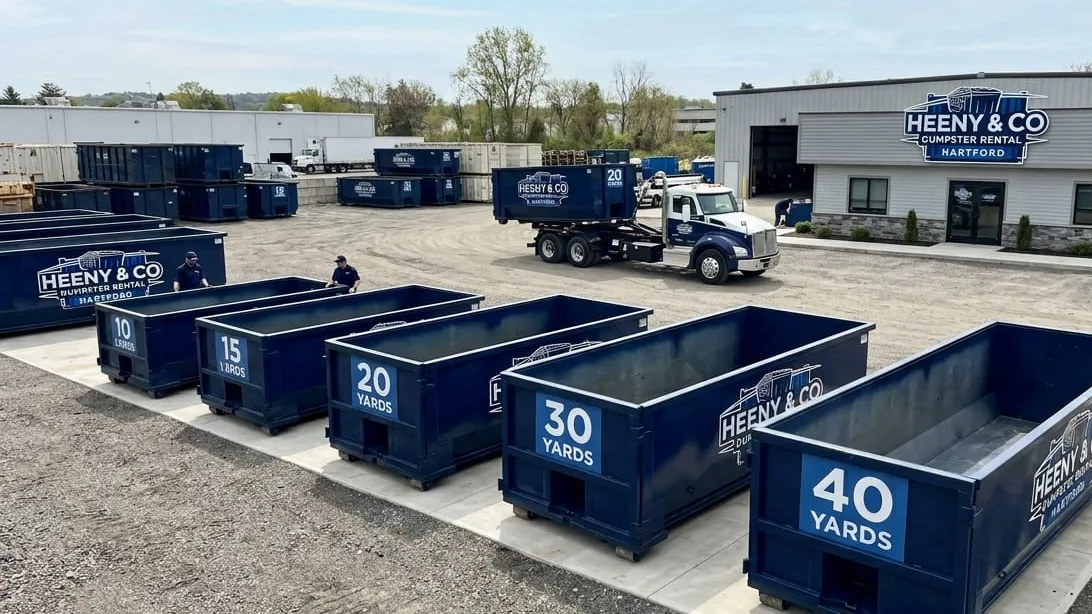
Heeny & Co Dumpster Rental Hartford has run roll-offs out of the yard at 192 Ledyard Street, in the South Meadows, since 2014. Declan Heeny started with one truck and four cans and still answers the phone. We run 10, 15, 20, 30 and 40 yard boxes, with the dimensions on the dumpster sizes page. What follows is how to choose between them here rather than in general.
Forty-two inches, and the two floors it built
Connecticut's frost line is 42 inches. A footing has to bear below the depth the ground freezes to or frost lifts it every winter, so the excavation goes down forty-two inches before anything is poured. Once a builder is already that deep around the whole perimeter, going a little further and pouring full walls costs very little. That is why so much of Hartford's older stock has a full basement, and why so many jobs here start in the cellar.
Put the attic on top of that and the arithmetic is plain. A Hartford building usually has two floors of storage most national calculators do not assume — the basement and the attic. Neither is a room in the room count, both have been filling since the building went up, and the basement is normally the densest floor in the place. Our basement and attic cleanouts notes work those two floors on their own.
The working rule: on a whole-building clear-out in the pre-1950 stock, size one step above what a national calculator returns. On dense debris that rule inverts, and the next section explains why.
Eighty-one per cent multifamily: the unit of work is a building
81% of Hartford housing is multifamily and 19% is single-family, against 64% single-family statewide. Half of the city's housing units were built before 1950, a figure from the City's Municipal Affordable Housing Plan adopted 12 December 2022. The owner-occupied rate is 25.7%, among the lowest of any American city, with 2.32 persons per household on Census QuickFacts.
So the caller here is more often a landlord, a property manager or a contractor than a homeowner clearing a garage, and the unit of work is a building rather than a house. Hartford's signature form is the "Hartford perfect six" — the Connecticut SHPO National Register nomination describes it as a variation on the triple decker, three storeys, a symmetrical double-bow facade, a centre-hall main entrance and six units, two on each floor, built in the late nineteenth and early twentieth centuries, with a later yellow-brick variant popular in the 1920s.
Six units, one shared cellar, one shared attic. A single-unit turnover in that building is a 15 or a 20. The whole building, cellar and attic included, is a 30, or a 20 pulled twice if the drive will not hold a 30. The overlap is covered in our notes on Perfect Six and multifamily turnovers.
One line from the city's own programme matters commercially. Hartford's Waste & Recycling Division collects from a "Single family home, Multifamily 6 units or less, Condo association of 6 units or less"; all other property types arrange private hauling. A seven-unit building is outside that from day one, and a six-unit building leaves it the moment the debris stops being household trash.
Size by size
10 yard: the weight box
The 10 yard has low walls, and the low walls are the point. It is the container for broken concrete, a cracked front walk, a chimney taken down to the roofline, plaster and lath out of one room, or footing spoil from a 42-inch trench. It fits on a short city drive and can sit where nothing longer will.
15 yard: one unit, one room, one tight lot
The 15 yard is the honest size for a single kitchen or bath, one apartment turnover with no cellar attached, a small deck, or a garage and shed cleared together. It is also the size that saves a job on a Frog Hollow lot where the drive is shared and short.
20 yard: the default
The 20 yard covers a full basement clear-out, a multi-room remodel, a single-layer roof tear-off on an ordinary house, or a whole single-family cleanout. If two sizes look plausible on a household job and nothing heavy is going in, this is usually the one.
30 yard: a whole building
The 30 yard is for the whole-property clear: a multifamily emptied top to bottom, cellar and attic together, a gut of two or three units, an estate clearance where the family lived on one floor and rented the rest. It needs real room to land and real room to swing the door open.
40 yard: bulky and light only
The 40 has a real place and a narrow one — siding and trim off a re-side, a porch or rear stair coming down, light bulk out of a multi-unit refresh, storm wood after a big blow. It is never the right box for anything dense, because payload arrives long before the walls fill.
| Container | Rough footprint | Typical payload | Pickup loads | The Hartford job |
|---|---|---|---|---|
| 10 yard | 12 ft x 8 ft x 3.5 ft | 1 to 2 tons | 4 to 5 | Concrete, masonry, plaster and lath, footing spoil |
| 15 yard | 16 ft x 8 ft x 4 ft | 2 to 3 tons | 6 to 7 | One kitchen or bath, one unit turnover, short shared drive |
| 20 yard | 22 ft x 8 ft x 4.5 ft | 3 to 4 tons | 8 to 10 | Full cellar, multi-room remodel, single-layer tear-off |
| 30 yard | 22 ft x 8 ft x 6 ft | 4 to 5 tons | 12 to 14 | Whole multifamily, cellar and attic, full gut, estate clear |
| 40 yard | 22 ft x 8 ft x 8 ft | 5 to 6 tons | 16 to 18 | Siding, porch teardown, light bulk from a six-unit refresh |
Use the pickup column as the sanity check. A full-size pickup bed loaded level is a bit over two cubic yards, so the 20 that sounds enormous on the phone is eight or nine truckloads — one weekend of a Hartford cellar.
Weight jobs and volume jobs are sized in opposite directions
Every roll-off has two ceilings: the space inside the box and what the truck can legally lift off your drive. Most household material runs out of space first. Four loads here run out of weight first, and early.
- Plaster and lath. Half of Hartford's stock predates 1950, and pre-war walls are plaster on wood lath, not board. It is dense, it is dusty, and one room of it will do more to a payload than a floor of furniture.
- Wet basement contents. Every spring the frost comes out of the ground and the water table comes up with it. Cardboard that sat dry for twenty years wicks it up overnight, and a soaked box of books is a weight item, not a volume item.
- Broken concrete and masonry. A front walk, a cracked step, a chimney, a section of drive. Rubble nests as it settles, so the box keeps taking weight after it has stopped looking hungry.
- Footing and excavation spoil. Because footings reach 42 inches, small structural jobs produce spoil out of proportion to the project, and wet spring soil is the heaviest thing we take off a residential drive.
All four load the same way: flat and low, spread across the floor, never mounded. A mounded box cannot be tarped and cannot legally leave. And the sizing rule reverses: on dense material, when two sizes both look plausible, take the smaller box and plan a swap. Concrete and masonry are covered under concrete and heavy debris.
What comes out of the load before you size it
Connecticut does not run a long list of banned materials the way some states do. CT DEEP's own guidance on renovation waste says the easiest and most common way to manage construction waste is to commingle most waste into one roll-off taken to a materials recovery facility or transfer station. One mixed container is not merely allowed, it is what the state recommends. But four categories genuinely come out first, and pulling them changes the size you need.
- Scrap metal and corrugated cardboard. These are mandatory recyclables in Connecticut under CGS §22a-241b and RCSA §22a-241b-2, and DEEP's renovation guidance says plainly that they must be separated from other building material wastes. On a gut job cardboard is most of the visible bulk and metal is most of the hidden weight, so pulling both can move you down a size and pay you for the metal at the same time.
- Mattresses. Connecticut was the first state to pass comprehensive mattress stewardship legislation, under Public Act 13-42, with the Bye Bye Mattress programme live since 1 May 2015 and funded by a recycling fee of $16.00, rising to $19.50 on 1 October 2026. The fee was paid at purchase, so drop-off is free to you. A six-unit turnover can produce a dozen mattresses, which is most of a container on its own.
- Electronics and televisions. Connecticut has a real disposal ban here — CGS §22a-636, effective 1 January 2011 — backed by a Covered Electronic Device programme. Free at the city's drop-off with a green permit.
- Paint, adhesives, oils and tars. Liquid and semi-liquid materials are excluded from the statutory definition of C&D waste under CGS §22a-208x, along with asbestos, clean fill, hazardous waste and radioactive material. Paint has its own route: PaintCare has operated in Connecticut since July 2013 under CGS §§22a-904 / 904a, funded by a point-of-sale fee of up to $2.25, with 157 drop-off sites statewide.
Asbestos never rides in a container. Connecticut is stricter than the federal rule: RCSA §19a-332a-1 defines a regulated facility to include residential buildings "including single family homes", with no owner-occupied carve-out. Notification runs through the Department of Public Health on ten days' notice. The rest is in our Connecticut recycling and disposal rules.
Where the box has to sit, which sometimes decides the size
A 30 that will not fit the approach is not a 30, it is a wasted trip. Before you settle on a size, walk the drive:
- About 60 feet of straight approach in front of the spot, so the truck can back in and let the box roll off level.
- Roughly 10.5 feet of width through the tightest pinch point, gate posts and fence lines included.
- 20 feet or more of clear overhead. The hoist goes up before the box comes down, so low branches, service drops and porch roofs all count.
- Five feet of clearance from the building. Connecticut has no per-dumpster fire permit, but it does have a placement rule: IFC 2021 §304.3.3, as adopted by the state, says containers of 1.5 cubic yards or more shall not be stored in buildings or placed within 5 feet of combustible walls, openings or combustible roof eave lines. On a narrow Hartford lot that five feet is often what decides between the drive and the side of the house.
If the container has to go in the street instead, Hartford's Public Works Permit Division issues an Obstruction Permit for temporary occupation of the public right-of-way — $50 plus three cents per square foot per day under the city's published rules. Call the Permit Division on 860-757-9970 first; the detail is in our Hartford permits guide.
When the city's free route beats a container
Sometimes it does, and it is worth saying so. Hartford gives two free bulky pickups per unit per year, of five or fewer items each, by appointment only on (860) 757-9983. DPW makes 25 appointments a day, first come first served. Additional collections are $75 each, and a $10 permit covers four self-haul loads to the Bulky Waste & Recycling Center at 180 Leibert Road, open Tuesday to Saturday, 8:45 a.m. to 1:45 p.m.
Two free pickups per unit per year is real capacity in a multifamily building. If the job is a sofa, a bed frame, a water heater and two chairs, book the appointment and keep the driveway. Where that route stops is renovation debris: the city does not list construction debris as an accepted bulky item, and DPW names construction debris as unacceptable material that will get a cart skipped. There is no C&D category in the bulky programme. Details are on hartfordct.gov.
What helps on the phone
Four answers size a job faster than any calculator: how many units, whether the cellar and attic are in scope, what the heaviest material is, and how the drive sits. Sizing here is a two-minute conversation, not a form. Call (959) 666-6427, or see the roll-off rental page and our contact page. Swaps are next-day when a job outruns its box.
Questions this guide did not answer? Call (959) 666-6427. We would rather spend two minutes on the phone than have you order the wrong container.