
Permits
Dumpster Permits in Hartford, CT: Placement, Not Paperwork
Connecticut has no per-dumpster fire permit and no Hartford container ordinance we could find. What governs a roll-off here is placement: five feet from combustible walls, openings and eave lines under IFC 2021 §304.3.3 — five, not the ten you will read on sites written for Massachusetts. Plus the city's Obstruction Permit, the 60-day demolition notice, and who to call.
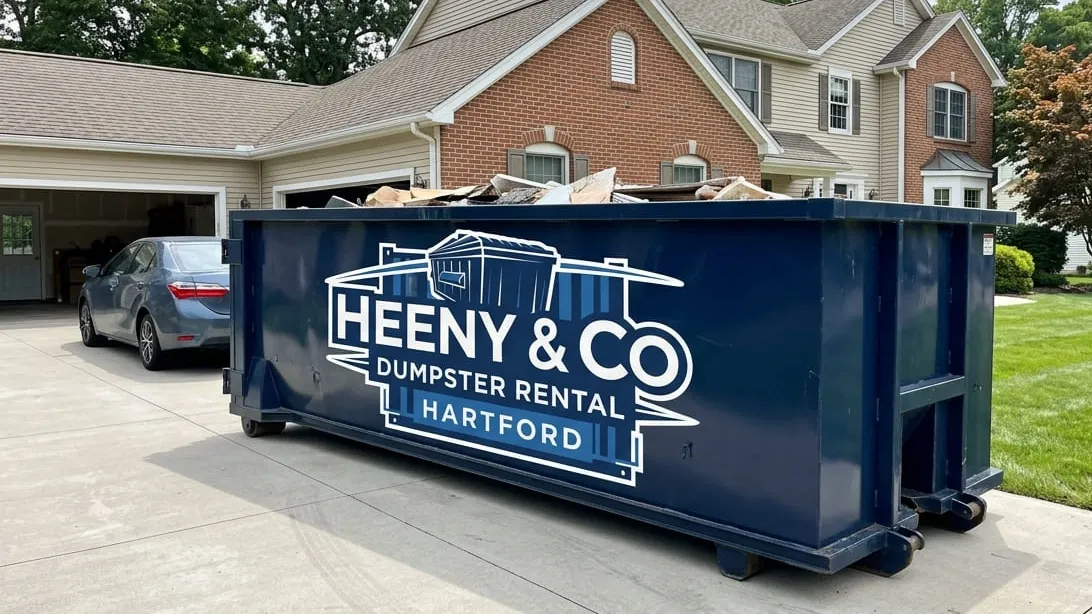
The permit question turns up right after the size question, and in Hartford the honest answer is shorter than most people expect. For a container on your own driveway in Hartford, no permit was identified — not a city one, not a fire-department one. Connecticut issues no per-dumpster fire permit at all, and no Hartford ordinance governing containers could be found published. What governs a roll-off here is placement: where the box sits and what it sits near. Paperwork enters at one point only, and that is when the container leaves your property for the public street.
Placement, not paperwork: the five-foot rule
Connecticut runs two fire codes side by side, both effective 1 October 2022 under CGS Chapter 541: the State Fire Prevention Code, which adopts NFPA 1, 2021 edition, and the State Fire Safety Code, which adopts the International Fire Code (IFC), 2021 edition, for buildings permitted on or after 1 January 2006.
The sentence that decides where a container goes sits in the IFC. IFC 2021 §304.3.3, as adopted here:
"Dumpsters and containers with an individual capacity of 1.5 cubic yards [40.5 cubic feet] or more shall not be stored in buildings or placed within 5 feet of combustible walls, openings or combustible roof eave lines."
It names three things and most people remember only the first. Not inside a building. Not within five feet of a combustible wall. Not within five feet of an opening — a door or window counts, even in a masonry wall. And not within five feet of a combustible roof eave line, the one that catches people out: an eave overhangs, and the five feet is measured from it.
There are exceptions — sprinklered areas, and dedicated Type I or Type IIA structures standing at least ten feet from other buildings — and neither describes a residential driveway, so the five feet stands. §304.3.4 adds a requirement one size down: containers of 1.0 cubic yard or more must meet the code's requirements for what they are made of.
Every container we run — 10, 15, 20, 30 and 40 yard — is far past 1.5 cubic yards, so §304.3.3 reaches all of them, on private property as much as anywhere. It is a placement rule, not a paperwork rule, and it is why the driveway rather than the side of the house is usually the right spot for a roll-off dumpster rental.
Five feet, and why so much of the internet says ten
Search for dumpster setbacks and you will find a five-foot figure and a ten-foot figure quoted with equal confidence, almost never attached to a state. Both are real; they belong to different codes. Connecticut is five feet, under IFC 2021 §304.3.3. Massachusetts works from NFPA 1, publishes ten feet, and also requires a fire-department permit for any rubbish container over six cubic yards. Connecticut does neither.
There is no per-dumpster fire permit in Connecticut
The Connecticut State Fire Prevention Code does carry a permit table, at §1.12.8(a), listing what a local fire marshal issues permits for. There is exactly one rubbish entry in it: "Commercial Rubbish-Handling Operation: To operate."
That is a permit to run a rubbish-handling business, not one tied to a container sitting in a customer's driveway for nine days, and nothing else in the table is either. When somebody tells you to pull a fire permit before a Connecticut delivery, they are thinking of another state.
One caveat, stated plainly. The fire code is administered locally by each municipality's fire marshal, and individual municipalities can add requirements of their own. Whether Hartford's Fire Marshal has done so we could not verify, so we will not claim either way. If the job is unusual, a call to the Fire Marshal's office settles it.
The street is the part that needs a permit
Private ground and the public right-of-way are two different questions, and the second has a real answer. The City of Hartford Public Works Permit Division regulates three permit categories: Curb and Walk, Street Excavation, and Obstruction — the last covering "temporary obstruction of public right-of-way." The published figures:
- Obstruction Permit: $50, plus $0.03 per square foot per day of occupied right-of-way.
- Performance bond: $10,000, and a certificate of liability insurance.
- Public Works Permit Division: 860-757-9970.
- Hartford 311: (860) 757-9311 for general city questions.
Those are the city's figures, not ours. The per-square-foot charge is small on its own; the bond and the insurance certificate are why most residential jobs find a way onto private ground. One further line from the city's manual matters for a week in the road: construction materials "must be removed at the end of each day unless written permission is given."
What the Hartford rules do not say
The Hartford rules document never uses the word "dumpster" and never uses the word "container." The Obstruction Permit is plainly the instrument that would apply to a box in the street — nothing else in the city's permit structure fits — but the document does not name roll-offs, and we will not tell you there is a "Hartford dumpster permit" with its own fee and form when none is published. So the step is a phone call, not a download: the Permit Division, 860-757-9970, with the address, the container size and the dates.
Who to call for what
| Situation | Who governs it | Contact or note |
|---|---|---|
| Container on your own driveway | No permit identified — IFC 2021 §304.3.3 applies | Five feet from combustible walls, openings, eave lines |
| Container in the street or a parking lane | Permit Division, Obstruction Permit | 860-757-9970 · $50 plus $0.03 per sq ft per day · $10,000 bond |
| Condominium driveway or parking area | The association, under the Common Interest Ownership Act | Written consent before the truck is scheduled |
| Demolition | 60-day notice, Section 9-14(b), plus three state agencies | DPH ten days · DEEP $300 authorization · DAS licensing |
| Any digging | Call Before You Dig, CGS §16-345 et seq. | 811 · not the Massachusetts programme |
What we could not find, and will not invent
Plenty of dumpster sites publish a city ordinance number, a day limit and a screening requirement. For Hartford, no ordinance governing dumpsters — no day limit, no screening rule — was found, so we cite no section number. Two things from the city's own documents we can confirm: Refuse Collector Registration lives in Chapter 15, and a 60-day public-notice period before applying for a demolition permit lives in Section 9-14(b).
Demolition: sixty days, then three state agencies
If the job is a demolition rather than a renovation, the container is the last thing to worry about. Start with the calendar: that 60-day public-notice period under Section 9-14(b) runs before the permit application, so the paperwork begins two months before anybody touches the building. Then the state layer, split three ways:
- The Department of Public Health (DPH) handles asbestos notification and licensing, with ten days' notice before work begins.
- CT DEEP issues the $300 Special Waste / Asbestos Disposal Authorization covering disposal of the material.
- The DAS Office of the State Fire Marshal licenses demolition contractors.
Two details surprise people used to the federal rules. RCSA §19a-332a-1 expressly includes residential structures, single-family homes among them — no owner-occupied carve-out of the sort federal practice is built around. And a demolition notification is required whether or not asbestos is present.
For the box on the driveway it comes to this. Asbestos-containing material cannot go in any container we own, ever, and it is excluded from the statutory definition of construction and demolition waste in any case. It leaves through a licensed abatement contractor before our truck arrives. The rest is ordinary demolition debris, and our guide to construction debris disposal in Connecticut covers it.
Digging: Call Before You Dig, not the programme next door
Setting a container on a driveway does not involve a locate. The work it serves often does — footings at a 42-inch frost line, a fence line, a stump, a driveway tear-out, an old oil tank. Connecticut is served by Call Before You Dig (CBYD), under CGS §16-345 et seq. That is a trap for anyone who has worked in Massachusetts, Rhode Island, New Hampshire, Maine or Vermont: the one-call centre those states use does not cover Connecticut. Call 811 or file with CBYD.
Landlords and contractors: Hartford registers the trucks
This one is not about your container but about who delivers it. Hartford requires annual registration of every vehicle used in the city for waste and recycling collection. It applies to "all collectors," is due by 30 October, and each vehicle carries a permit tag on the left windshield, under Chapter 15.
What we cannot tell you is the fee, or whether roll-off haulers are expressly named among the covered collectors — neither could be verified, so treat both as questions for the Department of Public Works. What it does tell you is that Hartford takes an interest in which trucks work in the city, and that a hauler already operating here every week is worth more than a keener quote from one who is not.
Condominiums: the association decides, not the unit owner
Under the Connecticut Common Interest Ownership Act, the driveways and parking areas of a condominium are typically common area rather than part of anybody's unit, so a unit owner cannot unilaterally authorise a container to stand on that ground. The association has to consent, in writing, before the delivery is booked — not on the morning the driver is at the gate.
In Hartford that is usually less painful than it sounds, because of where city collection stops: single-family homes, multifamily buildings of six units or fewer, and condominium associations of six units or fewer. Anything larger already contracts privately and already has a board used to signing off on waste. The same goes for a rented unit — the owner authorises the placement, not the tenant.
A placement checklist worth running before the truck comes
Almost every problem we see is a placement problem, and most are solved the day before. Before delivery:
- Five feet clear of any combustible wall or opening, under IFC §304.3.3.
- Clear of the eave line as well as the wall — measure from the overhang.
- Off the sidewalk and out of the right-of-way, unless you hold the Obstruction Permit.
- Not blocking a hydrant or fire-apparatus access.
- Cars moved before the delivery window. The truck needs a straight run and room to back.
- Overhead clear — branches and service drops decide more placements on Hartford's older streets than anything on the ground.
- A photo of the spot texted to the driver. Thirty seconds, and it takes the guesswork out of arrival.
Surface matters too, particularly on an older driveway patched more than once. Our notes on driveway protection at delivery cover boards under the rails and where the weight lands.
The short version
Four things carry it. One: on your own driveway, no permit was identified, and the constraint is placement rather than paperwork. Two: that rule is five feet from combustible walls, openings and roof eave lines for any container of 1.5 cubic yards or more, under IFC 2021 §304.3.3 — five, not the ten written for Massachusetts. Three: Connecticut has no per-dumpster fire permit. Four: the street is the exception, and the Obstruction Permit is the instrument to ask the Permit Division about on 860-757-9970.
Confirm current requirements yourself rather than taking any website's word for it, this one included. City permit information is published by the City of Hartford, the fire codes and the asbestos and demolition programmes by the State of Connecticut. Then size the job on our dumpster sizes page, check the load against our Connecticut recycling and disposal rules, and read up on a construction dumpster rental.
Heeny & Co Dumpster Rental Hartford has run out of the yard at 192 Ledyard Street since 2014. Declan Heeny started with one truck and four cans and still answers the phone, and he would rather spend five minutes on placement than move a container twice. Call (959) 666-6427 or our contact page.
Questions this guide did not answer? Call (959) 666-6427. We would rather spend two minutes on the phone than have you order the wrong container.