
Roofing
Roofing Tear-Off Dumpster Size Guide for Hartford
A shingle tear-off is a weight job, not a volume job. Size it by squares and layers, plan for the ice-dam work that follows, pull the metal and cardboard out of the load, and keep the box five feet off the eave line.
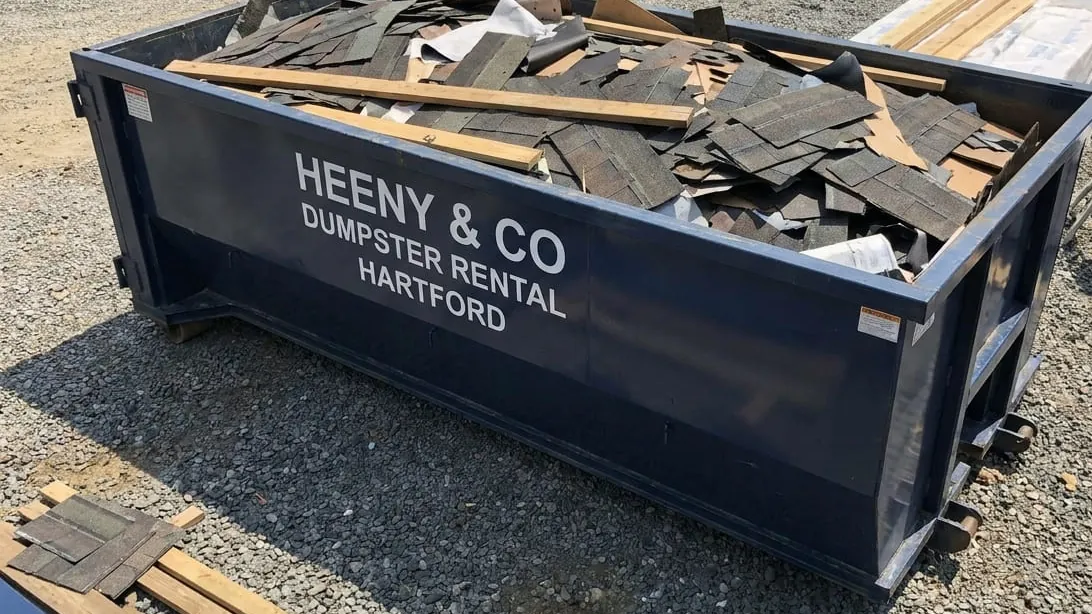
Roofing is the one job where the floor plan of the house tells us nothing. What we need is the roof in squares and the number of layers already up there, because a tear-off is a weight job rather than a volume job. Volume runs out slowly, weight runs out fast, and weight decides whether the truck can pick the box back up off a Hartford driveway. A twenty yard with three feet of shingle in it can be at its working limit and still look half empty from the street.
Asphalt and composition shingle is what nearly every roof in this city wears, so that is what this guide is sized around. Slate, tile or standing seam is a different conversation — call first.
Ice dams are the Connecticut driver
Most roofing content on the internet is written around hail claims. That is not the story here. Hartford's official climate station at Bradley Airport records about 40.5 inches of snow a year and 124.9 nights at or below 32°F. That combination is an ice-dam machine, and ice-dam damage generates a large share of the roofing and ceiling work we haul away.
The mechanism is always the same. Heat leaks into the attic, snow melts on the warm part of the deck, the meltwater runs to the cold overhang and freezes there. The ridge of ice holds the next melt behind it, and shingles lapped to shed running water do not hold standing water. It works back under the courses and shows up on a ceiling nowhere near where it got in.
Connecticut builds for this. The 2022 Connecticut State Building Code adopts the 2021 International Residential Code, which calls for an ice barrier — the self-adhering membrane roofers call ice-and-water shield — at the eaves wherever the jurisdiction's filled-in Table R301.2 identifies ice formation as a hazard. Confirm the values for your address with the building official before the job is priced. In practice, membrane at the eaves is routine detailing on a Capitol Region re-roof whether the old roof had any or not.
Which is why a Hartford roofing job is often three jobs: the roof redone with membrane at the eaves, the attic air-sealed and insulated so the deck stops melting snow from underneath, and the wet fibreglass and stained ceiling drywall coming out as their own load a week or two later. Late winter into spring is the season — the leak announces itself in February and the work happens as soon as the deck is dry enough to walk.
Squares, layers, and the number people forget
A square is 100 square feet of roof surface, not of floor area. Pitch, hips, valleys, dormers and overhang all add surface, so a Perfect Six with a steep gable and dormers carries far more roof than the assessor's card suggests. Take the square count off the roofer's proposal — he has already measured it to order material.
A single layer of three-tab asphalt runs roughly 250 lb per square. Architectural laminate runs 300 to 400 lb per square. Add 5 to 10 percent for felt, membrane, drip edge, ridge cap, boots and nails, and more again if the deck boards are coming off with it.
Then the number that changes the container. A second layer roughly doubles the tear-off weight and a third roughly triples it, on the same roof, on the same footprint, with nothing visible from the street to warn you. Count the courses in the cut edge at a rake or an eave before you order. The container can be changed with a phone call at that point, not once it is full.
The sizing table
Weights are shingle plus underlayment and fasteners, rounded, for a standard laminate. Staged means one box in the drive with a swap booked in advance, not a bigger box.
| Roof size | Layers | Approximate weight | Container that works | Notes |
|---|---|---|---|---|
| 10 squares | 1 | ~1.4 tons | 10 yard | Garage or porch roof. |
| 15 squares | 1 | ~2.0 tons | 15 yard | Small cape or ranch. One pull. |
| 20 squares | 1 | ~2.6 tons | 15 yard | Room to spare. Load it low and level. |
| 20 squares | 2 | ~5.2 tons | 20 yard | The row people underestimate. |
| 20 squares | 3 | ~7.8 tons | 20 yard, staged | Two pulls. Not one. |
| 28 squares | 2 | ~7.3 tons | 20 yard, staged | Typical multifamily. Book the swap up front. |
| 30 squares | 3 | ~11.5 tons | Staged, two to three pulls | A scheduling job. Call before you book. |
| Deck boards off | Any | Add the boards | One more pull | Bulky rather than heavy. |
Notice what the table is not doing. It is not reaching for the 30 yard as the roof gets bigger. On a tear-off a smaller box loaded low is usually the right answer, because the limit you hit is weight, not the rim. Nearly all our roofing work runs on the 10 yard, 15 yard and 20 yard. Footprints are on the dumpster sizes page.
What comes out of the load first
Connecticut does not publish a list of materials banned from disposal. What the state does is designate items that must be recycled under CGS §22a-241b and RCSA §22a-241b-2, and forbid anyone remixing them once they have been separated. Two of those land on a roofing job every time.
- Scrap metal. Drip edge, step and valley flashing, chimney counterflashing, old gutter and downpipe, vent collars. A mandatory recyclable, separated from the building material waste. Pull it into its own pile as it comes off, because once it is under six tons of shingle nobody goes back for it.
- Corrugated cardboard. A shingle job produces more than people expect — every bundle wrapper, every carton of ridge cap and starter. Also a mandatory recyclable, and it takes up volume.
CT DEEP's guidance on renovation waste says the easiest and most common way to manage construction waste is to commingle most of it into one roll-off, then names cardboard and scrap metal as the two things that must come out. That is the whole separation duty on a roof. More in our guide to Connecticut recycling and disposal rules.
Keep out entirely: paint, adhesives, roofing tar and solvents. Liquids are excluded from the statutory definition of construction and demolition waste, so a half-used pail of flashing cement rides home in the truck.
Old felt, old boards, and half a city built before 1950
Half of Hartford's housing units were built before 1950, a figure the City published in its Municipal Affordable Housing Plan adopted on 12 December 2022. On that stock the tear-off does not stop at the shingle. Underneath there is often layered organic felt gone to powder, sometimes over skip sheathing or square-edge board rather than plywood. Once the boards start coming off the load stops being dense and starts being bulky, and the box that was going to be half full at eight tons is full at four. Tell us in advance if the deck is coming off.
Asbestos, and why Connecticut has no single-family carve-out
Older asphalt/asbestos-cement roofing and, far more commonly on Hartford's pre-1940 stock, asbestos-cement siding shingles can contain asbestos. On the wall they are the rigid, brittle, wavy-butt shingle that snaps rather than tears, often sitting under later vinyl or aluminium. CT DPH publishes a factsheet specifically on asbestos-containing siding shingles, which tells you how routine the problem is here.
The federal NESHAP rule carves out owner-occupied single-family homes. Connecticut does not. RCSA §19a-332a-1 defines a facility to include residential premises “including single family homes.” There is no owner-occupied exemption to fall back on, and the administration runs three ways:
- The Department of Public Health licenses the abatement work and takes the notification — ten days' notice.
- CT DEEP issues the $300 Special Waste / Asbestos Disposal Authorization.
- The DAS Office of the State Fire Marshal licenses demolition contractors, and a demolition notification is required for any structure demolished whether asbestos is present or not.
We cannot take asbestos-containing material in any container, on any job, ever. Test before anyone puts a bar under it. A positive result goes to a licensed abatement contractor with the DPH notification filed and the DEEP authorization in hand. The agency pages are on the state portal.
Placement for a roofing job
A re-roof is a crew shovelling from height, so debris lands where gravity puts it. Set the box where the pitch drops, not where it looks tidiest from the kerb.
- Protection boards go under the rails and wheels on every residential set, without being asked. A loaded container is a concentrated line load on ground that freezes and thaws a hundred-odd times a winter.
- Approach: about 60 feet of straight run for truck and container together, so the driver can set down and hook back up without swinging the tail.
- Width: about 10.5 feet past gates, fence posts, corner boards and parked cars.
- Overhead: 20 feet or more of clear vertical space while the hoist is working. The arm, not the box, is what ends deliveries.
- Moving the box mid-job is normal on a roof with two working slopes, and cheaper than carrying shingle around the house. Say so when you book.
Then the placement rule that catches people out. Connecticut has no per-dumpster fire permit. What it has is a distance rule. IFC 2021 §304.3.3, as adopted by the 2022 Connecticut State Fire Safety Code, provides that dumpsters and containers with an individual capacity of 1.5 cubic yards or more shall not be stored in buildings or placed within five feet of combustible walls, openings or combustible roof eave lines.
Five feet, and note what it names. On a tear-off the combustible roof eave line is precisely what you are working over, which is why this rule genuinely bites on a roofing job in a way it does not on a kitchen gut. The instinctive spot — box tucked tight under the eave so the shovels have the shortest throw — is the one spot the code rules out. Five feet clear, with a tarp bridging the gap, is the working compromise. Individual fire marshals may add local requirements, so on a tight lot it is worth a call first. Street placement is covered in dumpster permits in Hartford.
A Perfect Six or a triple-decker
Hartford's own building type is the Perfect Six — three storeys, symmetrical double-bow facade, centre-hall entrance, two units on each floor, built by the hundred in the late nineteenth and early twentieth centuries. The three-decker is its parent form. For a roofer both mean the same three things.
The roof is large: bows and bays adding surface, often twenty-five to thirty-five squares before anyone counts a porch roof. The lot is tight: these buildings sit close together on narrow parcels and the side yard is frequently not 10.5 feet at its pinch point. And the street is parked both sides all day, because 81 percent of Hartford's housing is multifamily and the city is 25.7 percent owner-occupied. So the box usually goes at the head of the drive rather than beside the house, the crew tarps and carries rather than shovelling straight down, and the delivery is booked early before the street fills. If the container has to go in the travelled way, Hartford's Public Works Permit Division issues an Obstruction Permit for temporary occupation of the public right-of-way — $50 plus three cents per square foot per day under the city's published Rules and Specifications, with a performance bond and a certificate of insurance. Call the Permit Division on 860-757-9970 before anything goes in the street. Turnover work on these buildings is in Perfect Six and multifamily turnovers.
Which box, and what to tell us
Single layer under about 22 squares, the 15 yard is normally right. Two layers, or anything over 22 squares, the 20 yard. Three layers on a large multifamily is a staged job and should be booked as one. The 10 yard is not a compromise — it is the correct box for a garage or a single-slope repair, and it fits driveways nothing else will. Keep the load to the roof. Metal goes to scrap, cardboard comes out, and the wet insulation and ceiling drywall from the ice-dam damage run better as their own load. Mixed renovation debris belongs on a construction dumpster; roofing detail is on our roofing dumpster rental page.
Four things and we can size it on the phone: the square count, the number of layers, whether the deck boards are coming off, and what the driveway approach looks like. Heeny & Co Dumpster Rental Hartford has run out of the yard at 192 Ledyard Street, in the South Meadows behind the dike the city built after the 1936 flood, since 2014. Declan Heeny still answers the phone. Call (959) 666-6427 or use the contact page.
Questions this guide did not answer? Call (959) 666-6427. We would rather spend two minutes on the phone than have you order the wrong container.