
Recycling
Recycling and Disposal in Hartford, CT: Where Everything Actually Goes
A Hartford operator's map of where material actually goes: who the city collects from, two free bulky pickups a year, the green, blue and red permits at 180 Leibert Road, the yard waste seasons, and why the MIRA plant closing changed the answer.
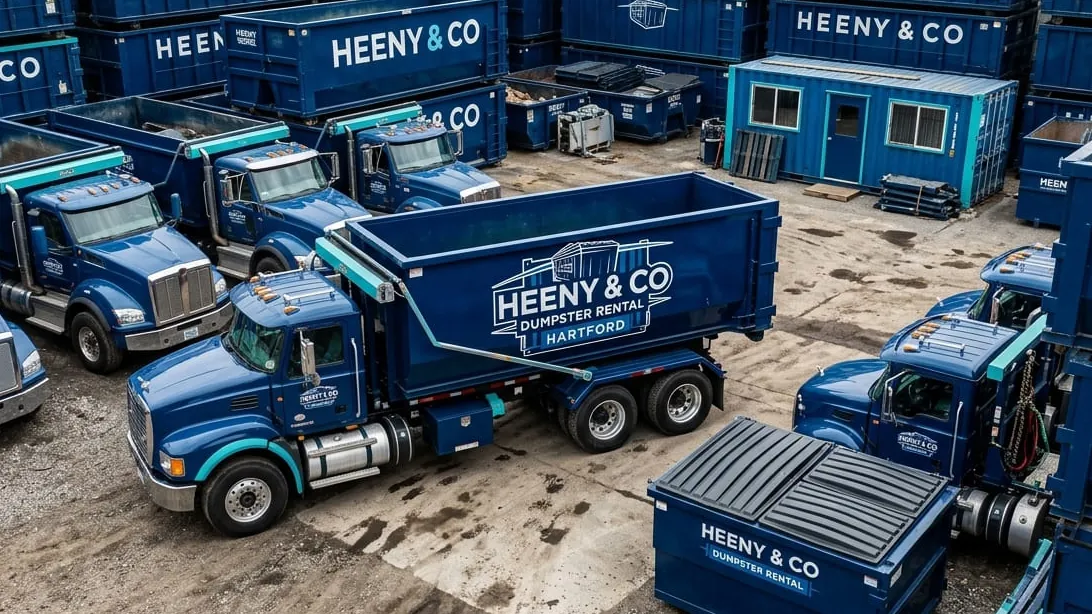
A container leaves the yard on Ledyard Street, lands on a driveway in Barry Square, and the question that follows is always the same: where does all of this end up. This page is the city-level answer — what Hartford itself runs, in the order you need it. The statewide half, the mandatory recyclables and what may not ride in a construction load, is in our guide to Connecticut recycling and disposal rules.
Who gets city collection, and who does not
The City of Hartford Department of Public Works, Waste & Recycling Division collects residential trash and recycling directly — a city crew, not a contractor. The eligibility line is the single most useful fact on this page:
“Single family home, Multifamily 6 units or less, Condo association of 6 units or less.”
Everyone else arranges private hauling, from day one. A seven-unit building has never been a city-collection customer, and neither has a storefront or a restaurant. Hartford's signature building is the six-family Perfect Six, sitting exactly on that line, so on these blocks the difference between a city customer and a private one is one flat.
Two more rules do a lot of work. Recycling is single-stream, so paper, cardboard, cans, glass and rigid plastics go in one cart. And: “The City of Hartford only services trash placed in City issued trash bins unless other arrangements have been made.” A pile of bags beside the cart is not a setout.
Carts get skipped for contamination, and DPW names construction debris as contamination that will get a cart left at the kerb. Take that literally on a turnover: a few lengths of baseboard and half a bag of demolition plaster in the recycling cart is how a landlord loses a week of collection across a whole building.
Bulky pickup: two free a year, by appointment
Hartford's bulky programme is generous by most standards, and strictly rationed.
- Two free pickups per unit per year, each of five items or fewer.
- By appointment only, on (860) 757-9983. DPW makes 25 appointments a day, first come first served, so the phone matters more than the calendar.
- $75 per additional collection, or a $10 permit good for four self-haul loads.
- Kerbside from 4 p.m. the day before until 7 a.m. on collection day.
What it takes: appliances, electronics, small bundles of tree branches, tires, furniture, mattresses, bed frames, water heaters and sinks. Some categories carry preparation rules, and loose material is not collected at all.
| Material | How it has to be prepared | Limit |
|---|---|---|
| Carpet | Cut to 3-foot lengths, rolled to 18-inch diameter | 2 bundles per week |
| Wood | Cut to 6-foot lengths and tied | 3 bundles per week |
| Tree branches | 3-foot lengths, tied in bundles | 2 bundles per week |
| Tires | Need the $10 blue permit | Per the permit |
Read the carpet row next to a real job. A three-bedroom flat carpeted throughout, cut into three-foot lengths and rolled to eighteen inches, is a great many bundles at two a week. That is where a container stops being an indulgence. Our cleanout checklist works through the line.
What bulky will not take: the City is explicit that bulky waste does not include any hazardous or toxic materials, naming motor oil, asbestos and lead paint chips. Asbestos is a licensed job with a Department of Public Health notification and a CT DEEP disposal authorization behind it, and it cannot go in one of our containers either.
On renovation debris the accurate statement is this. Hartford's free bulky pickup is for furniture, appliances, mattresses and similar household items. It is not for renovation debris — the city's own DPW lists construction debris as unacceptable material, and there is no C&D category in the bulky programme. Where those loads go is covered in construction debris disposal in Connecticut.
The drop-off centre and its three permit tiers
Hartford Bulky Waste & Recycling Center, 180 Leibert Road. Tuesday to Saturday, 8:45 a.m. to 1:45 p.m. It is in the South Meadows, minutes from our yard. Access runs on a three-tier permit, and the tiers are worth reading closely, because the city has drawn the line between a resident and a business more sharply than most.
| Permit | Who it is for | Cost |
|---|---|---|
| Green — recyclables | Owner-occupied 1–6 family, condos, tenants | Free |
| Blue — residential | Same group | $10.00 for 4 visits |
| Red — commercial | Multiple-property owners, small businesses, handymen and landscapers | $50.00 plus a per-load charge |
Red per-load charges are published as half-ton $40, three-quarter-ton $60, one-ton $85, with trailers at $40 up to 6 feet, $60 up to 10 feet and $85 up to 16 feet. Green and blue are limited to passenger vehicles, pickups, vans and trailers up to sixteen feet.
Look at what the red tier says about itself. It names handymen and landscapers, and caps out at a one-ton load or a sixteen-foot trailer. Anyone gutting a kitchen or stripping a flat between tenants is past that ceiling in the first afternoon, and the alternative is a queue of pickup loads inside a four-and-a-half-hour window, in a truck you also need for the job. That is the roll-off case, written in the city's own fee schedule rather than ours.
One thing to check before you drive down. The city's own documents are not consistent about the address. The DPW FAQ gives the transfer station as 50 Jennings Road, Monday to Friday, while the Permit Division schedule and the yard waste pages both give 180 Leibert Road, Tuesday to Saturday. The coherent reading, and the one that matches how permits are sold, is that 50 Jennings Road is DPW headquarters where you buy the permit, and 180 Leibert Road is where you drop the material. We are not going to quietly pick one and hope. Buy the permit at Jennings, take the load to Leibert, and ring DPW first if your trip is unusual. The pages are at hartfordct.gov.
Mattresses, electronics and paint are already paid for
Mattresses and electronics come off free at the drop-off centre, and that is not municipal generosity. Connecticut built producer-funded programmes for both, so the manufacturer already paid the recycling cost at the point of sale.
- Mattresses. Public Act 13-42 made Connecticut the first state to pass comprehensive mattress stewardship legislation. The programme went live on 1 May 2015, funded by a fee of $16.00, rising to $19.50 on 1 October 2026, collected when the mattress is bought. Detail at byebyemattress.com.
- Electronics. CGS §22a-636 prohibits knowingly placing a covered electronic device in a solid waste facility, effective 1 January 2011. Televisions, monitors, computers and printers have a manufacturer-funded programme behind that ban, which is why they come off free with a green permit.
- Paint. PaintCare has operated in Connecticut since July 2013, funded by a point-of-sale fee of up to $2.25, with 157 drop-off sites across the state, most of them paint and hardware retailers. Find the nearest at paintcare.org.
So the honest line for a cleanout: paint, mattresses and electronics all have programmes somebody has already funded, which is exactly why they should not be in the container. Putting them in a roll-off means paying twice for the same material.
Household hazardous waste
Hartford's household hazardous waste runs regionally through the Metropolitan District Commission, whose Operations Facility is at 125 Maxim Road — in the South Meadows, minutes from our yard. The MDC runs collections across its member towns, and a resident of any member town may attend, with identification checked at the gate. Motor oil, car batteries, propane tanks, solvents, pesticides, fluorescent tubes and antifreeze are the everyday items. Check the current schedule at themdc.org. None of it goes in a roll-off.
Yard waste, and the plastic-bag rule
Hartford's yard waste collection is seasonal and the rules change with the season. Published dates are year-specific, so treat these as the shape rather than the calendar.
- Autumn: loose leaves at the kerb by zone, roughly early November to late December. Paper leaf bags in the same window.
- Spring: paper bags only, on normal trash days across three weeks in April. No loose-leaf collection in spring.
- Summer: brown leaf bags on normal trash days in the last week of June, July, August and September.
- Branches: tied bundles up to 6 feet, three bundles outside the collection periods.
And the line the city prints without qualification: “Leaves placed in plastic garbage bags will not be collected.” Year-round there is a drop-off route instead: a free green permit from 50 Jennings Road, material to 180 Leibert Road. Anything past a few bundles — a hedge line out, a storm-broken maple, an overgrown back garden — is a yard waste load, cleanest as its own container with no plastic mixed through it.
Where it all ends up
The MIRA South Meadows trash-to-energy plant has closed. It stood minutes from our yard, it burned Hartford's rubbish for decades, and it is gone. A transfer station operates on the site now. Connecticut has no active municipal solid waste landfills, and the state exports a very large share of its municipal solid waste out of state, by truck and by rail. CT DEEP treats that as a genuine capacity shortfall and has a materials management strategy built around it.
That is a change of frame. In Connecticut, disposal is a logistics and distance problem, not a what-is-banned problem. Nobody hands you a list of forbidden materials. What the shortfall does is make weight and distance real: every ton leaving a Hartford job is a ton somebody trucks a long way. Which is why separating a load here genuinely matters.
What we separate, and why it is worth your time
Disposal is charged by weight and by destination, so anything pulled before the box goes on the truck is worth pulling. Five streams matter on a Hartford job.
- Clean concrete and masonry. A broken walk, a chimney base, footing spoil. With no wood or soil through it, it has its own destination; mixed in, it is just very heavy rubbish, which is why we run a separate heavy debris container.
- Scrap metal. Cast iron radiators, a steel tub, water heaters, ductwork, railings, an old range. A mandatory recyclable in Connecticut, and it must be separated. Pull it before loading, because once it is under lath and plaster nobody goes back for it.
- Corrugated cardboard. Also a mandatory recyclable. It bales cleanly if it stays dry, and on a move-out it is real volume.
- Clean wood. Framing offcuts, pallets, fence boards without hardware.
- Vegetative debris as its own load. Storm limb wood off the maples and oaks, hedge removal, stumps. No plastic in it; paper bags are fine.
Before any of that, pull the salvage first. Cabinets still square, solid-core doors, working appliances, light fixtures, radiators, mantels, tools. On a Perfect Six turnover that is regularly a trailer of material nobody needed to pay to move twice, and on pre-1950 stock some of it is worth real money to the right buyer. Where the sorting is the actual work, that is junk removal rather than a container.
The short version
City collection covers a single family home, a multifamily of six units or less and a condo association of six units or less, in city-issued bins, single-stream, with construction debris named as contamination. Two free bulky pickups a year of five items or fewer, by appointment on (860) 757-9983, $75 for extra collections and $10 for four self-haul loads, with carpet, wood and branches cut, tied and limited. Permit at 50 Jennings Road, material to 180 Leibert Road, Tuesday to Saturday, green free, blue $10, red $50 and up. Mattresses, electronics and paint to the programmes that already paid for them, hazardous waste to the MDC at 125 Maxim Road, leaves never in plastic bags.
Heeny & Co Dumpster Rental Hartford has run out of 192 Ledyard Street since 2014 — behind the wall the city built after the 1936 flood, minutes from the plant that used to burn Hartford's rubbish and does not any more. Declan Heeny still answers the phone, and he will say plainly when a bulky appointment or a trip to Leibert Road beats a container on the driveway. When it does not, call (959) 666-6427 or use the contact page.
Questions this guide did not answer? Call (959) 666-6427. We would rather spend two minutes on the phone than have you order the wrong container.