
Cleanouts
Estate Cleanout Checklist for a Hartford Multifamily
The order that works when a Hartford two- or three-family has to be emptied against a probate or closing date: secure the papers first, value before you dispose, divert everything with a free route, and let the container come last.
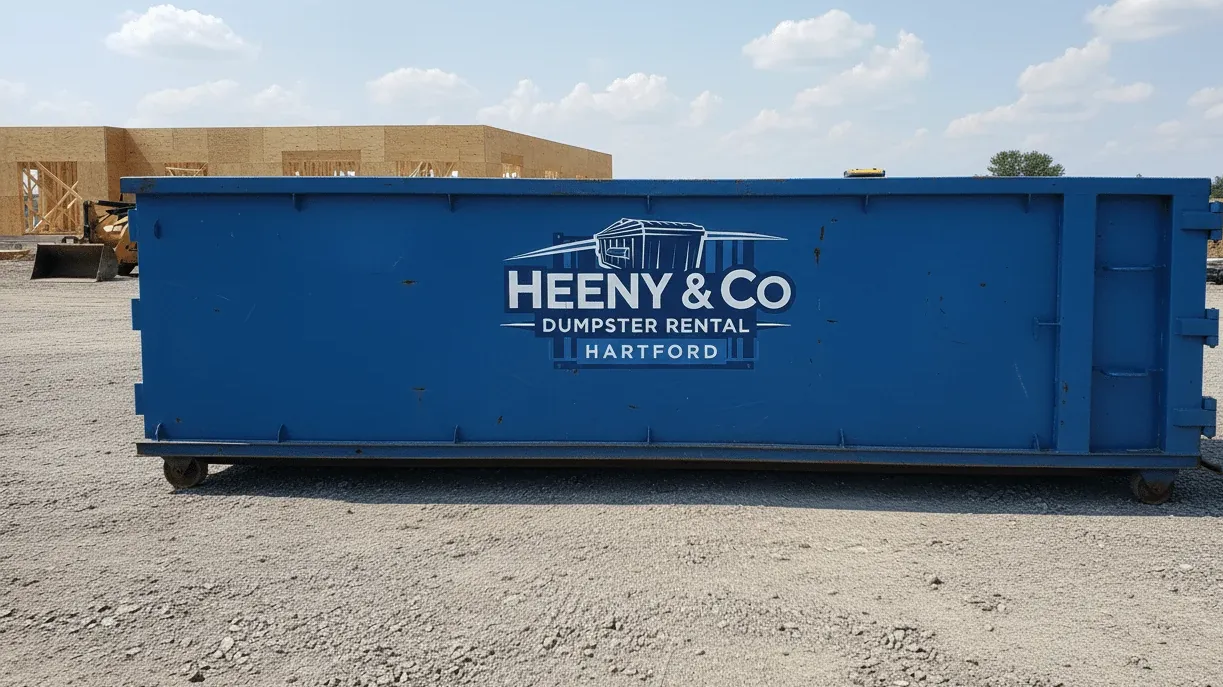
An estate cleanout is not a junk job with a sad backstory. It is the emptying of a home somebody lived in for forty or fifty years, done by people who are grieving, against a date somebody else set — a probate schedule, a closing, a listing. So this page is about order rather than speed, and the container turns up late on purpose.
Nothing here is legal advice. Anything touching title, or the estate's obligations, goes to the executor or the estate's attorney.
The Hartford building it usually is
In this city the house being cleared is very often not a house. 81% of Hartford housing is multifamily against 19% single-family, and the owner-occupied rate is 25.7%. The pattern that follows is specific and it changes the job: the family lived on one floor and rented the other two, sometimes for decades, sometimes with a second generation upstairs.
The forms repeat. Two- and three-family houses, and Hartford's own type, the "Hartford perfect six" — the Connecticut SHPO National Register nomination calls it a variation on the triple decker, three storeys, a symmetrical double-bow facade, a centre-hall main entrance, six units, two on each floor, built in the late nineteenth and early twentieth centuries, with a yellow-brick variant popular in the 1920s.
Half of Hartford's housing units were built before 1950, from the City's Municipal Affordable Housing Plan adopted 12 December 2022. That age brings plaster on wood lath rather than board, painted trim that on a pre-1978 building deserves lead precautions, and a mechanical room that has been added to rather than replaced.
Under all of it, a full basement. Connecticut's frost line is 42 inches, so a footing goes that deep regardless and full walls cost little more once the hole is dug. Over it, an attic. Both are shared across the units, which is the sentence that catches families out: the cellar is not one household's storage, it is every household's, plus every tenancy since the building went up.
The order, which matters more than the speed
- Secure the documents, photographs and valuables before anything moves at all.
- Let the family take what they want, with a written deadline.
- Appraise, salvage and sell before a single thing is thrown.
- Donate what is usable, with pickups booked ahead.
- Divert everything that has a free route of its own.
- Then the container, for what is genuinely left.
The common mistake is ordering the box in week one because it feels like progress. It puts a clock on decisions nobody is ready to make, and once a load is on the truck it is gone.
Documents, photographs and valuables first
Pick one room, put one box in it, and let nothing out of it: the will, deeds, insurance policies, tax records, vehicle titles and bank statements, which are how families find the storage unit nobody mentioned. In a building with tenants, add the leases, the rent record and the security deposit account — the estate still has obligations to the people upstairs.
Photographs, negatives and home video are what families most regret losing, and in a building this old they are never in one place. Run a shred pile as its own category and keep it indoors: a container on a shared driveway is not a secure document store, and on a multifamily lot it is not even a private one.
Selections, then valuation
Set the rule in advance, set an end date, and write down what left and who took it. Open-ended selection stalls an estate for months. Then get an appraiser or an estate-sale company through before anything is thrown.
The salvage pass, in this stock
Pull these before the container arrives, because once a box is on the driveway everything near it becomes a candidate for it.
- Period hardware — mortise locks, cast escutcheons, brass hinges, pushbutton switch plates.
- Newel posts and stair parts, often the best joinery in the building.
- Mantels, including ones boarded over when a fireplace was closed off.
- Solid doors, five-panel and four-panel, with their original hardware.
- Clawfoot tubs and pedestal sinks.
- Cast iron radiators, copper pipe and scrap metal. Metal has to come out of the load anyway, so you may as well be paid for it.
- Old hand tools and machinist tools, which in a Hartford cellar are frequently the best thing in the building.
Room by room, unit by unit
The shared basement
The largest single job in the building, and the one families consistently underestimate. Expect the oil tank and the burner, often with the dead one still standing beside the new; the workbench built into the joists; paint and solvents from three sets of owners with the labels gone; storm windows stuck together on edge; a second fridge and a chest freezer; and the abandoned boxes of every tenancy the building has had. Anything that has taken spring groundwater weighs several times what it looks like. Our basement and attic guide covers those two floors on their own.
The attic
Boxes, trunks and furniture carried up and never carried down. Before shifting anything, look at what the attic is made of. Vermiculite is a stop-and-check item, loose fill of any age wants identifying before it is disturbed, and knob-and-tube wiring in the joist bays means an electrician first. The floor is often loose boards over joists; take a headlamp, and take somebody with you.
The rest of the building
- Each unit separately. Treat every floor as its own house, because it was one, and clear the occupied unit last.
- The rear porches and back stairs, where bicycles and tenant leftovers accumulate for decades.
- The back hall and pantry, which is where the path to the driveway gets blocked.
- The shed and any garage — mower, fuel cans, leftover building materials.
The three things that are not a container job
The oil tank in the cellar
We do not take heating oil tanks in a container. It is a licensed job. An aboveground tank has to be drained, cleaned and cut out; a buried one is an excavation, so a Call Before You Dig ticket under CGS §16-345 et seq. goes in before a shovel does. And if the tank has leaked, a release of heating oil to the ground, to groundwater or into the building is reportable, and the duty sits with the owner. A stain on the cellar floor or a smell in the stairwell is not housekeeping. Contaminated soil never rides out with the boxes.
Asbestos, and Connecticut's missing exemption
This is where Connecticut differs from the federal rule, and it matters in a pre-1950 building. Federal NESHAP carves out owner-occupied single-family homes. Connecticut does not. RCSA §19a-332a-1 defines a regulated facility to include residential buildings "including single family homes". There is no owner-occupied carve-out here.
What you are likely to meet is pipe insulation on the old heating lines in the cellar — the white plaster-like wrap at the elbows, sometimes patched with tape — along with duct wrap, floor tile and the mastic under it. CT DPH also publishes a factsheet specifically on asbestos-containing siding shingles, which is a live issue on the pre-1940 stock. Administration splits three ways:
| Agency | What it does |
|---|---|
| Department of Public Health | Abatement notification and licensing — ten days' notice |
| CT DEEP | Issues the $300 Special Waste / Asbestos Disposal Authorization |
| DAS Office of the State Fire Marshal | Licenses demolition contractors |
A demolition notification is required for any structure demolished, asbestos present or not. We cannot take asbestos-containing material in any container, ever, and it is expressly excluded from the statutory definition of C&D waste under CGS §22a-208x. The agencies are on portal.ct.gov.
Lead paint, motor oil and the city's refusal list
On a pre-1978 building, painted trim, sashes and doors deserve lead precautions before anyone sands or scrapes, and the city runs a Lead Hazard Reduction Grant Program for lower-income households with children under six. For a cleanout the practical point is narrower: lead paint chips, motor oil and asbestos are all refused by Hartford's bulky waste programme, which states that bulky waste does not include hazardous or toxic materials. None of the three is a kerbside item and none is a container item.
What is diverted rather than binned
Connecticut does not run a long list of banned materials. What it has is mandatory recyclables, two real disposal bans, and producer-funded programmes that make several of these free to you — which is exactly why they should not be in a paid container.
| Material | Route in Hartford | Why |
|---|---|---|
| Mattresses and box springs | 180 Leibert Road, or a bulky appointment. Free | Public Act 13-42; programme live 1 May 2015; fee $16.00, rising to $19.50 on 1 Oct 2026 |
| Electronics and televisions | 180 Leibert Road, green permit. Free | Disposal ban, CGS §22a-636, since 1 January 2011 |
| Scrap metal | Scrap yard, or 180 Leibert Road | Mandatory recyclable, CGS §22a-241b |
| Corrugated cardboard | Single-stream kerbside, or 180 Leibert Road | Mandatory recyclable, RCSA §22a-241b-2 |
| Paint, stain and varnish | PaintCare drop-off, or MDC at 125 Maxim Road | 157 sites; fee up to $2.25 paid at purchase |
| Tires | 180 Leibert Road | Requires the $10 blue permit |
| Appliances and water heaters | Bulky appointment, or 180 Leibert Road | Accepted bulky items |
The drop-off is the Bulky Waste & Recycling Center, 180 Leibert Road, Tuesday to Saturday, 8:45 a.m. to 1:45 p.m. Kerbside, the city gives two free bulky pickups per unit per year of five or fewer items each, by appointment on (860) 757-9983, with 25 appointments a day and $75 for additional collections. On a multifamily, two pickups per unit is more capacity than families expect — worth using before the container arrives. PaintCare has operated here since July 2013, and Bye Bye Mattress since 2015; the manufacturer already paid, so you do not. City detail is on hartfordct.gov.
Sizing, and the date somebody else set
A single home, cleared once the salvage and donation passes are done, is normally a 20 yard. A whole multifamily — every unit, plus the shared cellar and the attic — is a 30, or a 20 pulled twice where the drive will not hold a 30. Weight is the separate question: plaster and lath, wet cellar contents and any masonry reach payload while the box still looks half empty, so keep dense material low and level. The sizing guide has the dimensions.
Then the calendar. A probate sale or a listing date is a real constraint, and it usually arrives faster than the family's readiness does. Two things help. First, swaps are next-day, so a smaller box emptied twice is often better than a large one nobody can fill in time. Second, book the free routes early, because a bulky appointment depends on 25 slots a day and the drop-off is open five days a week for five hours.
Where it sits
- Five feet off the building. Connecticut has no per-dumpster fire permit. What it has is a placement rule: IFC 2021 §304.3.3, as adopted by the state, says containers of 1.5 cubic yards or more shall not be stored in buildings or placed within 5 feet of combustible walls, openings or combustible roof eave lines. On a Hartford multifamily lot, with the building close to the line and the drive narrow, that five feet is usually what decides the spot.
- Boards under it, since freeze-thaw has already worked on most of these drives.
- The street is a permit. The Public Works Permit Division issues an Obstruction Permit for temporary obstruction of the public right-of-way, published at $50 plus $0.03 per square foot per day. Call 860-757-9970 before delivery day.
- Tell the tenants. On an occupied building, a container arriving unannounced costs you a parking space and some goodwill.
Heeny & Co Dumpster Rental Hartford has run roll-offs out of the yard at 192 Ledyard Street since 2014. Declan Heeny started with one truck and four cans and still answers the phone, and on an estate job he will talk through the order rather than push a size. There is no form. Call (959) 666-6427, see estate cleanout or junk removal for smaller loads, or use our contact page.
Questions this guide did not answer? Call (959) 666-6427. We would rather spend two minutes on the phone than have you order the wrong container.