
Disposal Rules
Connecticut Recycling and Disposal Rules: What the Law Actually Requires
Connecticut does not publish a waste ban list. It designates items that must be recycled and forbids remixing them, which makes one mixed roll-off the state's own recommendation for construction waste. The real bans, the C&D exclusions, the paint and mattress programmes, and the Hartford routes.
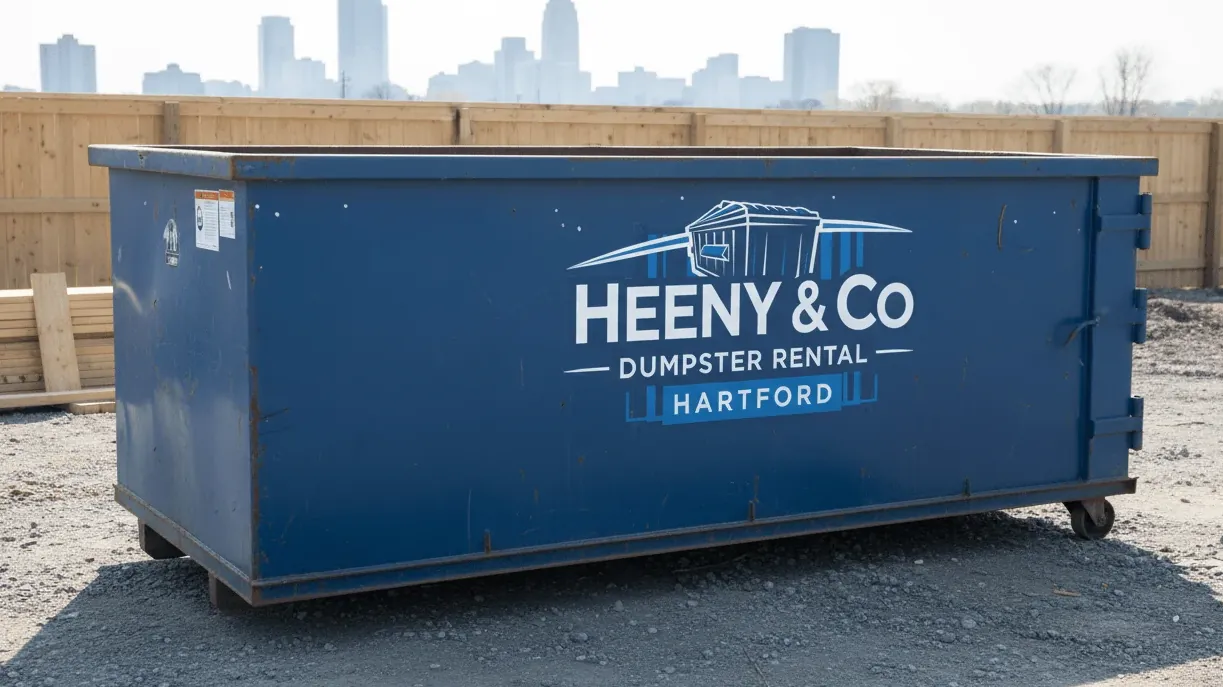
Most disposal advice online was written for states that ban materials outright: here is the list, keep these out of the box, done. Connecticut does not work that way, and starting from the wrong mechanism is how people end up sorting things nobody asked them to sort. The law here does not say you may not dispose of something. It says certain items are designated for recycling, that whoever generates them must separate them, and that once separated nobody may mix them back in. On a Hartford renovation that is a far shorter list of duties than expected.
The mechanism: designated recyclables, not a ban list
The governing statute is CGS §22a-241b, which directs CT DEEP to adopt regulations "designating items that are required to be recycled" and puts the duty on the generator. A household must "separate from other solid waste the items designated for recycling." A landlord or contractor must "make provision for and cause the separation" of the same items. Then comes the sentence that governs how a roll-off is loaded:
"No person shall knowingly combine previously segregated designated recyclable items with other solid waste."
That is narrower than a ban. It does not forbid a material from being thrown away; it forbids tipping an already separated stream back into the mixed load. The companion regulation, RCSA §22a-241b-2, names the items and adds the facility-side half: after 1 January 1991 no approval to landfill or incinerate them may be granted.
The two real disposal bans are short
Electronics. CGS §22a-636 prohibits knowingly placing a covered electronic device in a solid waste facility, effective 1 January 2011. Covered devices are computers, printers, televisions and monitors, and manufacturers fund the collection programme behind the ban, so residents drop them off free.
Grass clippings. CGS §22a-208v provides that no resources recovery or permitted solid waste facility, other than a composting facility, "may accept significant quantities of grass clippings for disposal." That binds the facility, not the homeowner: a container of clippings has nowhere to tip. Leave them on the lawn, compost them, or run a clean yard waste load.
That is the extent of it. Anyone telling you Connecticut bans wood, wallboard, shingles or carpet from disposal is reciting another state's rules.
What is on the designated list
The regulation names boxboard, cardboard, glass and metal food containers, HDPE and PET containers, leaves, magazines, newspaper, office and high-grade white paper, coloured ledger paper, scrap metal, storage batteries, and waste oil. DEEP sorts those into two routes:
- Single stream: glass, metal and plastic containers, corrugated cardboard, boxboard, newspaper, magazines and office paper.
- Separate programmes: scrap metal including appliances, rechargeable and lead-acid batteries, waste oil, leaves and grass clippings for composting, and source-separated organics from covered businesses.
Read that from the seat of a truck and the effect on a renovation is narrow, because almost all of it is household packaging and paper. The two entries that turn up in a gut job are cardboard and scrap metal.
Construction debris: one mixed roll-off is what the state recommends
CT DEEP's own guidance on residential construction waste says "the easiest and most common way to manage construction waste is to commingle most waste into one roll-off where it is taken by the hauler to a materials recovery facility or transfer station." It then states the one qualification: "Corrugated cardboard and scrap metal are mandatory recyclables in Connecticut and must be separated from other building material wastes."
A single mixed container is not a loophole. It is the state's own recommendation, and the only mandatory separations on a kitchen tear-out or a whole-floor turnover are the flattened cardboard and the metal. Connecticut sets no required recycling rate on the facilities that receive construction and demolition debris, so no load is refused over its percentages.
Pulling the metal first is worth doing anyway: radiators, ductwork and a water heater are worth money as scrap and are dead weight in a container priced by tonnage. More in construction debris disposal in Connecticut and what size dumpster you need.
What may not ride in a C&D container
The statutory definition at CGS §22a-208x covers "waste building materials and packaging resulting from construction, remodeling, repair and demolition operations on houses, commercial buildings and other structures." Five things are excluded from it, which is why no hauler will take them.
| Excluded from C&D waste | What it is on a job, and where it goes |
|---|---|
| Asbestos | Siding shingles, pipe wrap and floor tile in pre-1940 stock. Licensed abatement, never a container. |
| Clean fill | Soil, rock and stone from an excavation or tear-out. Its own load — a heavy debris container. |
| Hazardous waste above de minimis | Solvents, strippers, unknown drums in a cellar. MDC collections or a licensed contractor. |
| Radioactive material | Rare in a house, real in a lab fit-out. Specialist handling. |
| Liquids and semi-liquids | Adhesives, paints, oils and tars. PaintCare for paint; MDC events for the rest. |
Add the two mandatory recyclables and that is the whole rule: one roll-off for mixed construction and demolition debris is fine, keep out asbestos, paint, adhesives, oils, tars and hazardous waste, and pull the cardboard and the scrap metal before the box is loaded.
Why the rules feel this way: the plant closed
Connecticut's rules read the way they do because of a capacity problem, and Hartford sits at the centre of it. The MIRA South Meadows trash-to-energy plant in Hartford is closed. DEEP puts the loss at 739,855 tons a year of permitted capacity, roughly a third of the state's total, and Connecticut has no active municipal solid waste landfills. Of 2.16 million tons of municipal solid waste generated in 2021, about 17 percent left the state; DEEP projected exports rising after the closure toward 40 percent, or roughly 861,000 tons a year, and titled one of its own news releases "Facing A Crisis."
The translation matters more than the tonnages. In Connecticut, disposal is a logistics and distance problem, not a what-is-banned problem. Very little is prohibited; the cost and the scheduling come from how far a loaded truck drives. Our yard is on Ledyard Street in the South Meadows, minutes from the site of the plant that used to burn Hartford's trash and does not any more.
Paint and mattresses: the producer already paid
PaintCare has operated in Connecticut since July 2013 under CGS §§22a-904 and 22a-904a, funded by a point-of-sale fee rising with container size to a maximum of $2.25 and running 157 year-round drop-off sites, mostly paint retailers, taking house paint, primers, stains and sealers. Paint has two reasons not to be in your container: it is a liquid, expressly excluded from C&D waste, and there is a free take-back network you already funded. Use the PaintCare locator rather than a store name.
Connecticut did not join mattress stewardship, it invented it. Public Act 13-42 made Connecticut, in DEEP's words, "the first state to pass comprehensive mattress stewardship legislation," and the programme went live 1 May 2015. The fee is $16.00 per mattress or box spring sold, rising to $19.50 on 1 October 2026. Because the manufacturer already paid, Hartford takes mattresses free at the transfer station or on a bulky appointment, which on a multi-unit turnover is one of the few times the municipal route beats the box.
Electronics work the same way: manufacturers finance the recycling, so in Hartford televisions and electronics are free at the transfer station with a green permit, and are an accepted bulky-pickup item.
Where it actually goes in Hartford
| Material | Where it goes in Hartford |
|---|---|
| Corrugated cardboard | Single-stream recycling, flattened. A mandatory recyclable. |
| Scrap metal and appliances | A metal yard or the drop-off centre. A mandatory recyclable. |
| Televisions, monitors, computers, printers | Free at the drop-off centre with a green permit, or on bulky pickup. |
| Mattresses and box springs | Free at the transfer station or by bulky appointment. |
| Paint, stain and varnish | A PaintCare drop-off site, or an MDC hazardous waste day. |
| Leaves and grass clippings | Seasonal kerbside collection, or drop-off with a free green permit. Leaves in plastic bags are not collected. |
| Tyres | The drop-off centre, with the $10 blue permit. |
| Motor oil, batteries, solvents | MDC hazardous waste collections. |
| Furniture and household clearout | Bulky pickup within the item limit, or a container past it — an ordinary junk removal job. |
| Mixed construction and demolition debris | One roll-off to a permitted transfer station or processor. |
The drop-off centre and its three permits
The Hartford Bulky Waste & Recycling Center is at 180 Leibert Road in the South Meadows, open Tuesday to Saturday, 8:45 a.m. to 1:45 p.m. Access runs on three permits: green for recyclables and yard waste, free to owner-occupied one to six family homes and tenants; blue for residential bulky, $10.00 for four visits; and red for commercial users, $50.00 plus a per-load charge of $40 a half-ton, $60 three-quarters, $85 a ton.
One thing to sort out first. The city's documents give two addresses: the DPW FAQ points to 50 Jennings Road, the permit schedule and yard waste page to 180 Leibert Road. The coherent reading is that Jennings Road is where you buy the permit and Leibert Road is where you tip, but confirm with DPW rather than trusting either page.
City bulky collection
Hartford gives two free bulky pickups per unit per year, of five or fewer items each, by appointment on (860) 757-9983. DPW takes 25 appointments a day, first come first served, and additional collections are $75 each, with carpet cut to three-foot lengths and wood to six. The programme is for furniture, appliances, mattresses and similar household items, not for renovation debris — DPW names construction debris as unacceptable material, and there is no construction and demolition category in it at all.
The six-unit line
City collection covers "single family home, multifamily 6 units or less, condo association of 6 units or less." Every other property type arranges private hauling from day one, and Hartford's signature building is the six-family Perfect Six, sitting exactly on that line.
The red permit marks the other edge: it names handymen and landscapers and caps out at a one-ton load or a sixteen-foot trailer. Anyone gutting a floor is past that ceiling before the first afternoon is over. If the container is going in the street, read our Hartford permit guide; if it is a full tear-out, demolition debris covers staging those loads.
Household hazardous waste
Hartford's household hazardous waste runs regionally through the Metropolitan District Commission, whose Operations Facility is at 125 Maxim Road in the South Meadows. The MDC holds Saturday collections each spring and autumn across its member towns, and a resident of any member town may attend any event, with identification checked. Motor oil, car batteries, propane tanks, paint, fluorescent bulbs, antifreeze and solvents are the everyday items. Check the current schedule rather than last year's dates.
The short version
Connecticut does not hand you a ban list. It designates items for recycling, tells you not to remix them once separated, and leaves a mixed roll-off as the normal way to move construction waste. Pull the cardboard and the scrap metal. Keep out asbestos, liquids and hazardous waste. Send paint, mattresses and electronics to the programmes already paid for. Everything else rides in one box. Sizes are on the dumpster sizes page and local detail in our Hartford recycling and disposal guide; the sources are CT DEEP and the City of Hartford.
Heeny & Co Dumpster Rental Hartford has run out of the yard at 192 Ledyard Street since 2014. Declan Heeny started with one truck and four cans and still answers the phone, and he will say plainly when the transfer station or a bulky appointment beats a container on the driveway. When it does not, call (959) 666-6427 or the contact page.
Questions this guide did not answer? Call (959) 666-6427. We would rather spend two minutes on the phone than have you order the wrong container.