
Property Management
The Hartford Perfect Six and Multifamily Turnovers
Hartford's own building type is the Perfect Six: three storeys, a double-bow facade, one centre entrance and six units. The city collects trash for buildings of six units or less, so Hartford's signature building sits exactly on the line. Here is what a turnover actually produces, which materials leave the load first, where the free bulky pickups run out, and how to place a container on a narrow Frog Hollow lot.
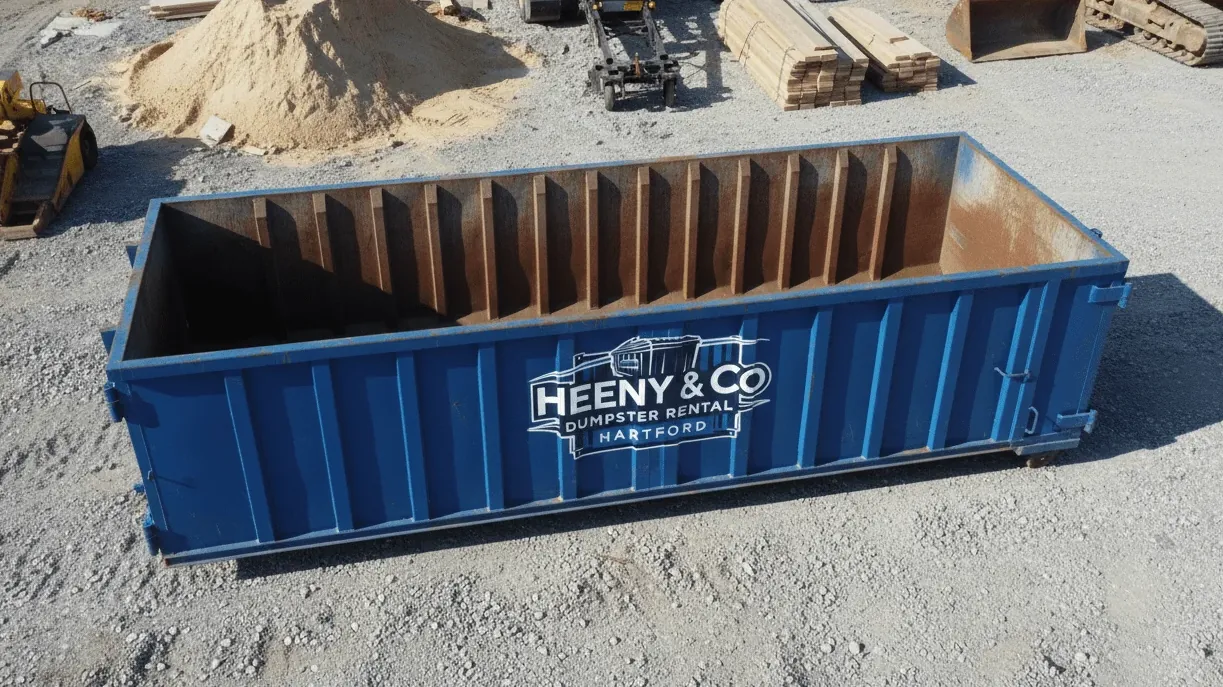
Stand at the kerb in Frog Hollow or Barry Square and count the front doors. You will usually find one. Three storeys above it, a pair of bows either side, a centre hall running back from a single entrance — and behind that one door, six households. That is the Hartford Perfect Six. A turnover in one is not a house cleanout with extra stairs. It is six leases, six kitchens, one shared basement and one narrow lot.
What a Perfect Six actually is
The cleanest description comes from a Connecticut State Historic Preservation Office National Register nomination, which places the building in its family before describing it. The "Hartford perfect six", the nomination says, "is essentially a variation on the triple decker. It typically stood three stories in height with a symmetrical, double-bow facade and a center-hall main entrance and was designed to accommodate six units, or two on each floor."
On origins it is equally direct: the type was developed by builders in Hartford in the late nineteenth and early twentieth centuries, to meet the need for affordable, modern residential buildings for the city's growing population of middle- and working-class inhabitants. There is a later yellow brick variant popular in Hartford in the 1920s, generally newer than the clapboard ones.
Two things follow. The triple-decker is the parent form and the Perfect Six is Hartford's own mutation of it. And there is no founding year: the nomination gives a period, not a date, and so will we.
Six units is also exactly where the city stops collecting
Now the part that writes itself. The City of Hartford Department of Public Works, Waste & Recycling Division collects residential trash directly — a city crew, not a contractor. The eligibility line, in the city's own words, covers only a "single family home, multifamily 6 units or less, condo association of 6 units or less." All other property types must arrange private hauling.
Hartford's signature building is a six-unit building, and the city's collection line is drawn at six units. The Perfect Six sits exactly on it.
That coincidence explains most of the calls we take. A seven-unit building is a private-hauler customer from the day the deed is signed. A six-unit building is city-collected right up to the moment a turnover produces something that is not household trash.
This is a landlord's city, and the numbers say so
Census QuickFacts puts Hartford's owner-occupied rate at 25.7 percent, among the lowest of any city in the United States. Eighty-one percent of Hartford's housing is multifamily, against sixty-four percent single-family statewide; households average 2.32 persons and median gross rent is $1,269. The person on the phone here is more often a landlord between tenants, a property manager, a contractor hired to make ready, or a tenant clearing out. The rest of this is written for those four.
What a Perfect Six turnover actually produces
Take it unit by unit rather than by square footage. A single flat, cleared properly, tends to produce:
- Furniture and mattresses left behind. The couch that would not go back down the centre stair, a bed frame, a dresser missing a drawer. On an abandoned unit, everything.
- Carpet and what is under it — carpet and pad, then sheet vinyl over two or three earlier floors. Nobody counts the layers before pulling, which is why flooring is the usual volume surprise.
- Kitchen cabinets and counters, bulkier than expected once the boxes come off the wall.
- Bathroom fixtures — a vanity, sometimes the tub, plus tile, pipe and the plaster behind both.
- Plaster from patch-and-paint, because a make-ready is rarely just paint, and old appliances, a stove and a fridge per unit where the landlord supplies them.
Then the part that is in no unit at all. Half of Hartford's housing was built before 1950, a figure the city published in its Municipal Affordable Housing Plan adopted in December 2022, and buildings that age match it: lath and plaster behind every wall you open, painted trim that is heavy and awkward to load, and a full basement shared by six tenancies at a time for a century. That basement is on nobody's lease, which is why nobody has emptied it. Our basement and attic cleanout guide works that space, and where a tenancy ended because the tenant died, estate cleanout is the service line that fits.
Four things that come out of the load first
CT DEEP's own renovation guidance says the easiest and most common approach is to commingle most waste into one roll-off, and that is genuinely the rule here. But four streams do not belong in that box, and on a Perfect Six all four turn up.
| Stream | Why it leaves the load | Where it goes instead |
|---|---|---|
| Mattresses | Connecticut invented mattress stewardship: Public Act 13-42, programme live 1 May 2015, fee $16.00 rising to $19.50 on 1 October 2026. | Free at the transfer station or on a bulky appointment — the producer already paid. |
| Electronics and TVs | A real Connecticut disposal ban: CGS §22a-636, effective 1 January 2011. | Free at the transfer station with a green permit. |
| Paint | A liquid, expressly excluded from the statutory definition of C&D waste. PaintCare has operated in Connecticut since July 2013, funded by a fee of up to $2.25 at point of sale. | 157 drop-off sites statewide, mostly retailers. |
| Scrap metal and cardboard | Both are mandatory recyclables in Connecticut and must be separated from other building material wastes. | Out of the load: radiators, bed frames, pipe, storm doors, flattened boxes. |
The honest framing for a landlord: paint and mattresses both have producer-funded programmes here, so the manufacturer has already paid and you have not. Putting them in a container means paying twice. The rest is what a mixed roll-off is for, as our Connecticut recycling and disposal rules set out.
The city's free routes, and where they run out
- Two free bulky pickups per unit per year, of five or fewer items each. By appointment only on (860) 757-9983. DPW makes 25 appointments a day, first come first served, so the day fills early.
- Additional collections are $75 each, or a $10 permit buys four self-haul loads. Material goes out from 4:00 p.m. the day before until 7:00 a.m. on collection day.
- Carpet cut into 3-foot lengths and rolled to an 18-inch diameter, two bundles a week; wood cut to 6-foot lengths and tied, three bundles a week. Loose carpet or wood is refused.
- Not accepted: bulky waste does not include any hazardous or toxic materials, and the city names motor oil, asbestos and lead paint chips explicitly.
Then the boundary that matters on a make-ready. Hartford's free bulky pickup is for furniture, appliances, mattresses and similar household items. It is not for renovation debris — the city's own DPW lists construction debris as unacceptable material, and there is no construction and demolition category in the bulky programme. Cabinets, plaster, tile and lath are not on the accepted list.
Do the arithmetic on a real turnover
Say three of six tenants turn over across one summer, an ordinary year here. Each unit has its own allowance, so on paper that is up to six free pickups of five items each. On the ground it is three appointment calls into a queue of 25 slots a day and a fifteen-item ceiling — against three flats of contents, three carpets cut into 3-foot lengths and rolled, and a kitchen. One carpet alone can eat a week's two-bundle allowance. Add the cabinets, which the programme will not take on any trip, and the free route runs out before the second unit is empty.
Be fair about the other direction, because it matters more than the pitch does. For one tenant leaving one couch, the free bulky pickup is genuinely the better answer. It costs nothing and it was built for exactly that. Same for a single mattress, a fridge, a TV. The container earns its place when the volume is continuous rather than countable — material coming out for days, material the city will not take at all, or a schedule the appointment queue cannot match.
The red permit is the other boundary, and the city drew it
The drop-off route has its own ceiling, published in the fee schedule. The Hartford Bulky Waste & Recycling Center at 180 Leibert Road, the same road as our own corner of the South Meadows, runs Tuesday to Saturday, 8:45 a.m. to 1:45 p.m. on three permit tiers: green for recyclables, free; blue for residents, $10.00 for four visits; and red, the commercial tier, at $50.00 plus a per-load charge — half-ton $40, three-quarter-ton $60, one-ton $85.
The red description names who it is for: multiple-property owners, small businesses, handymen and landscapers. That is the tell. The tier built for trade customers caps out at a one-ton load or a 16-foot trailer, and a one-ton cap is a pickup bed. A six-unit make-ready is not a one-ton job, and a gut renovation of a Perfect Six is outside that system entirely. Note also that the City does not rent roll-off containers. One caution: the DPW FAQ gives the transfer station as 50 Jennings Road while the Permit Division schedule gives 180 Leibert Road. The coherent reading is that Jennings Road is DPW headquarters, where the permit is bought, and Leibert Road is the drop-off site; confirm with DPW before driving a full load.
Placement on a dense Hartford lot
A Perfect Six in Frog Hollow or Barry Square typically sits on a narrow lot with a shared drive down one side, granite kerbing at the front and cars parked on both sides of the street.
Start with what does not apply. In Hartford there is no per-dumpster fire permit. The five-foot placement rule is what governs instead: IFC 2021 §304.3.3, as adopted by Connecticut, says containers with an individual capacity of 1.5 cubic yards or more shall not be stored in buildings or placed within five feet of combustible walls, openings or combustible roof eave lines. Every roll-off we run is over 1.5 cubic yards.
On these lots that five feet is very often the binding constraint, not the length of the container. A narrow drive between a clapboard wall and the neighbour's fence often does not hold five feet of clearance plus a box, and a three-storey eave line overhangs further than people expect. If the box has to go in the street, that is a permit: Hartford's Public Works Permit Division issues an Obstruction Permit for temporary obstruction of the public right-of-way at $50 plus $0.03 per square foot per day. Call the Permit Division on 860-757-9970 first.
Lead, because half the stock predates 1950
With half of Hartford's housing built before 1950, essentially every Perfect Six make-ready is a pre-1978 job, and that means lead-safe work practices on anything that disturbs paint.The city runs a Lead Hazard Reduction Grant Program for low-to-moderate-income households with children under six. And lead paint chips are refused by the bulky programme outright, named alongside motor oil and asbestos, so chip debris and swept-up flakes are not a curbside item here. Asbestos-containing material cannot go in a container of ours ever, in any quantity.
Sizing a Perfect Six turnover
- One unit turning over — contents, carpet, a mattress or two, maybe the vanity — is a 15 yard or a 20 yard. Take the 20 if the kitchen is coming out.
- A multi-unit make-ready, two or three flats at once, is a 20 or a 30.
- The whole building, six units plus the basement, is a 30 yard, often more than one pull. A century of shared cellar storage is its own container before the flats are counted.
Where the labour rather than the container is the problem — an abandoned unit, a third-floor walk-up, nobody to carry it down — junk removal covers the loading. A single building is residential dumpster rental; a management company on a rolling schedule, or any building over six units, is what commercial dumpster rental is for. The bulky programme and the permit tiers are published by the City of Hartford, the mattress programme by Bye Bye Mattress, the paint network by PaintCare.
Heeny & Co Dumpster Rental Hartford has run out of the yard at 192 Ledyard Street, in the South Meadows, since 2014. Declan Heeny started with one truck and four cans and still answers the phone. Tell him how many units are turning, whether the cabinets are coming out and how wide the drive is, and he will size it. Call (959) 666-6427 or use our contact page.
Questions this guide did not answer? Call (959) 666-6427. We would rather spend two minutes on the phone than have you order the wrong container.