
Cleanouts
Basement and Attic Cleanouts in Hartford
In a state where footings must go 42 inches down anyway, digging a full basement was always the sensible choice, which is why so many roll-off jobs in Hartford start in the cellar. Half the city's housing predates 1950 and 81% of it is multifamily, so that cellar is usually shared by a whole building.
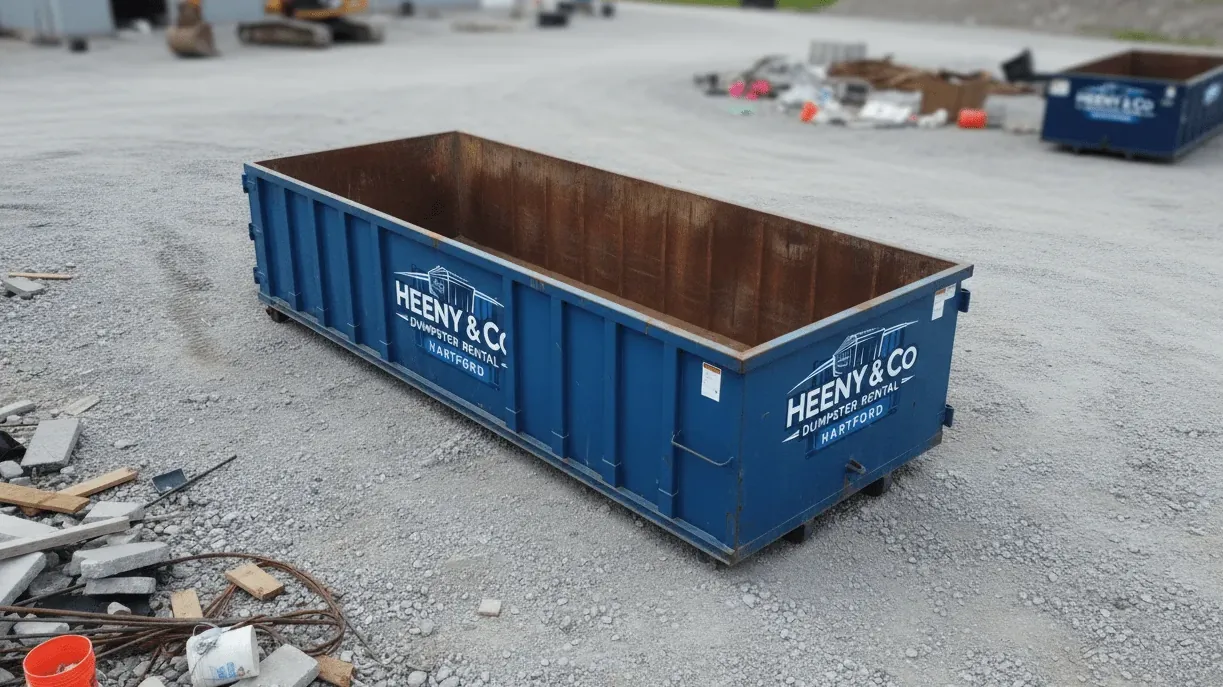
Dig a footing anywhere in Hartford and you are going down forty-two inches before you pour anything: Connecticut's frost line is 42 inches, and a footing has to bear below the depth the ground freezes to or frost lifts it every winter. In a state where footings must go 42 inches down anyway, digging a full basement was always the sensible choice — which is why so many roll-off jobs in Hartford start in the cellar.
What makes the Hartford cellar its own job is age and ownership. Half of Hartford's housing units were built before 1950, a figure from the City's Municipal Affordable Housing Plan, adopted 12 December 2022, alongside 81% of Hartford housing being multifamily against 64% single-family statewide. So the typical Hartford basement is not one family's. It is the shared cellar of a two-, three- or six-unit building, filled by a run of owners and a longer run of tenants — which changes the volume, what you find, and who is paying for the box in the driveway.
What is actually down there
The layout repeats. The mechanical corner first: a boiler, and beside it very often the old oil tank and the dead burner, left where they were cut out of service.
The workbench and the seasonal shelf
A bench built into the joists two owners back, coffee cans of fasteners, offcuts kept in case. Around it, paint and solvents from three sets of owners, half full, lids rusted on, some with the label long gone. Then storm windows stuck together, canning jars, luggage, and the second fridge and the chest freezer, all handled apart from the load.
What the tenants left
In a six-unit building the cellar has been the overflow room for every tenancy since it went up, and abandoned boxes accumulate at a rate no single-family guide anticipates. That layer alone can fill a container.
And the water
Every spring the frost comes out of the ground and the water table comes up with it. Spring thaw is what starts most of these jobs. Cardboard that sat dry for twenty years wicks it up overnight, and if the floor has ever had an inch on it that layer goes out whole.
The attic is a different problem
The basement is a volume problem. The attic is a hazard problem, for reasons of age rather than anything peculiar to Hartford.
- Blown-in insulation over and between the joists, two or three generations of it, so the decades of boxes carried up and never carried down sit half-buried in fill that comes out with them.
- Vermiculite. Loose granular fill, grey-brown, pours rather than mats. Have it identified before anyone moves boxes through it.
- Knob-and-tube wiring. Ceramic knobs on the joists, cloth-covered conductors through tubes in the framing. Burying it in new insulation is a fire problem.
- Plaster and lath where a knee wall has come apart, heavy out of all proportion to its bulk.
Take those as characteristic of pre-1940 New England housing rather than as Hartford statistics; there is no reliable count of how many Hartford attics hold them. Sequence the work: boxes first, identification and any abatement second, insulation last. We take the boxes, not what an abatement contractor removes.
The heating oil tank
We do not take oil tanks in a container. It is a licensed job. An aboveground tank has to be drained, cleaned and cut; a buried one is an excavation, so a Call Before You Dig ticket under CGS §16-345 et seq. goes in before a shovel does.
The part worth reading twice is what happens if the tank has leaked. A release of heating oil to the ground, to groundwater or into a building is a reportable release in Connecticut, and the duty to report sits with the owner. Do not treat a stain on the cellar floor or a smell in the stairwell as housekeeping, and do not wait on the volume. The first call is the local fire department; CT DEEP's emergency response programme takes the notification after that, and the rules are on portal.ct.gov. Contaminated soil never rides out with the boxes.
Asbestos, and why Connecticut has no single-family exemption
Federal rules carve out owner-occupied single-family homes. Connecticut does not. RCSA §19a-332a-1 defines a regulated "facility" to include residential buildings "including single family homes". Administration splits three ways:
| Agency | What it does |
|---|---|
| Department of Public Health | Notification and licensing — ten days' notice |
| CT DEEP | $300 Special Waste / Asbestos Disposal Authorization |
| DAS Office of the State Fire Marshal | Licenses demolition contractors |
A demolition notification is required whether or not asbestos is present — the demolition triggers it, not the finding. In a pre-1980 basement the classic find is pipe and duct insulation, the white wrap on the heating mains. CT DPH also publishes a factsheet on asbestos-containing siding shingles.
We cannot take asbestos-containing material in any container, ever. It is expressly excluded from the statutory definition of construction and demolition waste, so there is no container in Connecticut it may legally ride in. Suspect material gets tested; if positive it goes out under a licensed abatement contractor.
Lead
Half the stock predates 1950, so lead paint is the default assumption. Anything pre-1978 means lead-safe work practices once a cleanout turns into scraping, sanding or window replacement, and the dust matters more than the chips. Hartford runs a Lead Hazard Reduction Grant Program for low-to-moderate-income households with children under six; details are on hartfordct.gov. One hard limit: lead paint chips are refused by Hartford's bulky programme, alongside motor oil and asbestos. Contain chips and sweepings at the source.
What cannot go in the container, and where it goes instead
Connecticut does not run a long list of banned materials. It has a short set of mandatory recyclables that must stay out of a mixed load, two real disposal bans, and a definition of C&D waste that excludes liquids and asbestos outright. For a cleanout that comes down to this:
| Material | Hartford route |
|---|---|
| Paint, stains, solvents (liquids, excluded) | PaintCare drop-off, free |
| Motor oil, adhesives, tars (liquids, excluded) | MDC hazardous waste, 125 Maxim Road |
| Mattresses, box springs (stewardship pays) | Free at 180 Leibert Road or by appointment |
| TVs and electronics (ban, CGS §22a-636, 2011) | Free at the drop-off, green permit |
| Scrap metal (mandatory recyclable) | Out of the load; scrap yard or drop-off |
| Corrugated cardboard (mandatory recyclable) | Kerbside single-stream, or drop-off |
| Fridges, freezers, water heaters | Bulky appointment or drop-off |
| Tires | Drop-off, $10 blue permit |
| Asbestos material (excluded from C&D waste) | Licensed abatement only |
| Lead paint chips | Contained at source; bulky refuses them |
Two of those invert what people expect. PaintCare has operated in Connecticut since July 2013, funded by a point-of-sale fee of up to $2.25, with 157 drop-off sites statewide, so those half-cans have a free retail route already paid for; see paintcare.org. And Connecticut was the first state to pass comprehensive mattress stewardship legislation, Public Act 13-42, live 1 May 2015, fee $16.00 rising to $19.50 on 1 October 2026; Hartford takes mattresses free. Burying either in a container is paying twice; our Connecticut recycling and disposal rules page has the rest.
The Hartford routes
The address you will use most is the Hartford Bulky Waste & Recycling Center, 180 Leibert Road, Tuesday to Saturday, 8:45 a.m. to 1:45 p.m. The City's own pages are inconsistent about the site; the coherent reading is that 50 Jennings Road is DPW headquarters, where the permit is bought, and 180 Leibert Road is where the material is dropped. Confirm with DPW first.
Permits run in three tiers. Green, for owner-occupied one-to-six-family buildings, condominiums and tenants, is free and is what gets televisions and electronics taken at no charge. Blue, residential, is $10.00 for four visits. Red, named in the fee schedule for multiple-property owners, small businesses, handymen and landscapers, is $50.00 plus a per-load charge — $40 a half-ton, $60 three-quarters, $85 a ton. Kerbside, every unit gets two free bulky pickups a year, of five or fewer items each, by appointment on (860) 757-9983; DPW books 25 appointments a day, and extra collections are $75 each. Household hazardous waste goes through the MDC at 125 Maxim Road, minutes from our yard in the South Meadows.
Now do the arithmetic. Two pickups a year, five items each, is ten items, and a six-unit cellar is not ten items. The bulky programme is built for furniture, appliances and mattresses, not renovation debris — DPW names construction debris as unacceptable material, and there is no C&D category in it at all. That gap is where a container earns its place; the Hartford home cleanout checklist walks the sequence room by room.
Getting a container close enough to carry to
- The bulkhead and the cellar stair. Most of what comes out goes up the bulkhead rather than through a kitchen: clear the doors, board the sill. The interior stair is steep, tight at the turn and low-headed, so freezers and workbenches come apart at the bottom.
- The shared drive. Between two Frog Hollow multifamilies it is often a single lane, with granite kerbing and cars parked both sides of the street. The box has to sit within carrying distance without blocking the neighbour or the tenant upstairs.
- The five-foot rule. Connecticut has no per-dumpster fire permit. It has a placement rule: IFC §304.3.3 as adopted here says a container of 1.5 cubic yards or more must not sit inside a building or within five feet of combustible walls, openings or roof eave lines. On a narrow lot, that five feet decides where the box goes.
- The street. In the right-of-way it is an Obstruction Permit from the Public Works Permit Division, 860-757-9970. Call before delivery day.
Why February to April is basement and attic season
The 42-inch frost line does more than build cellars; it sets the calendar. Frost stays in the ground into spring, so excavation waits — footings, stumps, a buried tank. That pushes February through April into interior work, which in this stock means basements and attics. Then the thaw brings the water that starts most of these jobs anyway.
Plan around the yard-waste calendar too, because a spring clear-out spills out to the shed and the side of the building. Hartford's leaf collection runs roughly early November to late December, by zone. In spring the city takes brown paper leaf bags only, and there is no loose-leaf collection in spring at all.
Sizing a two-floor cleanout
Basement and attic material is bulky and light — boxes, furniture, storm windows, bins, insulation. It fills volume long before it approaches payload, which argues for a bigger box. One basement usually lands on a 15 yard or a 20 yard; a whole multifamily, cellar and attic on a turnover, is a 20 or a 30, sometimes a 20 with a second pull. Dimensions are on the dumpster sizes page. The exception is weight: wet contents and plaster hit payload early, so load them low and level, spread across the floor rather than in one corner.
For a few heavy items rather than two floors, junk removal may suit better; for clearing a building after a death, estate cleanout covers the sorting. Driveway work runs through residential dumpster rental, and if the cellar is part of a turnover, our notes on Perfect Six and multifamily turnovers cover the overlap. What helps on the phone: basement, attic or both; how many units; whether the cellar has taken water; whether an oil tank is in place; and how the drive sits.
Heeny & Co Dumpster Rental Hartford has run roll-offs out of the yard at 192 Ledyard Street since 2014, behind the wall the city built after the 1936 flood. Declan Heeny started with one truck and four cans and still answers the phone, and on a cellar job he will say plainly what has to go to Leibert Road or PaintCare first. Call (959) 666-6427 or use our contact page.
Questions this guide did not answer? Call (959) 666-6427. We would rather spend two minutes on the phone than have you order the wrong container.