
Storm Cleanup
Storm and Flood Cleanup in Hartford: What to Do With the Debris
The Connecticut River crested at 37.6 feet at Hartford in March 1936 and 35.4 feet in the 1938 hurricane, and the city built 35,000 feet of dike and 4,400 feet of floodwall in answer. Here is what a storm actually leaves on the ground in Hartford, how each pile loads, and which rules do not relax in an emergency.
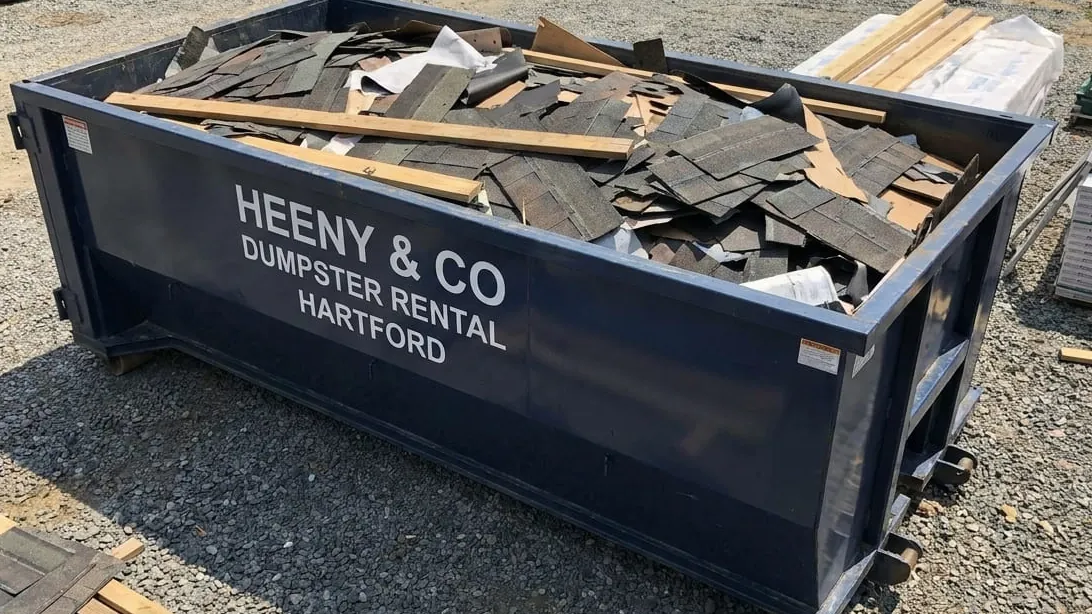
Hartford was built on the inside of a bend in the Connecticut River, and the river has been coming back into the city for as long as there has been a city here. That is what makes storm work different here than almost anywhere else in New England. Wind takes trees and shingles the way it does everywhere, but the water is the thing this city has spent close to a century engineering against, and the engineering is still going on. This is a guide to what a storm leaves on the ground in Hartford, how each pile loads, and which rules do not relax because everybody is in a hurry.
The river, and the numbers Hartford measures itself against
March 1936 is the flood of record. The Connecticut River at Hartford crested at 37.6 feet, with a flow of 313,000 cubic feet per second. Nothing before or since has come near it here.
September 1938 is remembered on the coast as a hurricane and inland as a flood. At Hartford the river reached 35.4 feet on a flow of 232,000 cubic feet per second, and roughly 600 lives were lost regionally. Two enormous floods inside thirty months turned a recurring nuisance into a public works programme.
August 1955, when the remnants of Connie and Diane arrived a week apart, put the river at Hartford at 30.6 feet. That is a serious crest and not a record on the mainstem, and it is worth being accurate about whose disaster 1955 was: the catastrophic damage that August belonged to the Naugatuck Valley, not to Hartford. Hartford's flood is 1936.
The wall the city built in response
What came out of 1936 and 1938 is the Hartford Local Protection Project, built with the US Army Corps of Engineers. It is not a single wall but a system, and its scale surprises people who have lived here for years.
The project protects about 3,000 acres of the city. It comprises roughly 35,000 feet of earthfill dikes and 4,400 feet of concrete floodwall, six stoplog structures where roads and rail lines pass through the line, and six pumping stations to lift interior drainage over the wall when the river is too high to let it out by gravity. It also carries the Park River underground: the Park River conduit runs over 10,000 feet, with a 9,200-foot auxiliary conduit driven about 200 feet below the surface.
The work was initiated in December 1938 and the main system completed in August 1944, with the auxiliary conduit and pumping stations following between June 1976 and July 1981. Total project cost: $71.5 million. Those figures are the Corps' own, and none of it is ancient history: the system is operated and maintained every year.
It is still live work
Hartford's Department of Public Works runs a dedicated Flood Division, and the Greater Hartford Flood Commission — covering Hartford, Bloomfield, West Hartford and Newington — has recently run a South Meadows Dike improvement project. The city's 2035 Plan of Conservation and Development does not pretend the problem was solved in 1944: "the flatness of the valley floor led to flooding each spring, a phenomenon that continues to this day."
The paperwork is moving too. FEMA opened a 90-day appeal and comment period around 16 April 2025 on updated Flood Insurance Rate Maps covering this area, so the maps that determine flood insurance requirements near the low ground are being redrawn now rather than at some point in the future.
One sentence about us, because it is a fact rather than a boast: 192 Ledyard Street is in the South Meadows, inside the diked area, on the same dike that is currently being repaired.
The storms we can actually name
Tropical Storm Irene, 28 August 2011
Irene did what tropical storms do to a mature tree canopy standing over old wiring. One death was attributed to wind and falling trees in Hartford County — a geographic designation only, since Connecticut abolished county government in 1960 — and a 44-knot gust was recorded at Windsor Locks, north of the city. The part people remember is not the wind speed: outages ran up to a week in parts of Connecticut, and a week without power in August is a freezer problem and a sump problem at once.
Tropical Storm Isaias, 4 August 2020
Isaias was a Connecticut event rather than a specifically Hartford one, and we will write it that way. Sustained winds to 40 knots with gusts to 55 knots were commonly observed across Connecticut, Rhode Island and Massachusetts, nearly 700,000 customers lost power, and there was one Connecticut death, in Naugatuck. The signature again is trees, wires and outage duration.
Tornadoes, without the overstatement
Connecticut does get tornadoes — southern Connecticut alone recorded 50 between 1950 and 2022, including an F4 in New Haven County in 1989 — but they are rare, and the state's worst outbreaks have been in the southwest, not the Connecticut River valley. Water and wind-driven tree damage are the realistic threats to a Hartford property.
The four cleanup jobs, and what each one puts in a container
1. Basement flooding and spring high water
This is the Hartford job. It arrives with the thaw, with a downpour that outruns the drains, or with a dead sump during an outage. Out comes soaked carpet and pad, drywall cut back above the tide line, ruined furniture, and stored contents that have been down there since the last owner.
What to understand before ordering a box: wet material is brutally heavy for its volume. Saturated carpet, wet drywall and waterlogged cardboard weigh several times what the same pile weighs dry, and a container hits its weight limit well before its volume limit. The right answer is almost always a smaller box loaded low — a 15 yard container filled to two-thirds beats a 30 yard box that cannot be lifted. Our basement and attic cleanout guide covers the sequence, and the clearing itself is closer to junk removal than to construction until the drywall saw comes out.
2. Wind and tree damage
Limbs come down on fences, cars and roofs, and the debris splits into three streams. Limb wood runs as its own clean separate load — no shingle, no fence hardware, no wire in it — because clean wood has outlets mixed debris does not; that is a yard waste load, ordered as such. Fencing is bulky, full of fasteners and will not compact. Torn shingles are heavy and go in a roofing container sized for weight, not for how big the pile looks.
3. Ice dams
Late winter's contribution. Water backs up under the shingle at the eave, finds the ceiling below, and shows as a stain days after the cold snap ended. Out comes ceiling drywall, wet insulation and whatever flooring took the drip, then the roofing work that follows when weather allows. That second phase is usually a separate week, so plan two pulls rather than holding one container through a re-roof. Interior tear-out runs as demolition debris.
4. Long power outages
The least glamorous storm job and a genuinely common one here. In a city of six-unit buildings, a week-long outage means spoiled food and the contents of several freezers, plus the chest freezer in the cellar nobody thought about until day four. Cleared as a batch it is a real volume, and it needs to move quickly rather than sit at the kerb.
| Storm job | What comes off the property | How it loads | Route |
|---|---|---|---|
| Basement flooding | Carpet, drywall, furniture, stored contents | Several times its dry weight | Smaller box, loaded low |
| Spring high water | Soaked cardboard, boxes, appliances | Metal and cardboard come out first | Cleanout load, items pulled |
| Wind and trees | Limb wood, brush, fence sections | Will not compact | Clean wood on its own |
| Ice dam | Ceiling board, wet insulation, flooring | Heavy once saturated | Interior load, then a roofing pull |
| Long outage | Spoiled food, freezer contents | Needs to move fast | Prompt swap, not a long hold |
The dumpster sizes page compares the 10, 15, 20, 30 and 40 yard boxes. As a rough rule, wet interior material wants a smaller box than people expect and roof or yard debris a larger one; a 20 yard container is the usual middle ground on a mixed wind-damage cleanup.
The rules that still apply in an emergency
Nothing about a storm suspends the disposal rules, and the ones that catch storm work are short enough to memorise.
Scrap metal and corrugated cardboard remain mandatory recyclables in Connecticut and must come out of the load. A flooded basement produces both in quantity: the water heater, the shelving, the washer, boxes upon boxes of pulped cardboard. Pull them at the start rather than at a failed load inspection. Our Connecticut recycling and disposal rules guide explains why the state designates rather than bans.
Paint, oils, adhesives and other liquids are excluded from construction and demolition waste and cannot ride along, however tempting it is when the shelf they sat on has just been under water. Asbestos never can, in any container, and older pipe insulation and siding shingles are exactly what a flood or a wind event exposes. The city draws the same lines: Hartford's bulky waste programme will not take motor oil, asbestos or lead paint chips.
Then there is the arithmetic after a region-wide storm, when the free routes are overwhelmed exactly as everybody needs them. Hartford offers two free bulky pickups per unit per year, of five items or fewer each, by appointment only on (860) 757-9983, and DPW makes about 25 appointments a day, first come first served. That is a good system for a couch and a mattress in an ordinary month. It does not absorb a street's worth of flooded cellars in one week, which is exactly when a container earns its keep.
Where the container goes after a storm
Debris piled at the kerb is not the same thing as debris in a container. A pile spreads, gets picked over, soaks up the next rain and gets heavier, and on a narrow lot it ends up in the road.
The five-foot rule still applies. Under IFC 2021 §304.3.3, as adopted in Connecticut, a container of 1.5 cubic yards or more must not be stored inside a building or placed within five feet of combustible walls, openings or combustible roof eave lines. That is a placement rule rather than a paperwork rule, and it is why the box goes on the driveway rather than against the side of the house. Worth pacing out before the truck arrives rather than after.
For the street you need an Obstruction Permit. Hartford's Public Works Permit Division issues one for temporary obstruction of the public right-of-way, at $50 plus $0.03 per square foot per day under the city's published rules. Call the Permit Division on 860-757-9970 before anything goes in the street; the detail is on the city's own pages at hartfordct.gov.
The Hartford storm calendar
The year has a shape here, and knowing it is most of the scheduling problem.
- Late winter: ice dams and roof leaks, and the ceiling work behind them.
- Spring: the thaw and high water on the river. Basements first, everything else second.
- Summer: thunderstorms, downed limbs and tree work.
- August to October: tropical remnants — the Irene and Isaias window. Wind, trees, long outages.
- December to February: nor'easters and the roof damage that turns up as a stain in March.
Two of those seasons overlap in a bad year, and that is when the phone rings all week. The National Weather Service is the place to check what is coming.
The working order after a storm
Photograph everything from four sides before you move a piece of it, and do not put anything in the container that an insurance adjuster still needs to see. After a region-wide event the adjuster may be a week or two out, and material already gone is hard to write into a claim.
Then sort in order: metal out, cardboard out, liquids and anything suspected of containing asbestos set aside entirely. Limb wood into its own load. Wet interior material into a box sized for weight. Roofing separately, when the roofer is ready.
Call early. After a storm that touched the whole Capitol Region, every household calls the same morning, and by day five the honest answer is often a date rather than a truck. What helps on the phone: what the storm did, whether the material is wet, whether there is a tree in it, whether a cellar took water, and how the driveway sits.
Heeny & Co Dumpster Rental Hartford has run roll-offs out of the yard at 192 Ledyard Street since 2014, behind the wall the city built after 1936. Declan Heeny started with one truck and four cans and still answers the phone, and on storm work he will size the box for weight rather than volume and say plainly what has to come out of the pile first. Call (959) 666-6427 or use our contact page.
Questions this guide did not answer? Call (959) 666-6427. We would rather spend two minutes on the phone than have you order the wrong container.